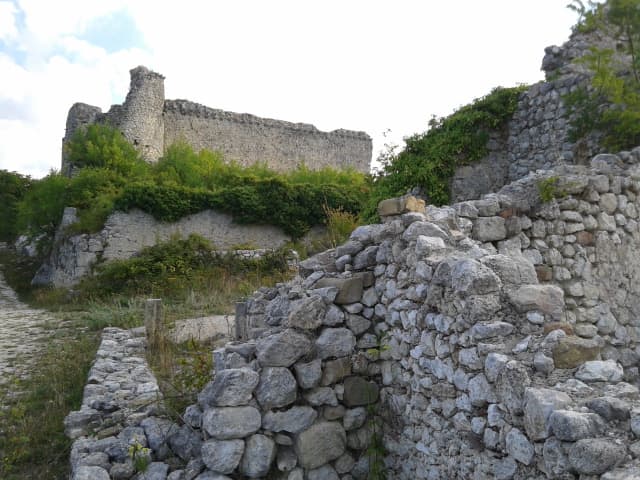
Castello Orsini
Castello Orsini stands prominently in the historic town of Soriano nel Cimino, nestled on the northeastern slope of Monte Cimino in the Lazio region of Italy. This hill castle boasts a rich history that spans from the early medieval period through the Renaissance and into modern times, reflecting the complex social, political, and architectural developments of central Italy.
The origins of Castello Orsini date back to around the year 1000, when the site was first fortified by the Guastapane-Pandolfo family, a lineage probably linked to the Roman Porcari family. This initial structure was a modest castle typical of the early medieval fortifications, designed primarily for local defense and control over the surrounding territory. The castle's strategic location on Monte Cimino allowed it to dominate the surrounding landscape and the town below, serving both military and administrative purposes.
In the late 13th century, the castle underwent significant expansion under the auspices of Pope Nicholas III Orsini, who reigned from 1277 to 1280. Between 1277 and 1278, the pope initiated a comprehensive enlargement project that incorporated the original tower into a much larger fortress complex. This expansion transformed Castello Orsini into a formidable stronghold and a comfortable papal residence. The castle's role as a papal fortress underscores its importance in the political and religious landscape of the time, serving both as a defensive bastion and a symbol of papal authority in the region. Pope Nicholas III's personal connection to Soriano nel Cimino is further emphasized by the fact that he died there shortly after the renovations, highlighting the castle's significance as a seat of power and residence.
Architectural features and layout
The castle's architectural composition centers around a tall, robust central tower approximately 35 meters high, which serves as the keep or maschio. This tower is the oldest surviving part of the structure, built with durable medieval masonry techniques that have ensured its longevity. The keep was the last line of defense and the symbolic heart of the castle, designed to withstand sieges and provide a vantage point over the surrounding territory.
Attached to the northern side of the keep is the cassero, a large rectangular block that functioned as the main residential and administrative building. The cassero is connected to the tower by a thick defensive wall featuring a cylindrical turret, which enhanced the castle's defensive capabilities by allowing guards to monitor and defend the perimeter effectively.
To the south, a smaller wing extends from the main building, illustrating the castle's phased growth over centuries. The entire complex is enclosed by a defensive wall crowned with Guelph-style battlements, characterized by their distinctive square merlons. These battlements provided cover for archers and soldiers patrolling the walls along the cammino di ronda, a walkway that ascends in a counterclockwise direction around the fortress and culminates at a large turret that originally served as the main entrance.
Internal spaces and later adaptations
Inside the castle walls, the layout includes several courtyards, staircases, and a chapel ceiling, which hint at the castle's dual role as a noble residence and religious site during the medieval period. The chapel would have served the spiritual needs of the castle's inhabitants, reflecting the close ties between secular and ecclesiastical power.
In the 19th century, the castle's function changed dramatically when Soriano nel Cimino came under the control of the Papal States in 1848. The nobility abandoned the fortress, and it was repurposed as a prison. Managed initially by the Holy See and later by the Italian state after unification in 1871, Castello Orsini served as a penitentiary and labor facility for over a century. This new role necessitated certain architectural modifications, including the installation of prison cells and security features, which remain visible today and provide a stark contrast to the castle's earlier residential and defensive functions.
Historical significance and legacy
Castello Orsini's history is deeply intertwined with the political and religious currents of central Italy. Its transformation from a modest early medieval stronghold to a grand papal fortress under Pope Nicholas III reflects the shifting power dynamics of the region during the Middle Ages. The castle's later use as a prison during the 19th and 20th centuries illustrates the adaptability of medieval fortifications to modern needs, as well as the changing social landscape following Italian unification.
The castle's preservation is notable, with its external walls and key architectural elements surviving remarkably well despite centuries of use and adaptation. Periodic restorations during the Renaissance and maintenance during its time as a prison have contributed to the castle's current condition, which remains largely intact. Today, Castello Orsini stands as a testament to the layered history of Soriano nel Cimino and offers valuable insights into medieval military architecture, papal history, and penal history in Italy.
Visiting castello orsini
Visitors to Castello Orsini can explore the imposing exterior walls, the towering keep, and the surrounding battlements. The castle's position on Monte Cimino provides panoramic views of the town and the surrounding countryside, enhancing its appeal as a historic site. While some interior sections reflect the castle's penitentiary past, the blend of medieval and later architectural features offers a unique perspective on the site's evolution over nearly a millennium.
The castle is an important cultural landmark in the Lazio region and attracts historians, architecture enthusiasts, and tourists interested in Italy's rich medieval heritage. Its well-preserved state and dramatic setting make it a compelling destination for those seeking to understand the complexities of Italian castle architecture and history.
Frequently asked questions (FAQ)
- What is the historical significance of Castello Orsini?
- Castello Orsini, built in the 15th century, is a prime example of medieval military architecture in Italy. It played a crucial role in the defense of the region and was home to the influential Orsini family, contributing to the political landscape of the time.
- When was Castello Orsini built?
- Construction of Castello Orsini began in the early 15th century and was completed in 1480. It was designed as a fortified residence to protect the surrounding area from invasions and to assert the power of the Orsini family.
- What are the opening hours for visiting Castello Orsini?
- Castello Orsini is typically open to visitors from 10 AM to 6 PM, but hours may vary depending on the season. It is advisable to check the official website or contact the castle directly for the most current information before planning your visit.
- Can I purchase tickets in advance for Castello Orsini?
- Yes, tickets for Castello Orsini can often be purchased in advance through the official website or at the castle's ticket office. Buying tickets in advance is recommended, especially during peak tourist seasons, to ensure your entry and avoid long wait times.
- Is it possible to access all areas of Castello Orsini?
- While many areas of Castello Orsini are accessible to visitors, some sections may have restricted access due to preservation efforts or safety regulations. It's best to check with staff upon arrival to understand which areas can be explored.
- What is the best time to visit Castello Orsini?
- The best time to visit Castello Orsini is during the spring (April to June) and early fall (September to October) when the weather is mild and pleasant. These seasons also tend to attract fewer tourists, allowing for a more enjoyable experience.
- Are there any nearby attractions to visit alongside Castello Orsini?
- Yes, nearby attractions include the beautiful town of Soriano nel Cimino, with its charming streets and local eateries. Additionally, visitors can explore the Cimini Mountains and nearby hiking trails for stunning natural scenery.
- What are the ticket prices for visiting Castello Orsini?
- Ticket prices for Castello Orsini typically range from €5 to €10, depending on age and whether it's a special event day. Reduced rates are often available for students and seniors, so be sure to inquire at the ticket office for discounts.
- How do I get to Castello Orsini?
- Castello Orsini is located in Soriano nel Cimino, which is accessible by car or public transportation from nearby cities like Rome. Regular bus services operate to the area, and parking is available for those driving.
Photo gallery

Information
Website
Visit websiteSources & official resources
Verify the information above using these authoritative references.
Loading map...
Visitor reviews
No reviews yet. Been here? Write the first review and help other travelers!
Write the first reviewVisited this castle? Share your experience
Your review helps other travelers and adds first-hand knowledge to our encyclopedia.


