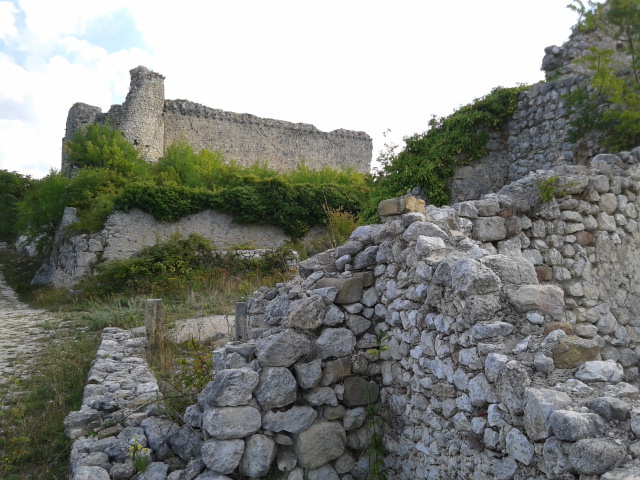
Castello di Giove
The Castello di Giove stands as a remarkable example of a medieval fortress that evolved into an elegant noble residence, located in the village of Giove in the Umbria region of Italy. Its name derives from an ancient Roman temple dedicated to the god Jupiter (Giove), signaling the site's deep historical roots that predate the castle itself. This hill castle occupies a strategic position at a crossroads connecting the towns of Orvieto, Todi, and Amelia, underscoring its historical military and administrative importance.
The earliest documented mention of the castle dates back to 1191, marking it as a significant fortress during the High Medieval period. Throughout the 14th and 15th centuries, the castle witnessed a complex history of ownership and control, passing among powerful regional entities such as the city of Orvieto, the region of Tuscany, and influential noble families including the Anguillara. The Anguillara family notably received the fief from Pope Urban IV in 1328. Other claimants included the town of Amelia, the Farnese family, the Apostolic Camera (papal treasury), the Hospital of Santo Spirito in Rome, and the Ordelaffi family, reflecting the castle's contested status in central Italy's political landscape.
Transformation under the Mattei family
A pivotal moment in the castle's history occurred in 1597 when Matteo Farnese sold the fiefdom to brothers Ciriaco and Asdrubale Mattei, who held the noble title of marquises. The Mattei family's acquisition marked the beginning of a lasting legacy, with their son Girolamo Mattei becoming the first Duke of Giove in 1643. This ducal title has been preserved by the family descendants to this day.
Under the Mattei, the castle was transformed from a defensive fortress into a refined summer residence that embodied the aristocratic lifestyle of the period. Asdrubale Mattei, a noted art collector and patron of the painter Caravaggio, commissioned the prominent Roman architect Carlo Maderno to design the Palazzo Mattei di Giove. This marked a significant architectural shift, blending the features of a medieval castle with those of a Renaissance palazzo.
Architectural renovations and artistic embellishments
The 17th century saw extensive renovations led by artists associated with the Vignola school, named after the influential architect Jacopo Barozzi da Vignola. These renovations redefined the castle's silhouette and interior, creating a harmonious blend of military and residential architecture. The castle's current form reflects this transformation, combining robust defensive elements with elegant palatial features.
One of the castle's most striking architectural features is its 365 windows, symbolically representing each day of the year. This elaborate design choice highlights the castle's symbolic and aesthetic considerations beyond mere functionality. Additionally, a monumental ramp was constructed to provide carriage access directly to the noble floor, illustrating the dual residential and status-display functions of the building.
Interior decoration and artistic heritage
The interior of Castello di Giove is richly decorated with frescoes by master painters such as Domenichino, Orazio Alfani, and Paolo Veronese. These artworks are exemplary of the Mannerist style, characterized by its elegance, complex compositions, and refined aesthetic sensibilities. The frescoes contribute significantly to the castle's cultural and artistic value, linking it to broader Renaissance and post-Renaissance artistic movements.
Historical significance and legacy
Throughout its history, Castello di Giove has been a focal point of regional power struggles and noble ambitions. Its strategic location made it a coveted asset among competing forces in central Italy. The castle's transformation under the Mattei family not only preserved its physical structure but also elevated its status as a symbol of noble prestige and cultural patronage.
Despite changes in ownership over the centuries, the castle remains closely associated with the Mattei family legacy. Its dual identity as both a fortress and a palazzo encapsulates the evolving functions of such structures in Italian history—from military bastions to aristocratic residences.
Architectural features and layout
The castle complex is expansive, featuring numerous rooms, terraces, corridors, and covered walkways that reflect its multifunctional role. The integration of defensive elements such as thick walls and battlements with residential comforts illustrates the architectural ingenuity of the renovations. The carriage ramp is particularly notable for its scale and design, providing practical access while enhancing the castle's grandeur.
The palazzo-castle's layout demonstrates careful planning, with symbolic and functional elements interwoven throughout. The presence of 365 windows is a unique architectural hallmark that underscores the castle's elaborate design philosophy.
Present condition and cultural importance
Today, Castello di Giove stands as a well-preserved example of a hill castle that has successfully integrated Renaissance palatial architecture. Its artistic and architectural heritage makes it a significant cultural landmark in the Umbria region. The castle's association with renowned artists and architects, as well as its historical role in regional politics, contribute to its importance as a heritage site.
Visitors to the castle can appreciate its architectural complexity, artistic treasures, and the historical narratives embedded within its walls. The enduring legacy of the Mattei family and the castle's symbolic features continue to captivate historians, architects, and tourists alike.
Frequently asked questions (FAQ)
- When was the Castello di Giove originally built?
- The earliest written record of Castello di Giove dates back to 1191, indicating its origins in the High Medieval period.
- What architectural styles are present in Castello di Giove?
- The castle features a mix of medieval fortress architecture and Renaissance palatial elements, with renovations influenced by the Vignola school and architect Carlo Maderno.
- Who were the key historical owners of the castle?
- Notable owners include the Anguillara family, the Farnese family, and from 1597, the Mattei family, who transformed it into a noble residence.
- What is unique about the castle's windows?
- The castle has exactly 365 windows, symbolizing each day of the year, reflecting its elaborate architectural design.
- Are there notable artworks inside the castle?
- Yes, the interiors feature frescoes by Domenichino, Orazio Alfani, and Paolo Veronese, exemplifying Mannerist artistic style.
Information
Sources & official resources
Verify the information above using these authoritative references.
Loading map...
Visitor reviews
No reviews yet. Been here? Write the first review and help other travelers!
Write the first reviewVisited this castle? Share your experience
Your review helps other travelers and adds first-hand knowledge to our encyclopedia.