Castello ducale di Crecchio
The Castello ducale di Crecchio stands prominently in the municipality of Crecchio, Italy, as a testament to centuries of architectural evolution and historical significance. Originally constructed by the Normans in the 11th century, this hill castle began its life as a defensive stronghold, centered around the imposing Torre dell’Ulivo. Over the centuries, it transformed from a fortress into a refined noble residence, reflecting broader shifts in architectural style and social function.
Located strategically between the Arielli and Rifago rivers, the castle occupies a commanding hilltop position. Its layout follows a square plan typical of noble residences rather than purely military fortifications, enclosed within sturdy perimeter walls. Originally, these walls enclosed a large garden, accessed via a bridge, which underscored the castle’s role as a symbol of prestige and comfort beyond mere defense.
Norman origins and early defensive architecture
The oldest part of the castle, the Torre dell’Ulivo, dates back to the 11th century Norman period. Constructed from roughly hewn stone blocks, this tower rises three levels high. Its elevated ground floor served as a food storage area, accessible only by a narrow spiral staircase designed for guard patrols, a typical medieval defensive feature. The tower’s robust construction and strategic design highlight its original purpose as a military lookout and refuge.
Transformation during the 15th century: from fortress to noble residence
The 15th century marked a significant turning point in the castle’s history. Extensive renovations shifted the castle’s character away from a purely defensive fortress toward a more comfortable and stately noble residence. During this period, two main phases of construction occurred. Initially, the southern loggia and the adjoining western building were added, introducing architectural elements designed for leisure and social functions.
Later, an upper loggia and a noble floor were constructed on a neighboring structure, further enhancing the castle’s residential qualities. The original battlements were removed during these renovations, symbolizing a deliberate move away from militaristic architecture toward elegance and status. This transformation aligns with broader Renaissance trends in castle architecture, where fortifications were adapted to accommodate noble lifestyles.
Architectural features of the 15th-century renovations
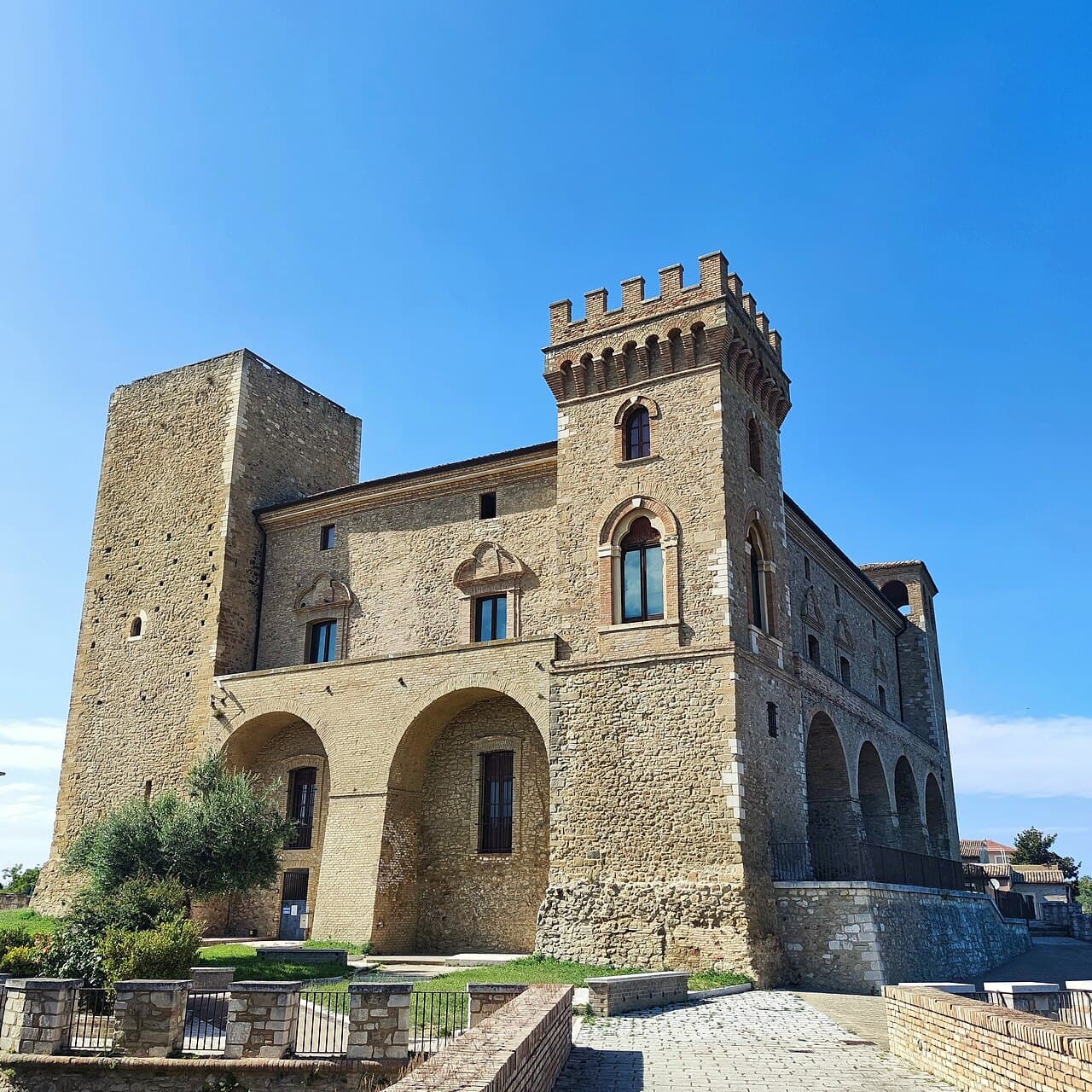
- The Torre Aragonese, facing the Norman tower, dates from this period. It features a square layout with battlements supported by corbels, blending medieval military architecture with Renaissance refinement.
- The addition of loggias provided open, airy spaces for social gatherings, a stark contrast to the castle’s earlier defensive austerity.
Later modifications and 18th-century additions
In the 18th century, two additional corner towers known as the Torri De Riseis were built. These twin towers exhibit square plans topped with sloped roofs and are adorned with double round-arched windows on each side. Their bases feature deep blind arcades, architectural remnants hinting at the older fortress bastions that once formed part of the castle’s defenses.
On the entrance side, an arched gateway leads visitors into a cloister and a monumental staircase, emphasizing the castle’s noble grandeur. A pilaster bearing the De Riseis family coat of arms dated 1789 links these towers to their noble patrons, underscoring the castle’s continued importance as a symbol of aristocratic power.
Damage and restoration in the 19th and 20th centuries
The castle endured significant challenges in the modern era. An earthquake in 1881 damaged one of the four corner towers, which was subsequently rebuilt in 1904, preserving the castle’s silhouette. During World War II, the castle again gained historical prominence. After the Armistice of Cassibile in September 1943, it served as a refuge for members of the royal House of Savoy fleeing Rome en route to Brindisi.
However, in June 1944, heavy bombing severely damaged the castle, necessitating extensive restoration in the mid-20th century. Postwar efforts faithfully recreated the castle’s original room arrangements, although furnishings are mostly modern additions. Notably, the chamber before the Norman tower’s entrance features a canopy bed and chest arranged to evoke the room where King Victor Emmanuel III reputedly stayed, though these items are not original.
Current use and cultural significance
Following restoration, the castle served as the municipal seat in the 1980s before being transformed into the Museum of Byzantine and Early Medieval Abruzzo. This museum showcases regional archaeological heritage, displaying artifacts in glass cases throughout the castle’s rooms. Historical photographs recount visits by Prince Umberto II in the 1930s and the royal family’s 1943 stay, enriching the visitor experience with personal historical narratives.
The castle’s ducal chapel dedicated to Saint Rocco and the large garden once adjacent to the structure were not reconstructed after the war restorations. The garden area was reduced due to the construction of a nearby school, reflecting changing urban landscapes.
Architectural highlights inside the castle
- Most rooms contain limited furnishings, emphasizing the archaeological displays and the castle’s historic ambiance.
- A single De Riseis tower near the main ground-floor wing retains a barrel vault decorated with late Baroque stucco work, offering a glimpse into the refined artistic styles of the 18th century.
Architectural layout and defensive elements
The castle’s four corner towers each represent different historical phases, collectively illustrating the complex layering of architectural styles and functions over time. The Norman Torre dell’Ulivo remains a visible reminder of the castle’s early defensive origins, while the later towers reflect the evolving needs and tastes of its noble occupants.
The perimeter walls, once enclosing a garden accessed by a bridge, emphasize the castle’s dual role as a fortress and a noble residence. The arched gateway and cloister provide grand entrances and transitional spaces, enhancing the castle’s aesthetic and functional qualities.
Frequently asked questions (FAQ)
- How do I get to Castello ducale di Crecchio?
- Castello ducale di Crecchio is located in the town of Crecchio, Italy. You can reach it by car via the A14 motorway, and there are also local bus services available from nearby cities like Pescara and Chieti. The castle is situated on a hill, providing stunning views of the surrounding countryside.
- What is the historical significance of Castello ducale di Crecchio?
- Castello ducale di Crecchio dates back to the 14th century and is a prime example of medieval architecture in the Abruzzo region. It served as a noble residence and played a key role in local history, witnessing various political and social changes over the centuries. Today, it stands as a monument to the rich heritage of the area.
- When was Castello ducale di Crecchio built?
- The construction of Castello ducale di Crecchio began in the 14th century, with significant renovations occurring in the following centuries. Its architecture reflects the transition from medieval fortifications to a more refined noble residence. The castle has been well-preserved, allowing visitors to appreciate its historical context.
- Can I visit Castello ducale di Crecchio year-round?
- Yes, Castello ducale di Crecchio is open to visitors throughout the year, though opening hours may vary seasonally. It is advisable to check the official website or contact the castle management for the most current visiting hours before planning your trip. Special events may also affect accessibility, so stay informed!
- Why is the architecture of Castello ducale di Crecchio noteworthy?
- The architecture of Castello ducale di Crecchio is notable for its blend of medieval and Renaissance styles, showcasing defensive elements alongside elegant living quarters. The castle features imposing walls, a central courtyard, and beautifully decorated interiors that reflect the lifestyle of the nobility. This architectural diversity makes it a fascinating site for history and architecture enthusiasts alike.
- Is it possible to take guided tours of the castle?
- Yes, guided tours of Castello ducale di Crecchio are available, providing visitors with in-depth insights into its history and architecture. These tours are led by knowledgeable guides who can answer questions and share fascinating stories about the castle's past. It’s a great way to enhance your visit and gain a deeper understanding of this historic site.
- What are the ticket prices for visiting Castello ducale di Crecchio?
- Ticket prices for Castello ducale di Crecchio are generally affordable, with discounts available for students and seniors. Children under a certain age may be admitted for free, making it a great family-friendly destination. Be sure to check the official website for the latest pricing information and any special promotions.
- What is the best time to visit Castello ducale di Crecchio?
- The best time to visit Castello ducale di Crecchio is during the spring (April to June) and fall (September to October) when the weather is mild and the surrounding landscapes are particularly beautiful. Visiting during these seasons allows you to avoid the summer crowds while enjoying pleasant temperatures for exploring the castle and its grounds.
- Are there any nearby attractions to see when visiting Crecchio?
- Yes, when visiting Crecchio, you can explore other nearby attractions such as the charming village of Città Sant'Angelo and the stunning Adriatic coast. Additionally, the region is known for its beautiful national parks and vineyards, offering a range of outdoor activities and local wine tastings. This makes for a wonderful day trip in the Abruzzo region.
Photo gallery

Information
Website
Visit websiteSources & official resources
Verify the information above using these authoritative references.
Loading map...
Visitor reviews
No reviews yet. Been here? Write the first review and help other travelers!
Write the first reviewVisited this castle? Share your experience
Your review helps other travelers and adds first-hand knowledge to our encyclopedia.