Aragonese Castle of Ortona
The Aragonese Castle of Ortona is a remarkable 15th-century fortress perched on the promontory known as "La Pizzuta," overlooking the Adriatic Sea and the charming town of Ortona in the province of Chieti, Abruzzo, Italy. This castle stands as a prominent example of the evolution from medieval fortifications to Renaissance military architecture, showcasing the strategic importance of coastal defense in the region during the late Middle Ages and early Renaissance.
Originally, the site hosted earlier fortifications dating back to the 13th century Angevin period. The castle's medieval foundations were significantly expanded in the 14th and 15th centuries by the influential Caldora family, particularly under the leadership of Giacomo Caldora. The Caldoras fortified the site to defend Ortona from external threats, notably from the Aragonese forces. Despite these efforts, the Aragonese conquered Ortona in 1452, leading to a substantial reconstruction of the castle under Alfonso of Aragon between 1450 and 1470.
Architectural transformation and Renaissance design
The castle’s current form reflects a quadrangular plan typical of Renaissance military architecture, emphasizing both defense and the aesthetic ideals of the period. The fortress was designed to protect the vital port of Ortona and to serve as a stronghold against naval attacks. Its location on a steep cliff provided a commanding view of the Costa dei Trabocchi, a stretch of Adriatic coastline famous for its natural coves and traditional fishing platforms known as "trabocchi."
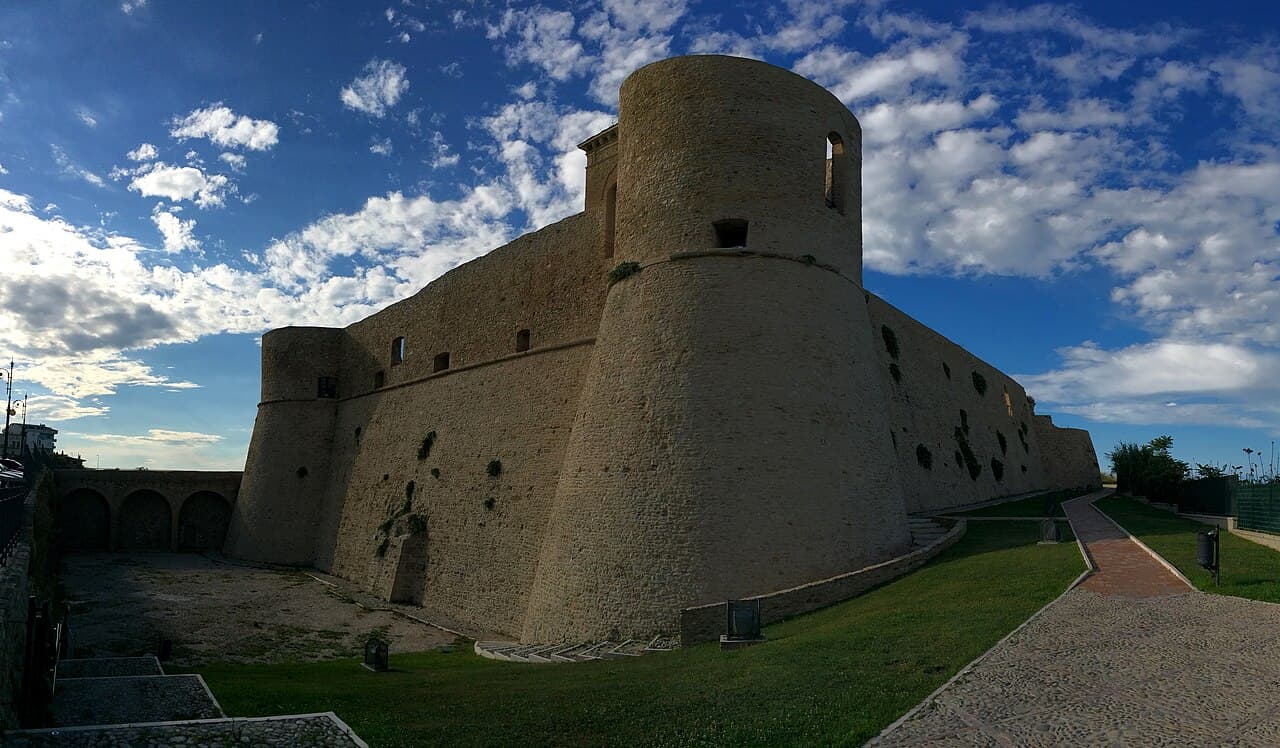
The castle’s walls are constructed with battered bases, a defensive technique that strengthens the structure by widening the foundation, making it more resistant to artillery fire and undermining. Each corner of the fortress is marked by cylindrical towers, originally four, though only three remain prominently visible today. These towers feature Gothic architectural elements such as pointed-arch windows, particularly evident in the two large round towers flanking the main entrance on the side facing Corso Matteotti.
Defensive features and layout
The entrance area reveals traces of a former water-filled moat, indicated by masonry arcades at the base pavement. Access to the interior is through a small garden alongside the walls and a staircase rising over the remains of a side tower. The castle’s internal spaces, heavily damaged during World War II and a subsequent landslide, have been converted into garden areas, with much of the original noble residence’s architectural detail lost.
Historical significance and ownership
After the Aragonese period, the castle passed into the hands of Margherita d'Austria in 1582, who purchased Ortona for 54,000 ducats. Her focus was on modernizing the town and fostering economic prosperity, but she largely left the castle intact. In the 17th century, the Baglioni family transformed the fortress into a noble residence, adding an internal palace that reflected the changing role of castles from military bastions to aristocratic homes.
The castle also served as the residence of Ludovica Ianneys from 1773 to 1812, known as a protector of Ortona. However, by the 19th century, the castle fell into neglect and was repurposed for industrial uses, including workshops and a gunpowder magazine, signaling the decline of its strategic importance.
Damage and restoration efforts
The castle suffered severe damage during the Battle of Ortona in 1943, when German bombings and American artillery strikes hit the fortress. The stored munitions exploded, devastating the upper walls and the noble palace. A landslide in 1946 further reduced the castle’s size, destroying much of the structure on its precarious tuff cliff foundation.
After decades of abandonment, restoration and consolidation efforts began in the early 21st century to preserve the castle’s remains and historical legacy. Today, visitors can explore the castle ruins, including a museum housed in the west tower that displays historical photographs and portraits of the noble families associated with Ortona’s history.
Architectural remains and visitor experience
The castle’s almost trapezoidal plan is strategically placed on a steep slope overlooking the sea, with three surviving cylindrical towers and walls characterized by their sloped bases. The main entrance is guarded by two large round towers with Gothic windows, while a smaller cylindrical tower on the west side also retains pointed-arch openings.
Inside, staircases lead to cellars and the museum in the west tower, while the east tower serves as a panoramic lookout offering sweeping views of the Adriatic coast and the town of Ortona. The remnants of the noble palace's perimeter wall, adorned with decorative cornices, hint at the castle’s former grandeur.
The castle’s location near modern residential buildings illustrates the blend of historical heritage and contemporary urban development. Despite its ruined state, the Aragonese Castle of Ortona remains a powerful symbol of the region’s layered history, from medieval fortifications to Renaissance elegance and modern preservation efforts.
Frequently asked questions (FAQ)
- What is the historical significance of the Aragonese Castle of Ortona?
- The Aragonese Castle of Ortona, built in the 15th century, played a crucial role in the defense of the Adriatic coast. Its strategic location allowed it to serve as a military stronghold during various conflicts, including World War II, making it a symbol of resilience and history for the region.
- When was the Aragonese Castle of Ortona constructed?
- The construction of the Aragonese Castle began in 1452 under the orders of King Ferdinand I of Aragon. It was completed in the late 15th century and has undergone numerous renovations since its inception, reflecting various architectural styles over the centuries.
- Can I visit the Aragonese Castle of Ortona?
- Yes, visitors can explore the Aragonese Castle of Ortona. Guided tours are available, providing insights into the castle's rich history and architectural features, making it a popular destination for history enthusiasts and tourists alike.
- What are the opening hours of the Aragonese Castle of Ortona?
- The Aragonese Castle is typically open to visitors from 9 AM to 7 PM, with extended hours during the summer months. It is advisable to check the official website or contact local authorities for any changes in the schedule or special events.
- Is it possible to access the Aragonese Castle with mobility challenges?
- The Aragonese Castle has limited accessibility for visitors with mobility challenges due to its historical architecture and uneven pathways. It is recommended to contact the castle administration in advance to inquire about specific accommodations and assistance options.
- What are the ticket prices for the Aragonese Castle?
- Ticket prices for the Aragonese Castle of Ortona are generally around €5 for adults, with discounts available for students and seniors. Children under a certain age may enter for free, making it an affordable visit for families.
- When is the best time to visit the Aragonese Castle?
- The best time to visit the Aragonese Castle of Ortona is during the spring and fall months when the weather is mild and the tourist crowds are smaller. Visiting during these seasons allows for a more enjoyable exploration of the castle and its stunning views of the Adriatic Sea.
- What nearby attractions can I explore after visiting the Aragonese Castle?
- After visiting the Aragonese Castle, you can explore the charming town of Ortona, known for its beautiful beaches and the nearby Church of St. Thomas the Apostle. Additionally, the region is home to several wineries and historical sites that provide a deeper insight into the local culture and heritage.
Photo gallery

Information
Loading map...
Visitor reviews
No reviews yet. Been here? Write the first review and help other travelers!
Write the first reviewVisited this castle? Share your experience
Your review helps other travelers and adds first-hand knowledge to our encyclopedia.