Castello di Septe
The Castello di Septe stands as a remarkable example of a medieval hill castle nestled in the municipality of Mozzagrogna, Italy. With origins tracing back to the Early Middle Ages, this fortress embodies the layered history of the region, reflecting the architectural and political shifts from the Lombard era through the Renaissance.
Historical background and significance
The castle’s foundation is attributed to the Lombards, a Germanic people who established dominion over parts of Italy during the 8th century. Sources vary on the precise construction date, placing it either towards the end of the 8th century or between the 9th and 10th centuries. Initially, the castle functioned as a strategic stronghold within the fiefdom governed by the Counts of Chieti. This early role underscores its importance in controlling local territories and safeguarding regional interests.
During the 11th century, the castle came under the influence of the Normans, who were expanding their reach across southern Italy. In 1095, Robert, the Norman Count of Loritello, granted the castle to Rainolfo, Bishop of Chieti. This transfer highlights the castle’s dual role in both secular and ecclesiastical power structures, a common feature of medieval fortresses that served as centers of administration and defense.
The mid-13th century marked another pivotal moment when King Manfred, ruler of Sicily and southern Italy, transferred control of the castle and its lands to the city of Lanciano in 1259. The castle also hosted notable figures such as Count Philip I of Flanders in 1268, whose stay ended in expulsion by 1308 due to his conduct, signaling the beginning of the castle’s gradual decline in strategic importance.
Ownership changed hands multiple times over the subsequent centuries. In 1625, the fief was sold to private families, including the Anfossos and Procaccino families. Later, in 1721, Baroness Chiara de Osses, lacking heirs, bestowed the castle upon Antonio Genoino. The Genoino family maintained possession until the mid-20th century, with the last heir mysteriously disappearing during World War II, closing a significant chapter in the castle’s history.
Architectural features and layout
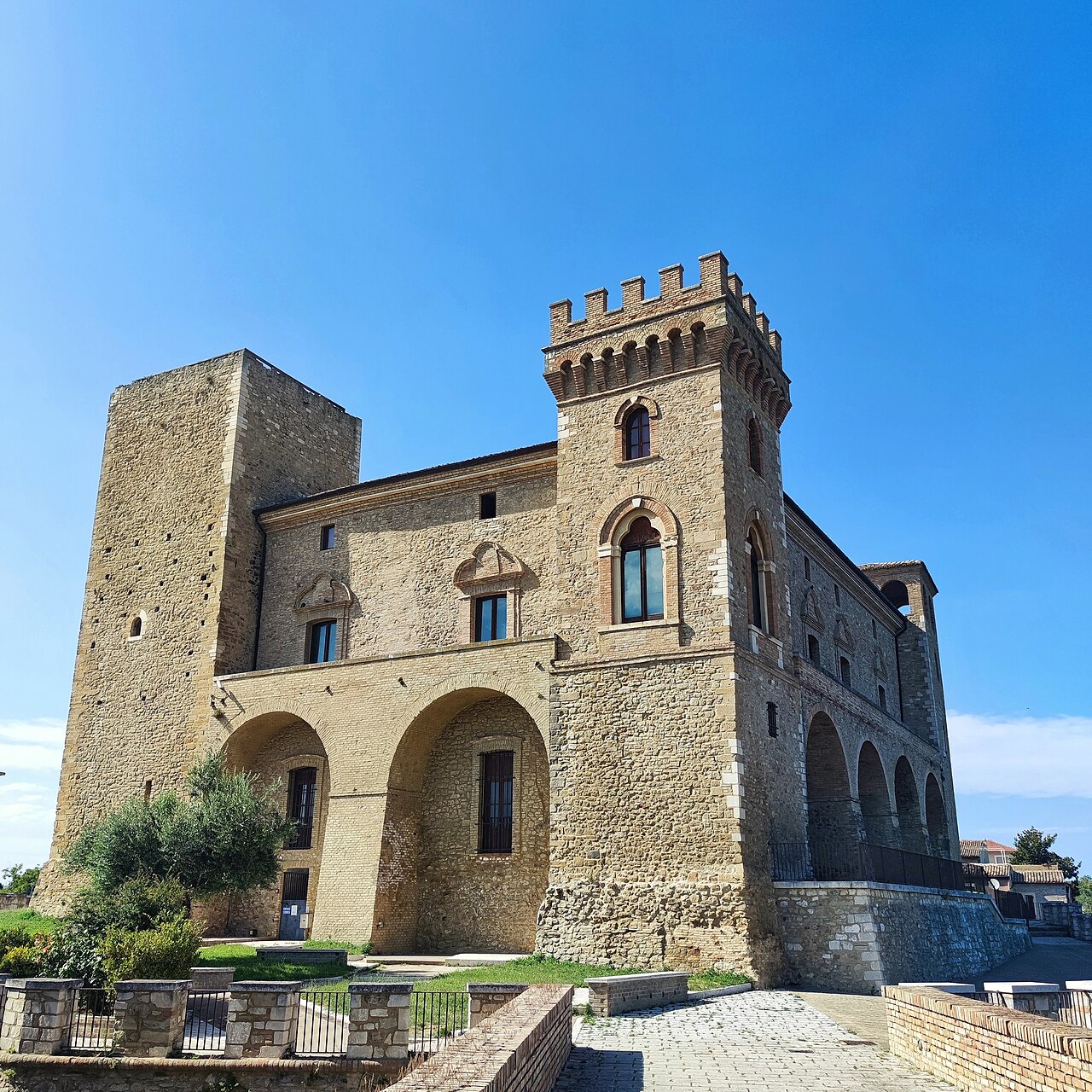
The Castello di Septe exhibits a fortified layout typical of medieval strongholds, constructed primarily of stone, reflecting building practices from the Late Middle Ages and Renaissance periods. The main façade is dominated by two large battlement-topped towers flanking the central structure, designed for both defense and surveillance. These towers provide commanding views of the surrounding landscape and form a formidable entrance to the castle.
The central portion of the castle features a protective roof covering the inner buildings, designed to shield important chambers from the elements. The exterior walls are constructed entirely of robust stone blocks, carefully joined to create a strong and enduring structure. Along the main façade runs a continuous cornice with bossage, where stones are worked to project outward, adding both visual rhythm and structural strength. This cornice is notably interrupted above the main entrance, where it rises higher to emphasize the gateway’s significance.
Windows throughout the castle are narrow and topped with rounded arches, architectural features that allowed defenders to monitor approaching threats while minimizing vulnerability to attack. These apertures exemplify the defensive priorities of medieval castle design.
Surrounding the castle is a garden area, providing a natural contrast to the fortress’s rigid stone construction and enhancing the site’s aesthetic appeal. Over the centuries, the castle’s appearance has evolved through various renovation efforts, which have preserved key medieval and Renaissance elements while adapting the structure for modern preservation.
The castle’s role in regional power dynamics
The Castello di Septe played a significant role in the shifting political landscape of southern Italy. Its early association with the Lombards positioned it as a critical military and administrative center. The subsequent Norman control introduced new governance structures, integrating the castle into broader feudal and ecclesiastical networks.
King Manfred’s transfer of the castle to Lanciano in the 13th century reflects the strategic importance of the fortress in regional politics. The castle’s hosting of prominent figures such as Count Philip I of Flanders further underscores its role as a site of political intrigue and power struggles.
Later private ownership, including the Anfossos, Procaccino, and Genoino families, illustrates the transition of the castle from a military stronghold to a noble residence, mirroring broader trends in castle use during the Renaissance and post-medieval periods.
Preservation and current condition
Today, the Castello di Septe is recognized for its well-preserved medieval and Renaissance architectural features. Restoration efforts have maintained the castle’s structural integrity, allowing visitors to appreciate its historical and architectural significance. The combination of defensive elements such as battlements, towers, and arched windows with residential features like the garden area illustrates the castle’s dual military and domestic functions.
The castle remains a valuable cultural heritage site within the Abruzzo region, attracting historians, architects, and tourists interested in medieval fortifications and Italian history.
Visiting information and cultural significance
While specific visiting hours and ticket information are not widely published, the Castello di Septe is accessible to those interested in exploring Italy’s medieval heritage. Its location in Mozzagrogna places it within reach of other historical sites in the Abruzzo region, making it a worthwhile destination for cultural tourism.
The castle’s enduring presence offers insights into the evolution of military architecture and the complex history of southern Italy’s feudal and noble families. Its preservation serves as a testament to the region’s commitment to maintaining its historical landmarks for future generations.
Frequently asked questions (FAQ)
- When was Castello di Septe originally built?
- Castello di Septe was originally built between the 8th and 10th centuries, with origins linked to the Lombard period in Italy.
- What architectural features define Castello di Septe?
- The castle features stone construction with battlement-topped towers, narrow rounded-arch windows, a cornice with bossage, and a protective roof over the inner buildings.
- Who were some notable historical owners of Castello di Septe?
- Notable owners include the Counts of Chieti, Norman Count Robert of Loritello, Bishop Rainolfo of Chieti, King Manfred, and later private families such as the Anfossos, Procaccino, and Genoino families.
- Is Castello di Septe open to visitors?
- While specific visiting hours are not widely published, the castle is accessible to visitors interested in exploring medieval heritage in the Abruzzo region.
- What is the current condition of the castle?
- Castello di Septe is well-preserved, with restoration efforts maintaining its medieval and Renaissance architectural features.
Information
Website
Visit websiteSources & official resources
Verify the information above using these authoritative references.
Loading map...
Visitor reviews
No reviews yet. Been here? Write the first review and help other travelers!
Write the first reviewVisited this castle? Share your experience
Your review helps other travelers and adds first-hand knowledge to our encyclopedia.