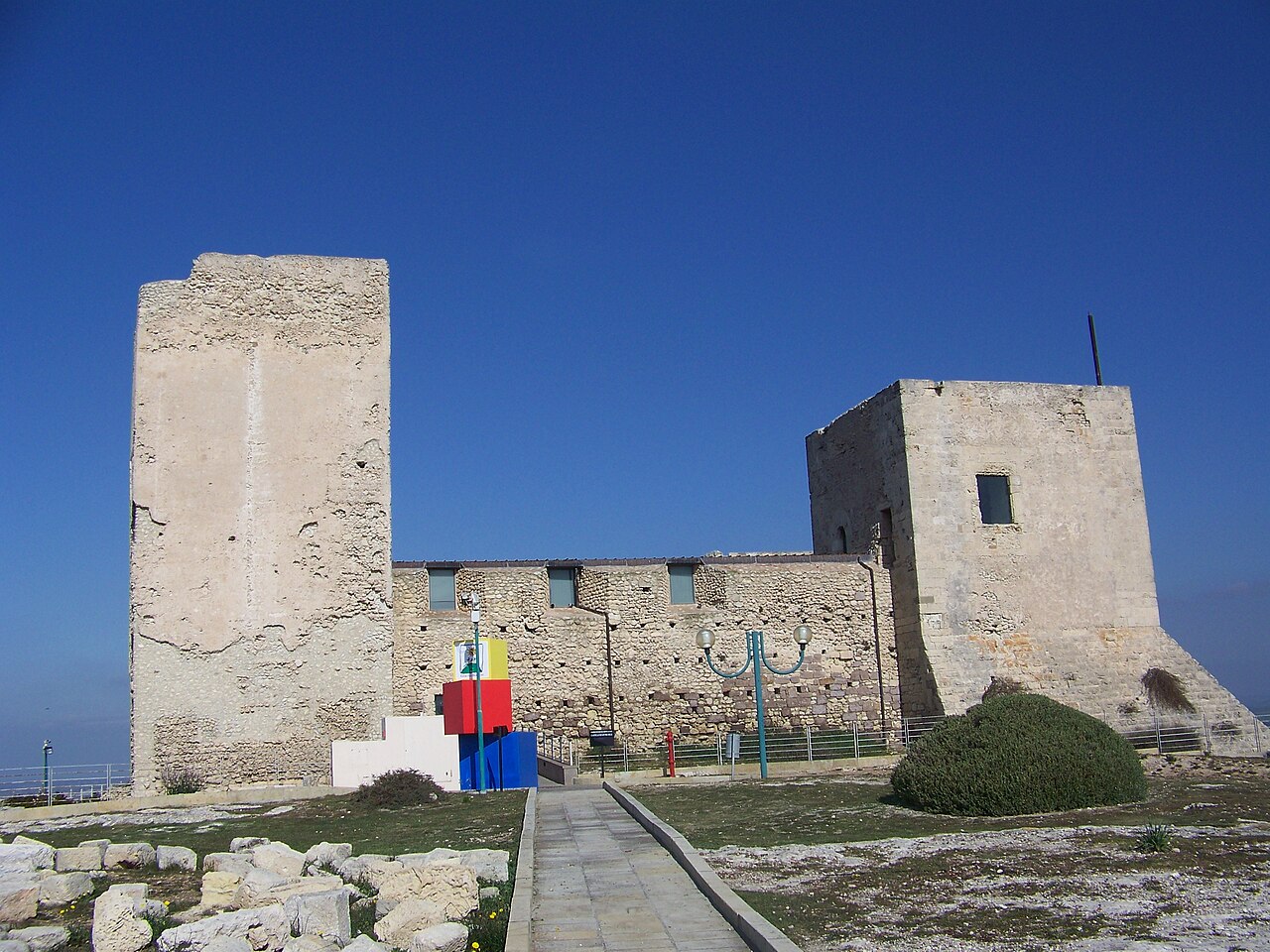
Castello di Villasor
The Castello di Villasor stands as a significant example of 15th-century Aragonese architecture in Sardinia, Italy. Situated in the historic center of Villasor, this hill castle was initially constructed in 1415 under the authorization of the Archbishop of Cagliari. The castle was commissioned by Giovanni Siviller, the feudal lord of Villasor, who built it atop the remains of the ancient parish church of Santa Maria. This location symbolically fused religious heritage with feudal authority, reflecting the complex social and political dynamics of early 15th-century Sardinia.
The castle's original purpose was dual: it served as the residence of the feudal lord and a defensive stronghold against potential uprisings by the Arborean rebels. These rebels had been subdued during the conflict between the Aragonese crown and the Judicate of Arborea, a local Sardinian kingdom. The military aspect of the castle is evident in its robust fortifications designed to protect the territory and assert Aragonese dominance during this turbulent period.
Historical lineage and noble associations
Ownership of the Castello di Villasor passed through prominent noble families, beginning with the Siviller family and subsequently the Alagon family through marriage to Isabella, daughter of Giovanni Siviller. This alliance established the castle as a seat of the Alagon lineage, a family influential in Sardinian history. In the 18th century, the Alagon family further intertwined with the noble De Silva family, resulting in the combined dynasty of Alagon Arborea de Silva. Their coat of arms, prominently displayed above the main entrance, symbolizes this noble heritage and the castle's enduring aristocratic significance.
Architectural features and layout
The Castello di Villasor occupies a trapezoidal plot bordered by Via Baronale, Via Castello, and Via Cagliari. Its plan is U-shaped around a squared internal courtyard, suggesting that a third wing once completed a fully enclosed rectangular layout. This architectural form combines elements typical of medieval fortifications with features more common to grand urban residences, highlighting its dual function as a fortress and noble dwelling.
Access to the castle is through a round-arched gateway on Via Baronale, which opens into an external courtyard. Above this entrance is the distinctive coat of arms of the Alagon Arborea de Silva family, crowned with a marquis's emblem, marking the castle’s aristocratic identity from the 18th century. The main façade is punctuated by Gothic Catalan-style window frames, finely carved with intricate detailing, adding an elegant contrast to the otherwise austere stone walls.
The castle’s defensive character is underscored by its battlements topped with Guelph merlons, characterized by their square-topped crenellations. This feature distinguishes it from other fortifications in the region that often employ the swallowtail-shaped Ghibelline merlons. The walls also feature narrow curtain windows, designed to provide light and ventilation while maintaining defensive integrity, softening the fortress’s exterior without compromising security.
Interior elements
Inside, the castle comprises two main levels. A notable highlight is a hall retaining a wooden coffered ceiling dating from the 15th to 16th centuries. This ceiling features recessed panels often ornamented, a decorative style typical of Mediterranean architecture during this period. The preservation of this ceiling provides a tangible link to the castle’s early history and artistic heritage.
Evolution of use and restoration efforts
Following the dismantling of the feudal system, the castle underwent various functional transformations. It served as a military barracks, a prison, and later as a school, reflecting changing societal needs. Eventually, the building fell into neglect and was used for agricultural storage, marking a decline from its noble origins.
In 1991, the municipality of Villasor acquired the castle and initiated restoration projects. These efforts have partially restored the structure, enabling the ground floor to be used for cultural events, exhibitions, and conferences. However, the upper floors remain closed to the public, preserving the castle’s integrity while allowing community engagement.
Legacy and current status
The title of Marquis of Villasor, historically linked to the castle’s founding family and their successors, is currently held by Don Álvaro Fernández-Villaverde y Silva, born in 1943. He is the 13th Marquis of Villasor and maintains several noble titles connected to the castle’s rich history.
Today, the Castello di Villasor stands as a well-preserved hill castle that embodies the layered history of Sardinia’s feudal and noble past. Its architectural features, noble associations, and adaptive reuse reflect the complex history of the region from the early modern period to contemporary times.
Frequently asked questions (FAQ)
- How do I visit Castello di Villasor?
- Castello di Villasor is located in the historic center of Villasor, Sardinia. Visitors can explore the ground floor areas which are open for cultural events and exhibitions. The upper floors are currently closed to the public.
- What is the historical significance of Castello di Villasor?
- Castello di Villasor was built in 1415 by the Aragonese to serve as a fortified residence and defense against Arborean rebels. It reflects the political and military history of Sardinia during the early modern period.
- What architectural styles are present in Castello di Villasor?
- The castle features Gothic architectural elements, including Gothic Catalan-style windows and battlements with Guelph merlons, blending medieval fortification with noble residential design.
- Is Castello di Villasor accessible for events?
- Yes, the ground floor of Castello di Villasor is used for cultural and community events such as exhibitions and conferences, making it accessible for visitors during these occasions.
- When was Castello di Villasor restored?
- Restoration efforts began after the municipality of Villasor acquired the castle in 1991, focusing on preserving its historical features and enabling partial public access.
Information
Current owner
Municipality of Villasor
Loading map...
Visitor reviews
No reviews yet. Been here? Write the first review and help other travelers!
Write the first reviewVisited this castle? Share your experience
Your review helps other travelers and adds first-hand knowledge to our encyclopedia.