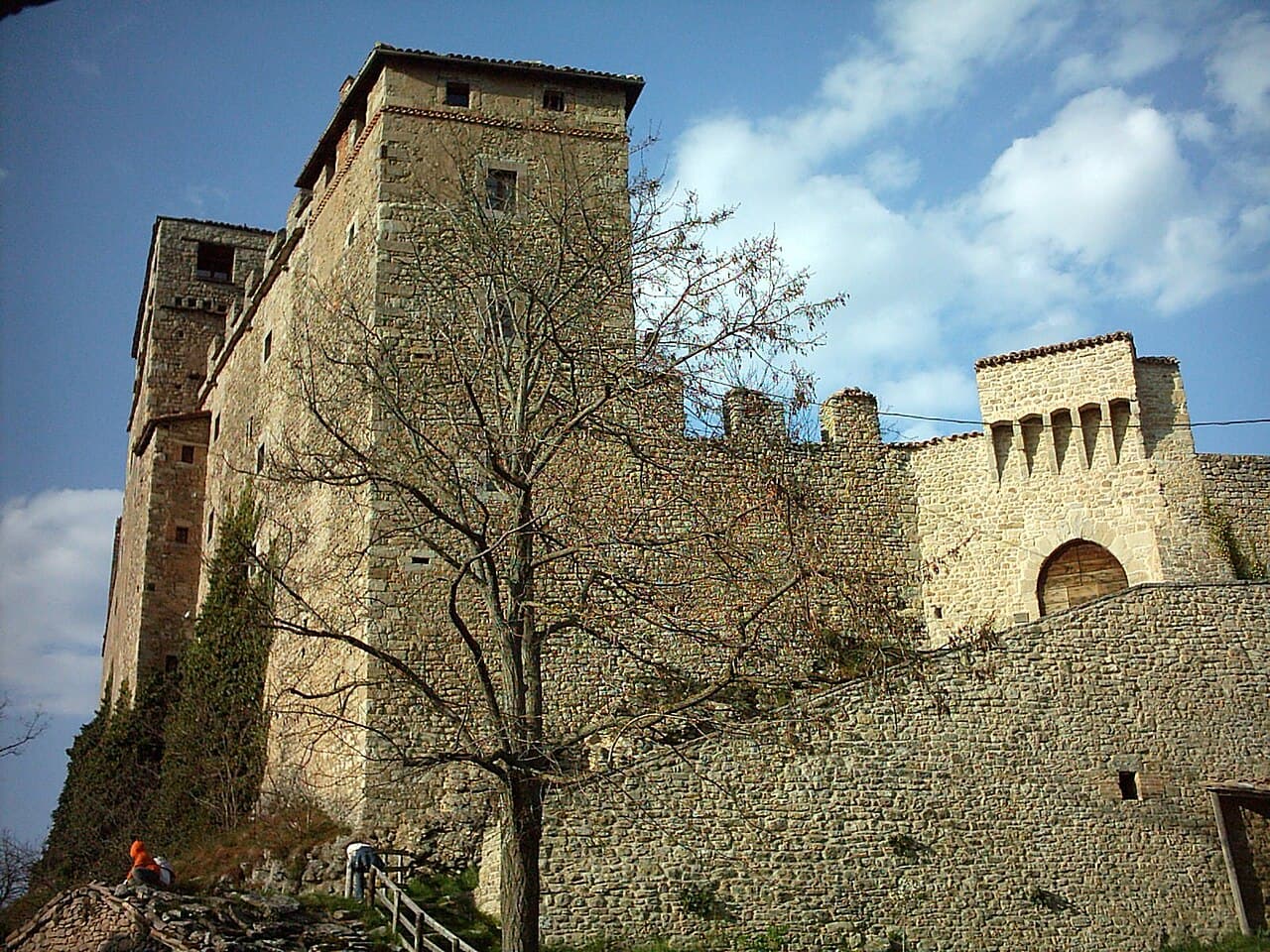
Castello di Montecuccolo
The Castello di Montecuccolo is a remarkable example of a hill castle with origins tracing back to the early 11th century, situated in the municipality of Pavullo nel Frignano in Italy. Its strategic location atop a hill overlooking the Pavullo valley allowed it to serve as a vital lookout and defensive site throughout the medieval period and beyond. This castle’s evolution from a simple wooden watchtower to a complex stone fortress encapsulates centuries of military, residential, and administrative functions, reflecting the shifting political and social landscapes of northern Italy.
The earliest phase of the castle began between 1019 and 1027 with the construction of a wooden palisade and watchtower. This initial fortification was primarily designed for surveillance and early warning against potential invaders. By 1027, the castle was formally recognized in historical documents, marking its established presence in the region. The castle’s early significance was further enhanced in 1116 when Emperor Henry V granted the site as a fief to vassals loyal to Matilda of Canossa, a powerful noblewoman whose influence extended across northern Italy. Under her vassals, the castle underwent its first major transformation from wood to stone, signaling a shift towards more permanent and robust defenses. This phase included the construction of a stone tower and a palace, laying the groundwork for the fortress’s subsequent expansions.
Medieval expansion and architectural development
From the 13th to the 16th centuries, the Castello di Montecuccolo experienced significant growth and fortification. The castle’s walls were extended and strengthened, eventually enclosing a courtyard and a lower village, known as the lower borgo, which developed around the main stronghold. This village included residential structures and communal spaces, highlighting the castle’s role as a center of local governance and community life. A notable addition during this period was the construction of the church of San Lorenzo in 1469, situated within the lower borgo. The church’s presence underscores the integration of religious functions within the castle complex, serving the spiritual needs of its inhabitants and reinforcing the castle’s multifaceted role.
The montecuccoli family and their legacy
The Montecuccoli family emerged as the dominant local rulers between the 15th and 17th centuries, consolidating control over the castle and its surrounding lands. Their tenure saw the addition of a new palace, a square tower, and an administrative building known as the podesteria. These structures not only enhanced the castle’s defensive capabilities but also reflected its evolution into a noble residence and administrative center. The family's influence is immortalized by the birth of Raimondo Montecuccoli in the castle on 21 February 1609. Raimondo became a renowned military commander and strategist, and his association with the castle adds considerable historical prestige to the site.
Decline, damage, and restoration efforts
The castle’s prominence declined after the main Montecuccoli lineage ended in the late 17th century. It suffered severe damage during the Napoleonic Wars, particularly in 1799 when Napoleonic forces attacked and set fire to the complex. This assault left the fortress partially ruined and led to its abandonment for over a century. The castle remained in a state of neglect until 1961, when ownership was transferred to the municipal authorities of Pavullo.
Between 1977 and 2009, extensive restoration campaigns were undertaken to stabilize and rebuild the castle and its adjoining village. These efforts included repairing leaning towers, reinforcing stone walls, and restoring key buildings such as the church of San Lorenzo. The restoration has transformed the site from a state of decay into a well-preserved cultural landmark, allowing visitors to appreciate its layered history and architectural complexity.
Architectural features and layout
The Castello di Montecuccolo is composed of two primary sections: the upper borgo, which contains the main fortress or rocca with its attached buildings, and the lower borgo, a medieval village organized around a communal square and the church. The construction predominantly features stone masonry, characteristic of medieval fortifications, evident in the robust walls, towers, and residential buildings.
The original wooden defenses were replaced in the 12th century by substantial stone walls forming multiple concentric layers of defense. These fortifications were expanded over the centuries to adapt to evolving military technologies and threats. The castle’s main entrance was originally on the south side, but the current visitor access is located on the northern end near a parking area.
Notable interior spaces
Within the castle, a central palace built between the 15th and 16th centuries connects the main keep to the tower of the trebbo via a spiral staircase. This architectural feature facilitated movement within the complex, linking residential quarters to defensive structures. One of the castle’s most remarkable interior rooms is the "stanza del Generale" or General’s room, which retains well-preserved decorations from 1545. This room features intricate friezes, coats of arms, and Latin inscriptions that provide insight into the identities and alliances of the castle’s historical owners.
The Montecuccoli family coat of arms is prominently displayed throughout the castle. It features six mountains adorned with olive branches symbolizing peace and strength, alongside an imperial eagle granted by Emperor Charles IV in 1369. These heraldic symbols emphasize the family’s noble status and imperial connections.
Current status and visitor experience
Today, the Castello di Montecuccolo stands as a well-preserved testament to medieval and Renaissance architecture, with ongoing efforts to maintain its structural integrity and historical authenticity. The castle complex includes several residential houses, an underground restaurant, and a historic street leading visitors toward the foundational structures of the fortress.
The site offers a unique opportunity to explore a fortified stronghold alongside a medieval village, providing a comprehensive understanding of the castle’s multifaceted role as a defensive bastion, noble residence, religious center, and administrative hub. Visitors can appreciate the castle’s rich history, architectural evolution, and the legacy of the Montecuccoli family within the broader context of Italian and European history.
Frequently asked questions (FAQ)
- When was Castello di Montecuccolo originally built?
- The castle's earliest construction phase began between 1019 and 1027 as a wooden watchtower and palisade.
- Who was Raimondo Montecuccoli?
- Raimondo Montecuccoli was a 17th-century military commander and strategist born in the castle in 1609, known for his significant contributions to European military history.
- What architectural styles are present in Castello di Montecuccolo?
- The castle features a mix of architectural styles, including medieval stone fortifications and Renaissance elements in its palaces and interior decorations.
- Is the castle open to visitors today?
- Yes, Castello di Montecuccolo is open to visitors, offering access to its historic buildings, restored towers, and the adjoining medieval village.
- What is the significance of the church of San Lorenzo within the castle complex?
- Built in 1469, the church of San Lorenzo serves as a religious center within the lower borgo, highlighting the integration of spiritual life with the castle's defensive and residential functions.
Photo gallery

Information
Sources & official resources
Verify the information above using these authoritative references.
Loading map...
Visitor reviews
No reviews yet. Been here? Write the first review and help other travelers!
Write the first reviewVisited this castle? Share your experience
Your review helps other travelers and adds first-hand knowledge to our encyclopedia.


