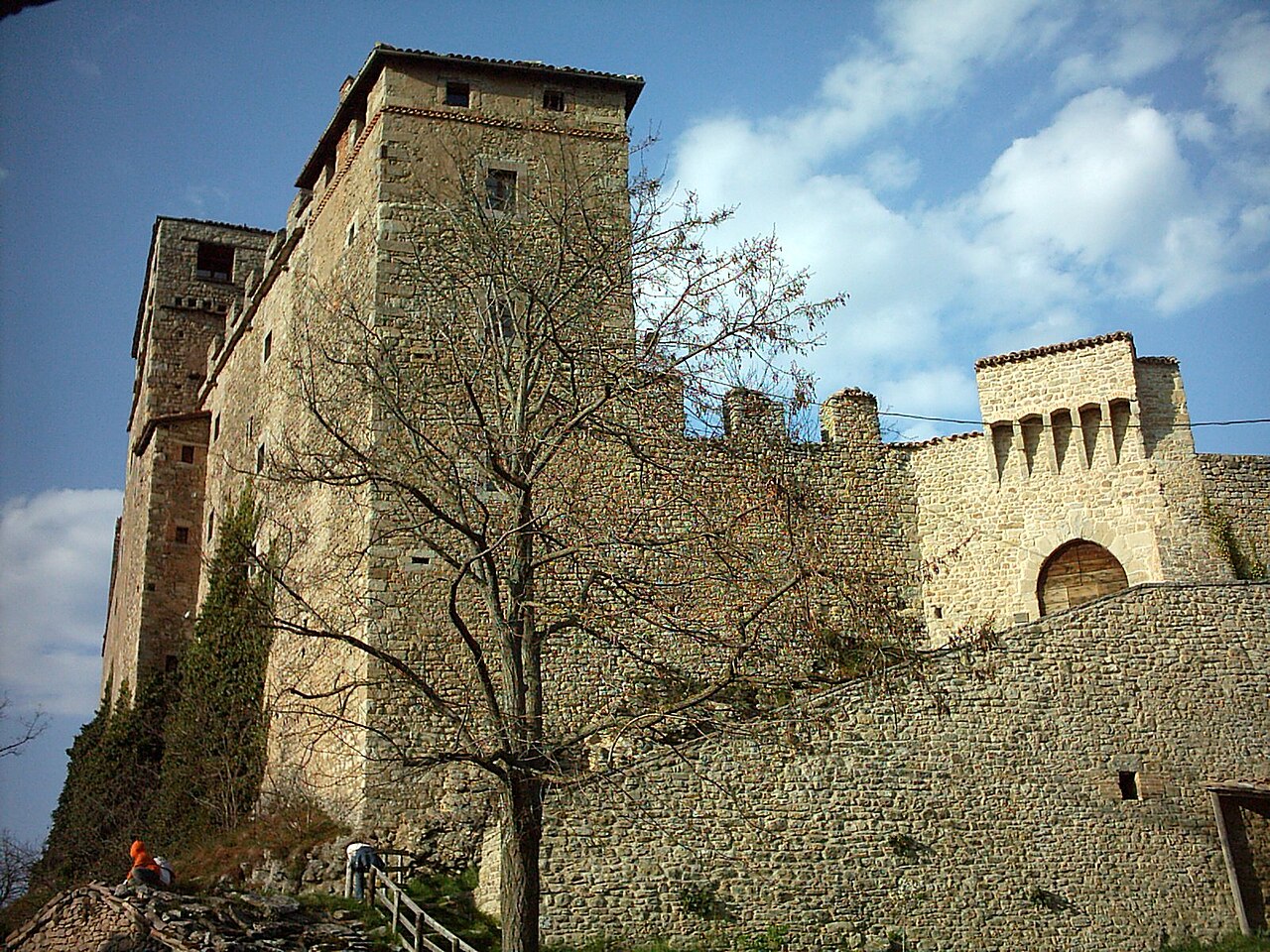
Rocca di Montefiorino
The Rocca di Montefiorino stands as a remarkable example of a medieval hill castle in Italy, embodying centuries of military, religious, and civic history. Located in the municipality of Montefiorino, this fortress was originally constructed in the late 12th century by the Montecuccoli family, who built it under the authority of the abbots of Frassinoro. These abbots were significant religious leaders whose territorial influence extended to this northern boundary marked by the Rocca.
The castle's strategic importance is reflected in its architectural evolution. Around 1170, the Montecuccoli established the central tower, creating the fortress's initial defensive core. As the nearby city of Modena expanded southward during the early 13th century, the Rocca was enlarged to meet increased military demands. By 1230, the addition of a residential palace-tower enhanced its role as both a stronghold and noble residence. Following attacks by Modenese troops, the fortress underwent further fortifications in 1245, including an outer defensive layer reinforced by two additional towers, strengthening its ability to withstand sieges.
Medieval fortifications and architectural layout
The Rocca di Montefiorino is composed of four main buildings arranged around a rectangular courtyard. Three sides of this courtyard are lined with porticoes, covered corridors beneath an upper level, which provided sheltered passage and access to various rooms. The fortress's main entrance features a semicircular arch doorway with a heavy wooden door, flanked by two of the four defensive towers that bolster the fortress walls. A carved relief of Saint Michael the Archangel adorns the right side of the façade, symbolizing protection and the site's religious ties, particularly to its chapel.
Inside the entrance, a staircase leads down to the courtyard, where an old well—once vital for the inhabitants' water supply—stands on the left. The courtyard is encircled by interconnected porticoed corridors on both the ground and upper floors, facilitating movement and defense. Dominating the west side is the mastio or main tower, which faces the entrance staircase. Near its base, an ancient rainwater cistern was discovered, highlighting medieval water management techniques. A sealed doorway high on the tower's wall hints at now-lost architectural functions.
Historical transformations and civic role
Following a siege by Modenese forces at the end of the 13th century, the Rocca was occupied and deliberately damaged to prevent further military use. The fortress was abandoned for several decades before being repurposed as a hermitage for two monks, marking a shift from military to religious use. In 1320, it was transformed into the fortified residence of Guidinello Montecuccoli, a descendant of the original builders. This period also saw the founding of the village of Montefiorino and the construction of the Market Tower, now the town's bell tower.
The Montecuccoli family maintained control until their last descendant was expelled, after which the fortress passed to the House of Este at the local population's request. Under Este rule, the Rocca became the administrative center of the podesteria, a local government office, and later housed municipal administrations—a function it still serves today.
World War II significance and modern cultural use
The Rocca di Montefiorino gained renewed historical importance during World War II as the political center of the Republic of Montefiorino, the first Italian partisan republic declared on June 17, 1944. This short-lived self-governing community symbolized local resistance against Nazi-fascist occupiers. The castle and town suffered severe bombardment and occupation, with many civilians deported to the Fossoli concentration camp.
Local tradition speaks of a secret underground passage linking the Rocca to the Market Tower, possibly used for clandestine movement between the two buildings. However, no archaeological evidence has confirmed this tunnel, leaving it a piece of regional folklore tied to the castle's past.
Today, the Rocca accommodates municipal offices, including the mayor's seat, and serves as the hub for the local union of municipalities. The right wing houses the Museum of the Republic of Montefiorino, which exhibits World War II artifacts, historical documents, and multimedia displays commemorating the partisan republic era. Adjacent to the entrance, the Ermanno Gorrieri Hall functions as a theater and exhibition space for cultural events.
The castle tower is open to visitors, offering panoramic views of the surrounding valleys and plains. Along the ascent, historical illustrations narrate Montefiorino's rich past, emphasizing the Rocca's enduring significance through centuries of military, religious, and civic history. This blend of preserved medieval architecture and modern cultural use underscores the Rocca di Montefiorino's role as a symbol of resilience and heritage in the Emilia-Romagna region.
Frequently asked questions (FAQ)
- How do I visit Rocca di Montefiorino?
- The Rocca di Montefiorino is open daily from 10:00 to 18:00 with free admission. Visitors can explore the castle, its museum, and climb the tower for panoramic views.
- What is the historical significance of Rocca di Montefiorino?
- The castle served as a strategic fortress in medieval times and was the political center of the first Italian partisan republic during World War II, symbolizing local resistance.
- Can I climb the tower at Rocca di Montefiorino?
- Yes, visitors can climb the main tower to enjoy panoramic views of the surrounding valleys and plains. Along the way, historical illustrations provide insights into the castle's history.
- Is there a museum at Rocca di Montefiorino?
- Yes, the Museum of the Republic of Montefiorino is located within the castle's right wing. It displays artifacts, documents, and multimedia related to the World War II partisan republic.
- What architectural style characterizes Rocca di Montefiorino?
- The castle exhibits Gothic architectural features, including fortified towers, porticoes, and defensive walls typical of the High Medieval period.
Information
Opening hours
10:00-18:00, daily
Ticket prices
Free
Current owner
Municipality of Montefiorino
Website
Visit websiteSources & official resources
Verify the information above using these authoritative references.
Loading map...
Visitor reviews
No reviews yet. Been here? Write the first review and help other travelers!
Write the first reviewVisited this castle? Share your experience
Your review helps other travelers and adds first-hand knowledge to our encyclopedia.