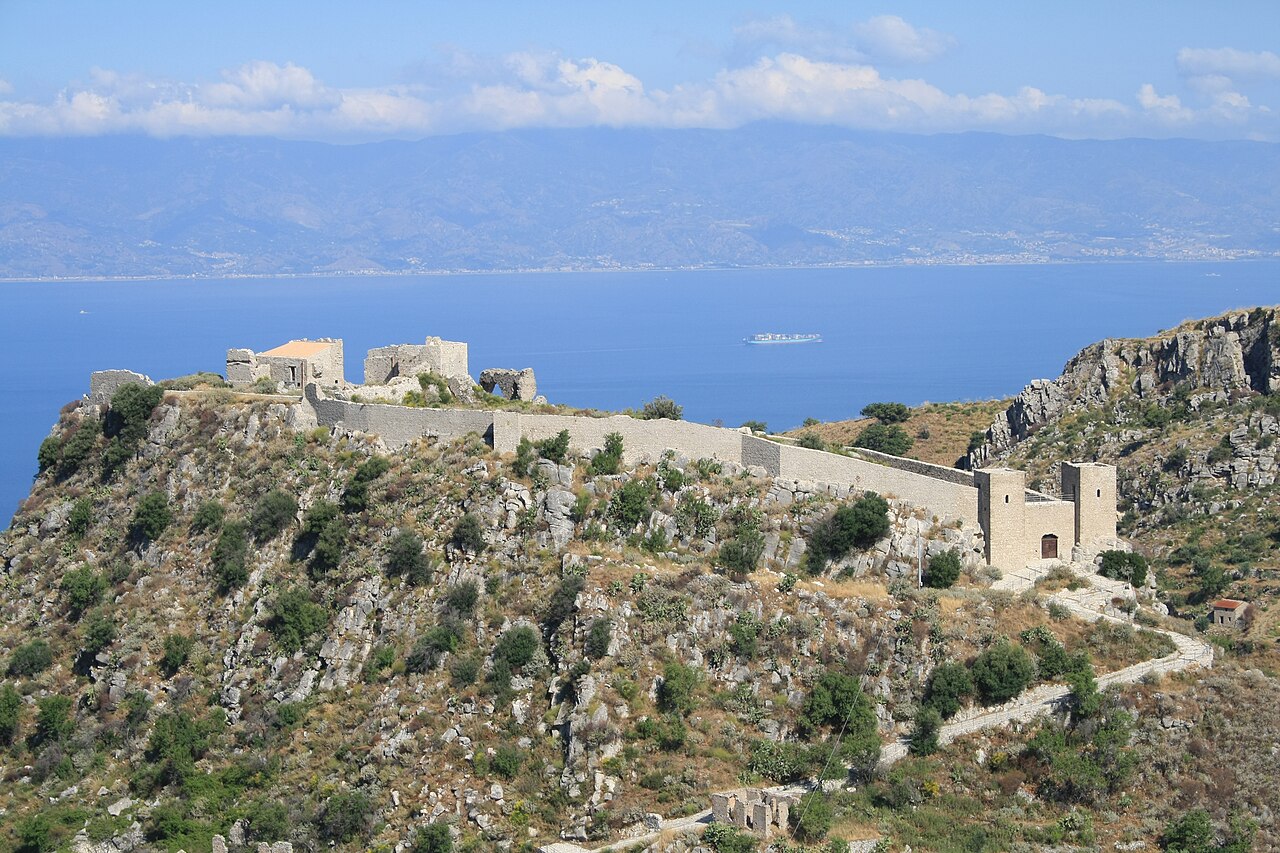
Castello di Palizzi
The Castello di Palizzi stands as a remarkable example of medieval military architecture nestled on a rocky ridge overlooking the village of Palizzi in Calabria, Italy. This hill castle, dating back to the 14th century, was originally commissioned by the noble Ruffo family as a strategic fortress to defend the region against persistent threats from Turkish pirate raids along the nearby coastline. Its commanding position approximately 300 meters above sea level provided a natural vantage point for surveillance and defense, with only a single access road enhancing its security.
Historical background and noble lineage
The castle's history is deeply intertwined with the fortunes of several influential noble families who shaped its form and function over the centuries. Initially constructed by the Ruffo family in the medieval period, the fortress soon became a crucial defensive bulwark in the turbulent geopolitical landscape of southern Italy. By the late 16th century, the castle had begun to show signs of wear, as noted by a Latin inscription dated 1580 above the entrance, which lamented the structure "falling into decay due to age."
Ownership and stewardship of the castle passed through the hands of prominent families including the Romanos, Colonnas, and Erbos during the 16th century. These families undertook significant modifications to the castle's defensive systems to adapt to evolving military technologies and threats. The 18th century saw further alterations under the Arduinos di Alcontres family, who continued to enhance the fortress's fortifications.
A pivotal transformation occurred in 1866 when the castle was converted from a purely military stronghold into a residential palace by the De Blasio baronial family. This conversion included the construction of a masonry palace on the west side of the castle, using brickwork that contrasted with the original medieval stone structures. The De Blasios maintained the castle as their family residence until the 1960s, during which time they also undertook some restoration efforts to preserve the building's integrity.
Architectural features and defensive elements
Towers and walls
The Castello di Palizzi exhibits a complex architectural evolution reflecting its long history of military and residential use. Two prominent towers dominate the surviving ruins: a cylindrical tower on the east side, topped with battlements featuring crenellations that allowed defenders to observe and fire upon attackers, and a rectangular tower on the west side, which served as a key defensive strongpoint.
The castle's perimeter walls remain largely intact and showcase sophisticated defensive engineering. These walls incorporate bastions with distinctive scarpa or sloped bases designed to deflect artillery fire and hinder scaling attempts. Structural reinforcements known as "toro di separazione" or separating bulls add further strength to the defensive barrier. Multiple tiers of gun openings are arranged along the walls, following the natural contours of the rocky ridge to maximize defensive coverage.
Medieval military features
Remnants of battlements and narrow vertical arrow slits are still visible, testifying to the castle's original function as a medieval fortress. These features allowed archers and later firearm users to defend the castle effectively while remaining protected. The castle's strategic design demonstrates the adaptation of traditional medieval fortifications to accommodate the increasing use of gunpowder weaponry during the Renaissance period.
Residential conversion and decline
The 19th-century conversion by the De Blasio family marked a significant shift from military to residential use. The addition of a brick masonry palace on the west side introduced a new architectural layer to the castle, reflecting the changing needs and tastes of the period. Despite some restoration efforts, the castle was eventually abandoned after the 1960s, leading to progressive deterioration.
Today, the castle stands as a partially ruined monument, with its roof lost and many internal spaces exposed to the elements. However, the remaining structures still provide valuable insights into the castle's multifaceted history and architectural evolution. Its elevated position continues to offer breathtaking views of the surrounding landscape, preserving its historical role as a sentinel over the region.
Cultural and historical significance
Castello di Palizzi is an important cultural landmark in Calabria, representing the region's medieval heritage and the complex history of noble families who shaped southern Italy's defensive architecture. The castle's layered construction phases illustrate the adaptation of fortifications over centuries in response to changing military technologies and social functions.
As a site that transitioned from a defensive fortress to a noble residence, the castle embodies the broader historical trends of fortification evolution and aristocratic lifestyle changes in Italy. Its preservation, despite partial ruin, offers historians and visitors alike a tangible connection to the past and a vivid example of medieval and post-medieval architecture.
Frequently asked questions (FAQ)
- When was Castello di Palizzi originally built?
- Castello di Palizzi was most likely constructed in the 14th century by the noble Ruffo family as a defensive fortress.
- What are the main architectural features of Castello di Palizzi?
- The castle features two prominent towers—a cylindrical tower with battlements and a rectangular tower—along with perimeter walls with bastions, scarpa bases, and multiple gun openings.
- How did Castello di Palizzi change over time?
- Originally a military fortress, it underwent modifications by various noble families and was converted into a residential palace in 1866 by the De Blasio family.
- Is Castello di Palizzi open to the public?
- There is no widely available information on public visiting hours, so visitors should check locally before planning a visit.
- What caused the castle's decline?
- After the 1960s, the castle was abandoned, leading to gradual ruin and loss of its roof, exposing the structure to weathering.
Information
Loading map...
Visitor reviews
No reviews yet. Been here? Write the first review and help other travelers!
Write the first reviewVisited this castle? Share your experience
Your review helps other travelers and adds first-hand knowledge to our encyclopedia.