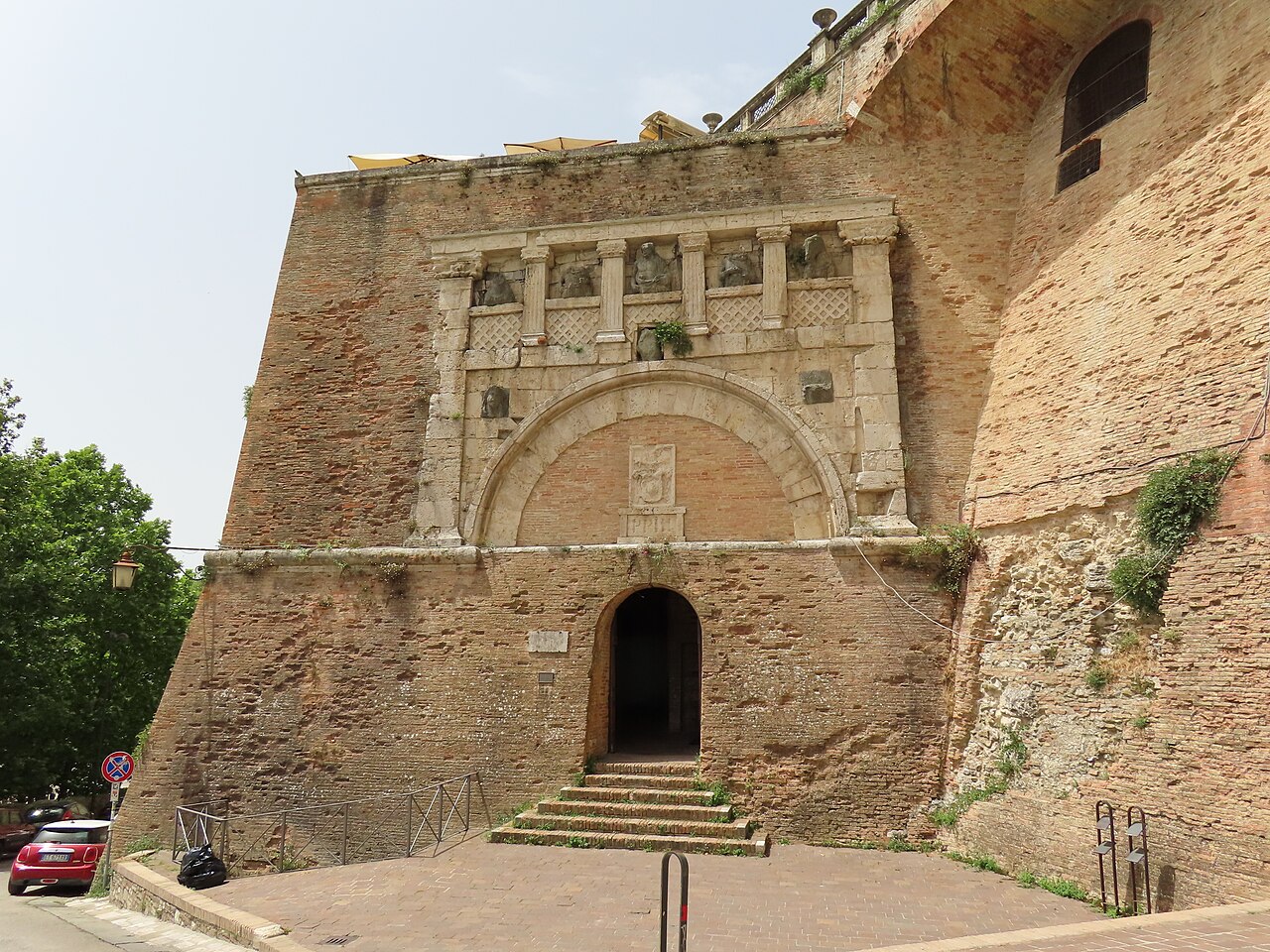
Castello di Procoio
The Castello di Procoio stands prominently above the village of Migiana di Monte Tezio, within the municipality of Perugia, Italy. This hill castle was originally established in the 12th century as a fortified settlement to oversee a vital route connecting Perugia to Gubbio, underscoring its strategic importance during the medieval period. The castle's location on Monte Tezio provided commanding views of the surrounding landscape, essential for controlling travel and trade through this part of Umbria.
The earliest core of the castle reflects early medieval military architecture, with a square plan and defensive features typical of the period. By the late 13th century, the area around the castle had developed into two villages, Megiane superioris Montis Teuzi and Megiane S. Petri Montis Teuzi, each with nine hearths, indicating a small but established community. Historical records from 1282 and 1296 highlight the settlement's significance, including the construction of a fountain in San Pietro di Migiana by Perugian authorities, although one village was abandoned by 1380.
Medieval origins and strategic role
The castle's initial purpose was to serve as a defensive stronghold controlling an important route between Perugia and Gubbio. Its square layout and fortified walls were designed to provide protection and surveillance. The castle's position on a hilltop allowed defenders to monitor movement and respond to threats effectively. The presence of two round towers planned for the northeast and northwest corners, although never completed, reflects the evolving military architecture of the late medieval period.
Defensive architecture and features
The castle's defensive elements include beccatelli (projecting corbels) supporting parapets, battlements topped with merlons, and loopholes designed for archers to shoot while remaining protected. The main entrance on the eastern side is marked by a doorway supported by corbels, which once held defensive features such as battlements and arrow slits. The oldest part of the structure, preserved at the northwest corner, retains the original 12th-century core, offering insight into early fortification techniques.
Construction phases and historical developments
Significant construction efforts in the 15th century, beginning in 1455, aimed to transform the site into a complete fortress. Local residents sought financial assistance from the Comune di Perugia in 1473 and 1480 to finish the building and secure a reliable water supply. Despite these attempts, the castle remained incomplete, likely due to financial constraints or shifting political priorities during the Renaissance.
By the early 18th century, the castle was known as Castel Vecchio or "Old Castle," as identified on maps from 1728. The site also contained a small chapel dedicated to Santa Eurasia, a saint venerated as the protector of crops and rural life, indicating the castle's dual role as a religious and defensive center.
Modern restoration and contemporary use
In the 21st century, the estate was acquired by the Lebedev family, who renamed it Castello di Santa Eurasia. The castle has since undergone extensive renovation led by architect Domenico Minchilli, who preserved the historic façade while rebuilding damaged walls and clearing structural debris to create functional living spaces. The castle now rises three stories and includes seven guest suites plus a large principal suite, each uniquely decorated.
Interior design and amenities
The interiors, designed by Martyn Lawrence Bullard, feature bespoke handcrafted furniture, wrought ironwork, and painted wooden ceilings. Decorative highlights include 17th-century Flemish stone fireplaces and a complete set of the Stations of the Cross. The furnishings incorporate 17th- and 18th-century pieces, such as banqueting tables, armoires from the 1700s, and monks’ chairs from Peru, blending historical authenticity with modern luxury.
The estate grounds offer amenities such as a gym, a Turkish-style hammam, and a spa area. The gardens surrounding the castle are planted with fragrant jasmine and lavender, centered around a rectangular emerald-green swimming pool, creating a serene environment that complements the castle's historic charm.
Cultural significance and notable events
The castle's chapel remains dedicated to Santa Eurasia, maintaining the historic spiritual connection to this saint as guardian of agriculture and rural communities. The castle's contemporary history includes hosting notable figures, including a symbolic same-sex marriage ceremony conducted by American actor Neil Patrick Harris in 2014, reflecting its evolving role in modern cultural life.
Due to Alexander Lebedev's past as a KGB officer, the castle has been subject to surveillance by Italian authorities over espionage concerns, adding a layer of intrigue to its modern narrative. Despite these complexities, Castello di Procoio remains a remarkable example of a medieval hilltop fortress that has been sensitively restored to serve as a luxurious residence and cultural landmark.
Frequently asked questions (FAQ)
- How do I visit Castello di Procoio?
- Castello di Procoio is a private estate, so visits are typically by appointment or during special events. It is recommended to check availability in advance through official channels or tour operators specializing in historic properties in Umbria.
- What is the historical significance of Castello di Procoio?
- The castle dates back to the 12th century and played a strategic role in controlling the route between Perugia and Gubbio. Its medieval origins and later Renaissance modifications reflect the region's military and social history.
- Can I see the castle's chapel dedicated to Santa Eurasia?
- Yes, the chapel dedicated to Santa Eurasia remains part of the estate and reflects the site's long-standing religious heritage. Visitors may view it during guided tours or special cultural events.
- When was the castle restored?
- Extensive restoration led by architect Domenico Minchilli took place in the 21st century, preserving the historic façade and adapting the interiors for modern use while maintaining historical features.
- Is the castle accessible to people with mobility challenges?
- Due to its medieval hilltop location and historic structure, accessibility may be limited. Visitors with mobility concerns should inquire in advance to understand the facilities and accommodations available.
- What architectural styles are represented in Castello di Procoio?
- The castle showcases a mix of medieval defensive architecture with later Renaissance influences, along with modern restoration elements that blend historic and contemporary design.
Information
Sources & official resources
Verify the information above using these authoritative references.
Loading map...
Visitor reviews
No reviews yet. Been here? Write the first review and help other travelers!
Write the first reviewVisited this castle? Share your experience
Your review helps other travelers and adds first-hand knowledge to our encyclopedia.