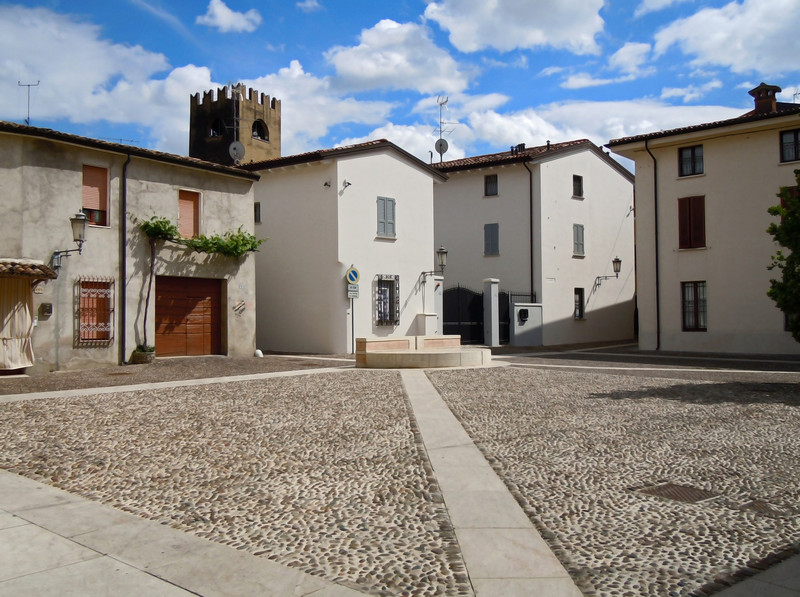
Castello di Mariana Mantovana
The Castello di Mariana Mantovana is a historic fortified site located in the municipality of Mariana Mantovana, in the Lombardy region of northern Italy. Its origins date back to the early medieval period, specifically the 11th and 12th centuries, when it was first documented as a medieval castrum—a type of fortified settlement typical of feudal Europe. The castle initially served as a strategic stronghold for the rural counts of Brescia and the palatine counts of Lomello, reflecting its importance within the complex feudal landscape of northern Italy during the Middle Ages.
Early history and medieval fortifications
Records from the years 1033, 1054, 1104, and 1180 mention the site, highlighting its long-standing role in regional defense and administration. By the early 13th century, the castle was referenced in the Liber Potheris, a medieval document from the commune of Brescia. A notable entry from 1215 describes the castle’s essential defensive features, including a moat (fossatum castri), stone walls (murus castri), and storage facilities (caneva castri) within the fortification. These elements illustrate the castle’s dual function as both a military fortress and a secure storage site for goods and supplies.
Renaissance transformation under the gonzaga family
During the 15th century, the castle underwent significant reconstruction under the auspices of Marquis Ludovico III Gonzaga. In 1475, he commissioned the redesign of the medieval fortress into a Renaissance military stronghold. The architect Giovanni da Padova was responsible for this transformation, which involved the incorporation of advanced defensive features suitable for the evolving military technologies of the time.
This renovation included the construction of robust masonry fortifications and the addition of a ravelin—a triangular outwork positioned before the main gate to enhance the castle’s protection against direct assault. An inscription dated 1466, bearing the Faroni family crest, remains visible near the castle entrance, providing tangible evidence of the mid-15th-century enhancements and the families involved in its history.
Architectural layout and defensive features
The castle occupies a roughly rectangular plot, with fortifications primarily constructed from earth and timber, complemented by key masonry elements. This combination was typical for fortresses on the Lombard plain, where earthen walls reinforced with wooden palisades were common, often protected by surrounding water defenses.
Among the surviving structures, two towers are particularly notable. The quadrangular bell tower remains partially intact, providing insights into the castle’s defensive and signaling functions. Nearby stands the gate tower, which retains the openings for drawbridge bolts, confirming the use of a movable bridge over the moat to control access. The main gate complex, located on the southern side, included a carriage entrance and a smaller pedestrian postern, both reinforced by the masonry tower.
The castle’s perimeter was originally defined by earth embankments topped with wooden fencing, a practical defense method of the period. Outside the main gate stood the ravelin, surrounded by its own moat, designed to shield the entrance from attackers. Historical maps from the 16th to 19th centuries illustrate the castle’s evolution, showing a second moat that created a peninsula further protected by earthworks.
Later history and preservation
Over the centuries, the castle’s military importance waned, and modifications reflected changing defensive needs. In the early 20th century, the original moat in front of the main tower was filled in, marking a shift away from its martial role. Today, the castle remains a partially preserved site, with its most prominent features being the surviving towers, gate structures, and the traces of its historic earthworks and moats.
The 1466 inscription with the Faroni family emblem near the entrance continues to link visitors to the castle’s rich medieval heritage. While much of the original timber and earthworks have eroded or been altered, the remaining masonry elements provide valuable insights into the Renaissance military architecture adapted from the earlier medieval fortress.
Cultural significance and visitor experience
The Castello di Mariana Mantovana stands as an important example of the transition from medieval fortifications to Renaissance military architecture in northern Italy. Its layered history reflects the changing political and military landscape of Lombardy from the Middle Ages through the Renaissance and into the modern era.
Visitors to the site can explore the remains of the towers and gate complex, observe the layout of the earthworks, and appreciate the strategic design elements such as the ravelin and moat systems. The castle’s location on a hill provides a vantage point over the surrounding landscape, emphasizing its historic role in regional defense.
Frequently asked questions (FAQ)
- When was Castello di Mariana Mantovana originally built?
- The castle's origins date back to the 11th and 12th centuries, with early records mentioning it in 1033 and subsequent years.
- What architectural style characterizes the castle?
- The castle exhibits a mixed architectural style, combining medieval fortifications with Renaissance military design elements introduced in the 15th century.
- Can visitors see the original defensive features?
- Yes, visitors can observe surviving towers, gate structures, and the layout of earthworks and moats that illustrate the castle's historic defenses.
- Who was responsible for the 15th-century reconstruction?
- The 15th-century reconstruction was commissioned by Marquis Ludovico III Gonzaga and designed by architect Giovanni da Padova.
- Is the castle well preserved today?
- The castle is partially preserved, with key masonry elements and earthworks remaining, though some original features like timber palisades have not survived.
Information
Architect
Giovanni da Padova
Loading map...
Visitor reviews
No reviews yet. Been here? Write the first review and help other travelers!
Write the first reviewVisited this castle? Share your experience
Your review helps other travelers and adds first-hand knowledge to our encyclopedia.