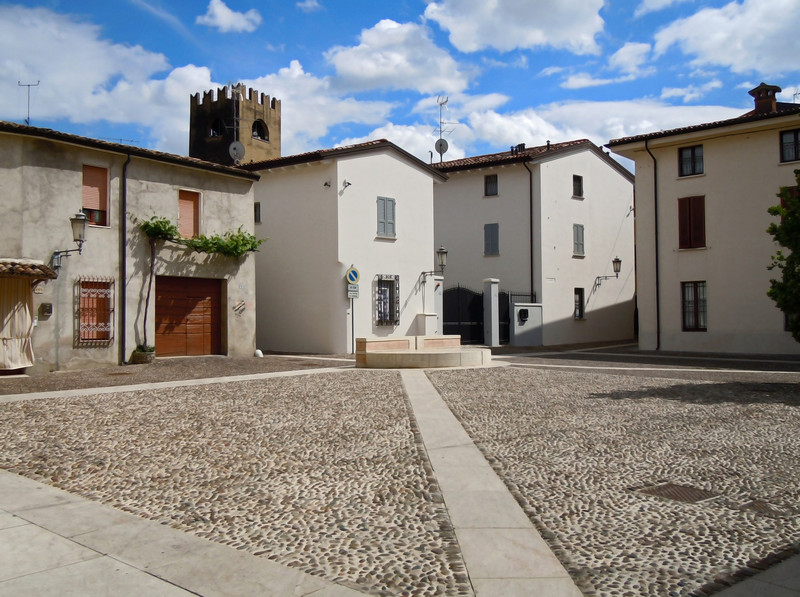
Castello di Ceresara
The Castello di Ceresara is a notable example of a medieval hill castle located in the municipality of Ceresara, in the Lombardy region of Italy. Constructed originally in the 13th century, it served as a fortified stronghold overseeing the strategic area near Mantua. The castle's history and architecture reflect the military and social dynamics of the late medieval period in northern Italy.
Historical background and ownership
The castle was initially built by medieval European builders during the high medieval period, primarily to secure the surrounding territory and control important routes. Its earliest known owners were the Bonacolsi family, who ruled Mantua until their overthrow in 1328. That year marked a significant political shift when Luigi Gonzaga expelled the Bonacolsi and took control of Mantua and its environs, including Ceresara.
In the late 14th century, the Ceresara family, who traced their lineage to a 12th-century German ancestor named Lanfranco, undertook substantial rebuilding efforts that shaped the castle's later form. This period saw the castle evolve from a simple fortified residence to a more complex defensive structure suited to the turbulent political climate.
During the 15th century, the castle's strategic importance increased under the Gonzaga family, who installed a vicario, or governor, to administer the castle and its surrounding village. Notable residents included Gianlucido Gonzaga, son of the first Marquis of Mantua, Gianfrancesco Gonzaga, who lived there until his untimely death at age 27. Later, the castle housed the scholar and poet Ascanio de’ Mori da Ceno from 1578 to 1582, during the reign of Duke Guglielmo Gonzaga.
Defensive features and architectural layout
The Castello di Ceresara was designed as a fortified rural stronghold typical of the Mantuan area in the late medieval period. It occupies a roughly square plan measuring approximately 130 meters on each side, combining stone and brick walls with earthworks and wooden defensive structures to create multiple layers of protection.
At the core of the castle's remains stands the Civic Tower or "Torre Civica", which served as the main gateway to the fortified village. This tower was equipped with a drawbridge, emphasizing its role as a key defensive and control point. The tower is located in what is now the Piazza Castello and underwent a restoration in 1981 to preserve its historical integrity.
The castle was surrounded by a water-filled moat, backed by an earthen embankment known as a "terrappieno". On this raised earthwork stood a wooden palisade called a "palancato", which provided a parapet for defenders. Along the walls were wooden watchtowers, variously called "battifredi", "butefredi", or "belfredi", offering elevated observation points. Additionally, "bertesche", or covered lookout posts, projected from the upper walls, allowing defenders to monitor the surroundings while protected.
Beyond the primary moat was a secondary moat called the "redefosso", followed by an outer boundary known as the "circha". This outer ring acted as the first line of defense and marked the limits of the inhabited area. The "circha" consisted of ditches, fences, hedges, enclosures, and clusters of huts, which later became identified as the Seriola canal. Between the "circha" and "redefosso" lay village houses, while smaller peripheral settlements called "circheta" were more vulnerable to fires and attacks.
The castle's entrance was further protected by a barbican, a fortified masonry gateway. This barbican remains one of the few masonry elements still preserved from the castle's defensive works, highlighting the emphasis on controlled access and layered defense.
The fortified village and rural community
Historical records from between the 10th and 14th centuries describe a defensive complex extending beyond the castle walls. This included a livestock enclosure known as a "ridotto" or "ricetto", located northeast of the castle gate. This enclosure housed over a thousand animals, indicating a concentrated rural community that sought protection within the fortified area during times of insecurity.
The village itself was fortified with multiple defensive layers, reflecting the warfare conditions of the period and the need to safeguard both inhabitants and their livestock. The presence of wooden watchtowers and covered lookout posts allowed for early warning and defense against raids.
Restoration and current condition
Today, the Castello di Ceresara survives as a partially preserved historic site. The Civic Tower remains a prominent feature, and the barbican stands as a testament to the castle's medieval defensive architecture. The complex system of moats, earthworks, wooden palisades, and watchtowers illustrates the adaptive military strategies of the time, designed to counter close combat and projectile weapons.
The 1981 restoration of the Torre Civica helped preserve this key architectural element, maintaining its presence in the local landscape and allowing visitors to appreciate the castle's historical significance. The surrounding area retains traces of the original fortifications and village layout, offering insight into the rural defensive networks typical of the Mantuan region during the late medieval period.
Architectural significance
The castle's combination of stone, brick, earthworks, and wooden structures exemplifies the multi-layered defensive design common in rural fortifications of northern Italy. Its concentric rings of defense—from the inner walls and moat to the outer "circha" boundary—demonstrate a sophisticated approach to medieval military architecture adapted to local needs and terrain.
Features such as the drawbridge-equipped Civic Tower, wooden palisades, and covered lookout posts reflect both practical defensive measures and the social organization of the fortified community. The castle's layout also highlights the integration of residential, administrative, and military functions within a single complex.
Frequently asked questions (FAQ)
- What is the best time to visit Castello di Ceresara?
- The best time to visit Castello di Ceresara is during the spring and early autumn months when the weather is mild and the surrounding landscape is particularly scenic. These seasons offer comfortable conditions for exploring the castle remains and the nearby village.
- Is Castello di Ceresara accessible to visitors year-round?
- Castello di Ceresara is generally accessible to visitors year-round, but it is advisable to check locally for any seasonal closures or special events that might affect access. The castle's outdoor remains can be explored at any time, though guided tours may be limited.
- How can I reach Castello di Ceresara from Mantua?
- Castello di Ceresara is located approximately 20 kilometers from Mantua and can be reached by car or local bus services. The journey takes about 30 minutes by car, making it a convenient day trip for visitors staying in Mantua.
- What are the notable architectural features of Castello di Ceresara?
- Notable architectural features include the <strong>Civic Tower</strong> with its historic drawbridge, the multi-layered defensive walls combining stone, brick, and wooden palisades, and the barbican gateway. The castle's concentric moats and watchtowers also highlight its medieval military design.
- Can I explore the fortified village area around Castello di Ceresara?
- Visitors can explore the area surrounding the castle, including the layout of the fortified village with its historic defensive boundaries such as the 'circha' and 'redefosso'. While some original structures are no longer standing, the site offers insight into the medieval rural community's defensive strategies.
Information
Loading map...
Visitor reviews
No reviews yet. Been here? Write the first review and help other travelers!
Write the first reviewVisited this castle? Share your experience
Your review helps other travelers and adds first-hand knowledge to our encyclopedia.