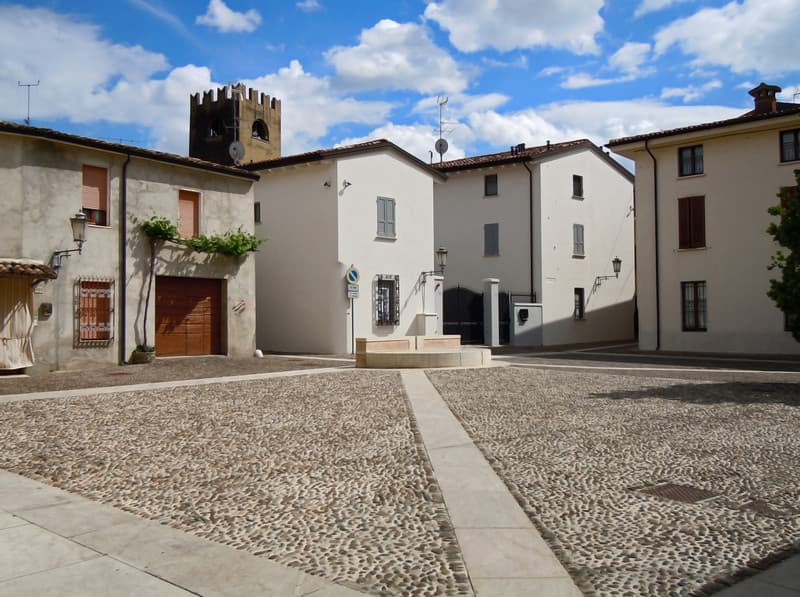
Castelvecchio (Castel Goffredo)
Castelvecchio, also known as Castellum vetus, is the historic fortified village at the heart of Castel Goffredo, located in the province of Mantua within the Lombardy region of northern Italy. This medieval defensive complex is characterized by its surrounding walls and a moat, which once served to protect the settlement and its inhabitants from external threats. The castle's boundaries today correspond roughly to the area encompassing the garden of Palazzo Gonzaga-Acerbi to the north, vicolo Remoto and vicolo Cannone to the east, Piazza Mazzini to the south, and piazzetta Castelvecchio along with vicolo Castelvecchio to the west.
Historical significance and origins
The origins of Castelvecchio trace back to the medieval period when fortified villages were essential for defense and control over local territories. As the name Castellum vetus suggests, meaning "old castle" in Latin, this site represents the earliest nucleus of the fortified settlement that would evolve into modern Castel Goffredo. The castle and its walls were integral to the community's protection during the turbulent Middle Ages, a time marked by frequent conflicts among local lords and external invaders.
Castel Goffredo itself became an important fiefdom under the control of the Gonzaga family, a powerful noble dynasty that ruled Mantua and its surrounding areas. The presence of the Palazzo Gonzaga-Acerbi adjacent to the castle grounds reflects the Gonzaga influence and their role in shaping the architectural and political landscape of the region.
Architectural features and layout
The fortified village of Castelvecchio is a classic example of a hill castle structure, strategically positioned to oversee and defend the surrounding territory. The defensive system includes robust stone walls that encircle the settlement, designed to withstand siege warfare and deter attackers. The walls are complemented by a moat, which added an extra layer of protection by creating a physical barrier against enemies.
Within the walls, the layout follows a compact and organized plan typical of medieval fortified villages, with narrow streets and closely built houses that maximize the use of space while maintaining defensibility. The proximity to the Palazzo Gonzaga-Acerbi suggests that the castle area was not only a military stronghold but also a center of administrative and residential activity.
Walls and moat
The walls of Castelvecchio are constructed from local stone and exhibit the masonry techniques of the medieval period. They feature battlements and walkways that would have allowed defenders to patrol and repel attackers effectively. The moat surrounding the walls was likely filled with water diverted from nearby sources, creating a formidable obstacle to siege engines and infantry assaults.
Entrances and gates
The castle's defensive perimeter included controlled entry points, likely fortified gates that regulated access to the village. These gates would have been equipped with portcullises and guard towers, typical of medieval fortifications, to monitor and defend against unauthorized entry.
Castelvecchio in the context of Lombardy's medieval fortifications
Castelvecchio is part of a broader network of medieval fortifications in the Lombardy region, which includes numerous castles, fortified villages, and walled towns. These structures were essential in maintaining territorial control and asserting the power of noble families like the Gonzagas. The castle's preservation within the urban fabric of Castel Goffredo highlights its historical importance and the continuity of settlement in this area.
Unlike many castles that have been extensively rebuilt or transformed, Castelvecchio retains much of its original medieval character, offering valuable insights into the defensive strategies and community organization of the period.
Current condition and cultural heritage
Today, Castelvecchio exists as a well-preserved example of a hill castle with significant portions of its walls and moat still visible. The castle's location within the modern town of Castel Goffredo means it is integrated into the contemporary urban environment, with its boundaries marked by streets and squares that reference the medieval layout.
The site is recognized for its cultural and historical value, attracting visitors interested in medieval architecture and the history of Lombardy. Efforts to maintain and protect the castle ensure that this heritage site remains an important part of the region's identity.
Visiting Castelvecchio
Visitors to Castelvecchio can explore the external walls and moat, gaining an appreciation for medieval defensive architecture. The proximity to the Palazzo Gonzaga-Acerbi offers additional opportunities to experience Renaissance architecture and the legacy of the Gonzaga family. The castle area forms a key part of the historical center of Castel Goffredo, with nearby streets and squares reflecting the medieval origins of the settlement.
While the castle itself is primarily an archaeological and architectural site rather than a fully restored fortress, it provides a tangible connection to the past and a setting for cultural events and local traditions.
Frequently asked questions (FAQ)
- What is the historical significance of Castelvecchio in Castel Goffredo?
- Castelvecchio is the ancient fortified village that formed the original nucleus of Castel Goffredo, playing a key role in local defense during the medieval period and reflecting the influence of the Gonzaga family.
- Can visitors explore the walls and moat of Castelvecchio?
- Yes, visitors can view and walk around the well-preserved walls and moat of Castelvecchio, which offer insight into medieval defensive architecture.
- How does Castelvecchio relate to the Palazzo Gonzaga-Acerbi?
- Castelvecchio's boundaries include the garden of Palazzo Gonzaga-Acerbi, highlighting the close historical and architectural connection between the medieval fortress and the Renaissance palace.
- Is Castelvecchio part of a larger network of castles in Lombardy?
- Yes, Castelvecchio is one of many medieval fortifications in Lombardy, illustrating the region's strategic importance and the power of noble families like the Gonzagas.
- What architectural features characterize Castelvecchio?
- The castle features robust stone walls with battlements, a surrounding moat, fortified gates, and a compact medieval village layout within its defenses.
Photo gallery

Information
Loading map...
Visitor reviews
No reviews yet. Been here? Write the first review and help other travelers!
Write the first reviewVisited this castle? Share your experience
Your review helps other travelers and adds first-hand knowledge to our encyclopedia.



