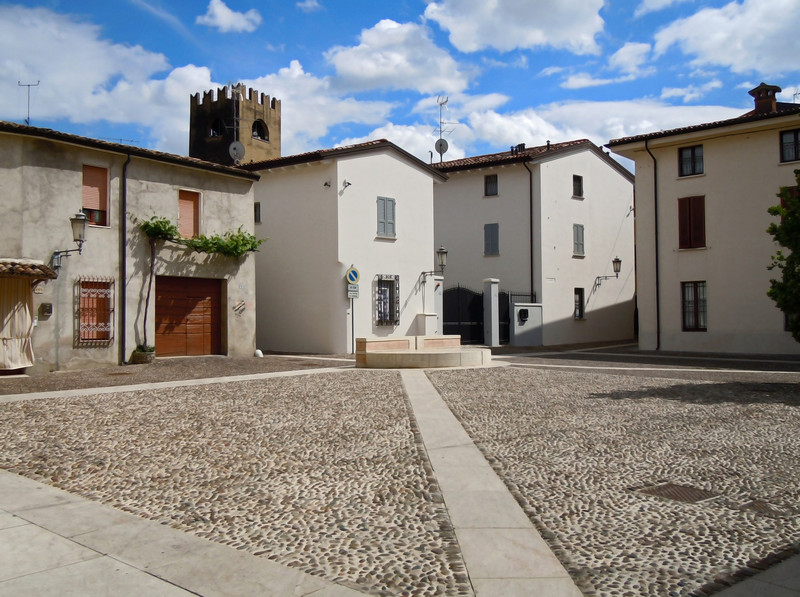
Castello di Casalmoro
The Castello di Casalmoro stands as a significant example of medieval military architecture in northern Italy, with a history that spans several centuries of political change and noble ownership. Located near the small town of Casalmoro, this hill castle was originally constructed in the early 14th century as a defensive fortress during a turbulent period marked by regional power struggles among Italian ruling families.
Its initial construction is attributed to the influence of Francesco I Gonzaga, a prominent figure of the Gonzaga family, who played a crucial role in the region's history. The castle was strategically positioned to oversee and control the surrounding territory, reflecting typical medieval fortification principles with thick masonry walls and a protective moat. The moat was ingeniously supplied with water from the nearby Fossa Regia canal, enhancing the castle's defensive capabilities against potential sieges.
Throughout its history, the Castello di Casalmoro experienced multiple changes in ownership, which mirror the broader political dynamics of northern Italy during the Middle Ages and Renaissance. In 1380, the castle was sold to the powerful Visconti family for 30,000 ducats, only to return to Gonzaga control less than a decade later. The castle's affiliation shifted again in 1405 when it was sold to the Malatesta family, another influential dynasty of the time.
The castle's role in regional politics and military history
By 1419, the castle came under the dominion of Duke Filippo Maria Visconti following its conquest by the famed condottiero Francesco Bussone, known as il Carmagnola. This event marked a significant political realignment, as the local population swore allegiance to the Milanese rulers. The castle's strategic importance was further underscored when Gianfrancesco Gonzaga, the first Marquis of Mantua, commissioned the construction of a new castle adjacent to the original fortress. This addition served a dual purpose: to protect the local inhabitants and to function as a residential hunting lodge, reflecting the evolving role of castles from purely military strongholds to noble residences.
In 1429, the castle was incorporated into the administrative district of the Quadra bresciana of Asola under the governance of the Venetian Republic, led by Doge Francesco Foscari. A peace treaty in 1438 between the Visconti and the Gonzaga, who were allied with Venice, confirmed the castle's status within the Marquisate of Mantua. During this period, the castle also served as a military base for the Venetian captain Gattamelata and his troops, highlighting its continued military significance.
The castle officially returned to Gonzaga control on August 10, 1482, and by the mid-16th century, it was owned by Alfonso Gonzaga, the second Marquis of Castel Goffredo. The site's history extends even further back, with records from the 11th century indicating that the land belonged to Benedictine monks from Serle, illustrating the long-standing importance of this location.
Architectural evolution and features
The current structures of the Castello di Casalmoro do not represent the original medieval fortress in its entirety but rather showcase a complex layering of architectural styles and functions accumulated over centuries. The main building, known as Corte Castello, occupies the southwestern portion of the original fortress area, which is still visible on historic maps dating back to the 17th century.
The fortress's central core, dating from the early 1300s, exhibits typical medieval defensive architecture with thick stone walls designed to withstand attacks. The moat surrounding the castle, once fed by the Fossa Regia canal, was a crucial element of its defense system, though it has undergone alterations over time due to changes in use and landscape.
Over the centuries, the castle was adapted for agricultural purposes, with annexes and outbuildings added after the medieval period. These modifications reflect the castle's transition from a military fortress to a multifunctional estate serving the needs of its noble owners and local community.
Artistic and decorative elements
The façade of the main building, dating from the late 15th century, still bears traces of frescoes that once adorned its surface, indicating the castle's role as a noble residence. Although no definitive documentation exists regarding the architect, stylistic analysis suggests the involvement of Luca Fancelli, a Florentine architect associated with the Gonzaga court, particularly under Ludovico III Gonzaga.
Inside the castle, restoration efforts completed in 2018 uncovered a remarkable series of 42 painted ornamental tablets embedded in the ceiling of the first floor. These tablets, dating to the early 16th century, display heraldic symbols linked to Niccolò Orsini, a prominent captain general of the Venetian Republic. The Orsini family, notable landowners in nearby Asola and Ghedi, likely used the castle as a residence for Niccolò's household, including his wife Guglielmina and their children.
Current condition and cultural significance
Today, the Castello di Casalmoro stands as a well-preserved testament to the region's layered history, combining medieval military architecture with Renaissance artistic influences and later agricultural adaptations. The castle's restoration has revealed its multifaceted past, highlighting its importance as both a defensive stronghold and a noble residence.
The castle remains a valuable cultural landmark, illustrating the complex interplay of power, art, and architecture in northern Italy from the Middle Ages through the Renaissance. Its connection to influential families such as the Gonzaga, Visconti, Malatesta, and Orsini enriches its historical narrative, making it an important site for understanding the region's heritage.
Visitors to the castle can explore its architectural features, including the thick defensive walls, remnants of the moat, frescoed façades, and the unique heraldic ceiling tablets. The site offers a tangible link to the past, reflecting the evolution of castle design and function over several centuries.
Frequently asked questions (FAQ)
- How do I get to Castello di Casalmoro?
- Castello di Casalmoro is located in the picturesque region of Italy, easily accessible by car or public transport. The nearest major city is Mantua, from where you can take a local bus or taxi to reach the castle. Make sure to check local transportation schedules for the best routes available.
- What is the historical significance of Castello di Casalmoro?
- Castello di Casalmoro dates back to the Middle Ages and served as a strategic fortification in the region. Its architecture reflects the military style of its time, showcasing the historical importance of the area in defensive battles. Today, it stands as a testament to Italy's rich historical heritage.
- When was Castello di Casalmoro built?
- The construction of Castello di Casalmoro began in the late 12th century and was completed in the 13th century. Over the years, it has undergone various renovations to preserve its structure and historical features. This makes it a fascinating place to explore for history enthusiasts.
- Can I visit Castello di Casalmoro year-round?
- Yes, Castello di Casalmoro is open to visitors throughout the year, although hours may vary seasonally. It is advisable to check the official website for current opening hours and any special holiday schedules. Visiting off-peak seasons can provide a quieter experience.
- Why is the architecture of Castello di Casalmoro unique?
- The architecture of Castello di Casalmoro is characterized by its robust stone walls and strategic design, which were typical of medieval fortresses. The castle's layout includes towers and battlements that offer stunning views of the surrounding countryside. This unique architectural style highlights the castle's defensive purpose and historical significance.
- Is it possible to take guided tours of Castello di Casalmoro?
- Yes, guided tours of Castello di Casalmoro are available and highly recommended for an in-depth understanding of its history and architecture. Knowledgeable guides can provide fascinating insights into the castle's past and its role in local history. Check in advance for tour availability and to reserve a spot.
- What are the ticket prices for visiting Castello di Casalmoro?
- Ticket prices for Castello di Casalmoro are generally affordable, with discounts available for students and seniors. Family passes may also be offered, making it a great option for visitors of all ages. Always verify current pricing on the official website before your visit.
- What is the best time to visit Castello di Casalmoro?
- The best time to visit Castello di Casalmoro is during the spring and fall when the weather is mild and the surrounding landscape is at its most beautiful. These seasons also tend to have fewer crowds, allowing for a more enjoyable experience. Summer can be hot, while winter may present challenges due to weather conditions.
- Are there any nearby attractions to visit while at Castello di Casalmoro?
- Yes, there are several nearby attractions, including the charming town of Mantua, known for its stunning palaces and art galleries. The surrounding countryside also offers beautiful hiking trails and picturesque villages. Make a day of it by exploring both the castle and the local area!
Information
Loading map...
Visitor reviews
No reviews yet. Been here? Write the first review and help other travelers!
Write the first reviewVisited this castle? Share your experience
Your review helps other travelers and adds first-hand knowledge to our encyclopedia.