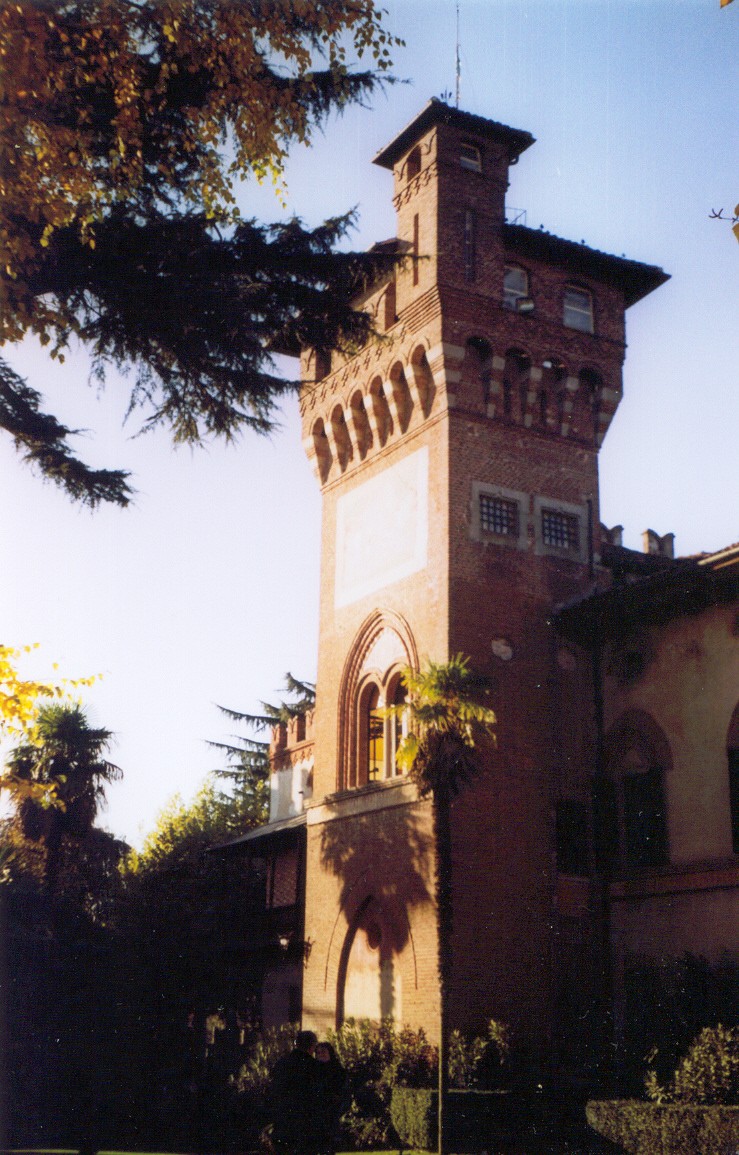
Castello di Foglizzo
Castello di Foglizzo stands as a remarkable example of architectural evolution, reflecting centuries of history in the Piedmont region of Italy. Originally constructed during the late Roman era, this hill castle was strategically positioned to oversee the village of Foglizzo and the surrounding plains, serving as a vital military stronghold. Its elevated location offered natural defense advantages, which were further enhanced through successive fortifications and expansions.
Throughout the early medieval period, the castle gained prominence as a defensive fortress. In 1140, the German Emperor Conrad III granted the castle and its lands to Guido III Biandrate, a key commander within the imperial militias stationed in Novara. This transfer marked the beginning of the Biandrate family's long association with the castle. By 1234, Pietro I Biandrate, Guido’s grandson, had established a distinct branch of the family at Foglizzo, expanding their control to nearby territories such as Balangero and Mathi under the sanction of the Marquess of Montferrat.
Medieval fortifications and community defense
During the 13th century, the Biandrate family undertook significant rebuilding efforts, focusing on strengthening the castle’s fortifications. They constructed a robust defensive perimeter wall that enclosed the core structures. Alongside this wall, a unique feature known as a "ricetto" was developed—a fortified shelter composed of houses built against the defensive walls to protect villagers during times of conflict. This communal defense system was an important aspect of medieval life in Foglizzo and remained intact until its removal in the 18th century.
14th and 15th-century architectural developments
The 14th century saw further enhancements with the addition of a northwest wing reinforced by brick corbels. These projecting supports not only added architectural strength but also improved the castle’s defensive capabilities. In the 15th century, a three-story northeast building was constructed, featuring a loggia—an open-sided gallery that provided light and ventilation. This loggia was later enclosed in the 19th century, adapting the space for changing residential needs while maintaining its original structural form.
Renaissance transformation and noble residence
The 16th century marked a pivotal shift in the castle’s function and style. Under the guidance of Guido Biandrate "the Senior" and his nephew, the fortress was remodeled into a Renaissance residence. This transformation reflected broader cultural trends favoring comfort and aesthetic refinement over purely military purposes. Interior spaces were redesigned to accommodate noble living, including the creation of a large hall used for social gatherings. This hall, now serving as the municipal council chamber, is richly decorated with frescoes, coats of arms, and emblematic motifs, alongside coffered and vaulted ceilings adorned with painted embellishments.
17th and 18th-century expansions
In the 17th and 18th centuries, the castle underwent further expansion with the addition of a southern wing that incorporated two older medieval towers. This addition blended defensive elements into a more palatial design, reflecting the castle’s transition from a military fortress to a noble countryside home. By this time, the Biandrate family had largely relocated to Turin, and the castle’s role shifted accordingly.
Modern use and preservation
Eventually, the Biandrate family sold the estate to a merchant family from Turin. In 1855, the municipality of Foglizzo acquired the castle, repurposing it as an administrative center. It housed schools until 1970 and today contains municipal offices, the local library, and health facilities. This ongoing civic use has helped preserve the castle’s architectural integrity and maintain its status as a community focal point.
The castle’s courtyard and interior spaces remain well-preserved, showcasing the layered history of the site. The balance of brick and stone construction alongside Renaissance detailing captures the evolution of the castle from a medieval fortress into a noble residence and, ultimately, a civic building. Photographic documentation and preservation efforts highlight the castle’s significance as a cultural and historical landmark in the Piedmont region.
Architectural highlights
- Northwest wing: 14th-century structure with distinctive brick corbels enhancing defense.
- Northeast building: 15th-century three-story structure originally featuring a loggia, later enclosed.
- Renaissance hall: Large interior space adorned with frescoes, coats of arms, and painted ceilings.
- Southern wing: 17th-century addition incorporating medieval towers into a palatial residence.
- Ricetto: Former fortified village shelter integrated into the defensive walls, removed in the 18th century.
Historical significance and legacy
Castello di Foglizzo exemplifies the architectural and historical progression typical of many Italian castles, evolving from a strategic military fortress into a Renaissance noble residence and later a civic building. Its association with the Biandrate family and its role in regional defense and governance underscore its importance in the medieval and early modern periods.
The castle’s adaptation over centuries reflects broader social and political changes, including shifts in military technology, noble lifestyles, and municipal administration. Today, it stands as a testament to the rich cultural heritage of the Piedmont region and continues to serve the community in new capacities.
Frequently asked questions (FAQ)
- How do I visit Castello di Foglizzo?
- Castello di Foglizzo is open to visitors Monday to Friday from 9:00 to 17:00. Admission is free, and visitors can explore the castle's exterior and some interior spaces used for municipal offices and the local library.
- What is the historical significance of Castello di Foglizzo?
- Castello di Foglizzo played a crucial role in regional defense during the medieval period and later became a Renaissance noble residence. It reflects the architectural evolution from a fortress to a civic building.
- Can I see medieval and Renaissance architectural features at the castle?
- Yes, the castle displays architectural elements from the 14th-century medieval fortifications to the 16th-century Renaissance renovations, including brick corbels, a loggia, frescoes, and vaulted ceilings.
- Is the castle accessible for visitors with mobility issues?
- While the castle is partially adapted for public use, some areas may have limited accessibility due to historic structures. Visitors with mobility concerns are advised to contact the municipality for detailed information.
- Are there guided tours available at Castello di Foglizzo?
- Guided tours are occasionally offered by the municipality or local cultural organizations. It is recommended to check in advance for availability and scheduling.
Information
Opening hours
Monday to Friday, 9:00-17:00
Ticket prices
Free
Current owner
Municipality of Foglizzo
Loading map...
Visitor reviews
No reviews yet. Been here? Write the first review and help other travelers!
Write the first reviewVisited this castle? Share your experience
Your review helps other travelers and adds first-hand knowledge to our encyclopedia.