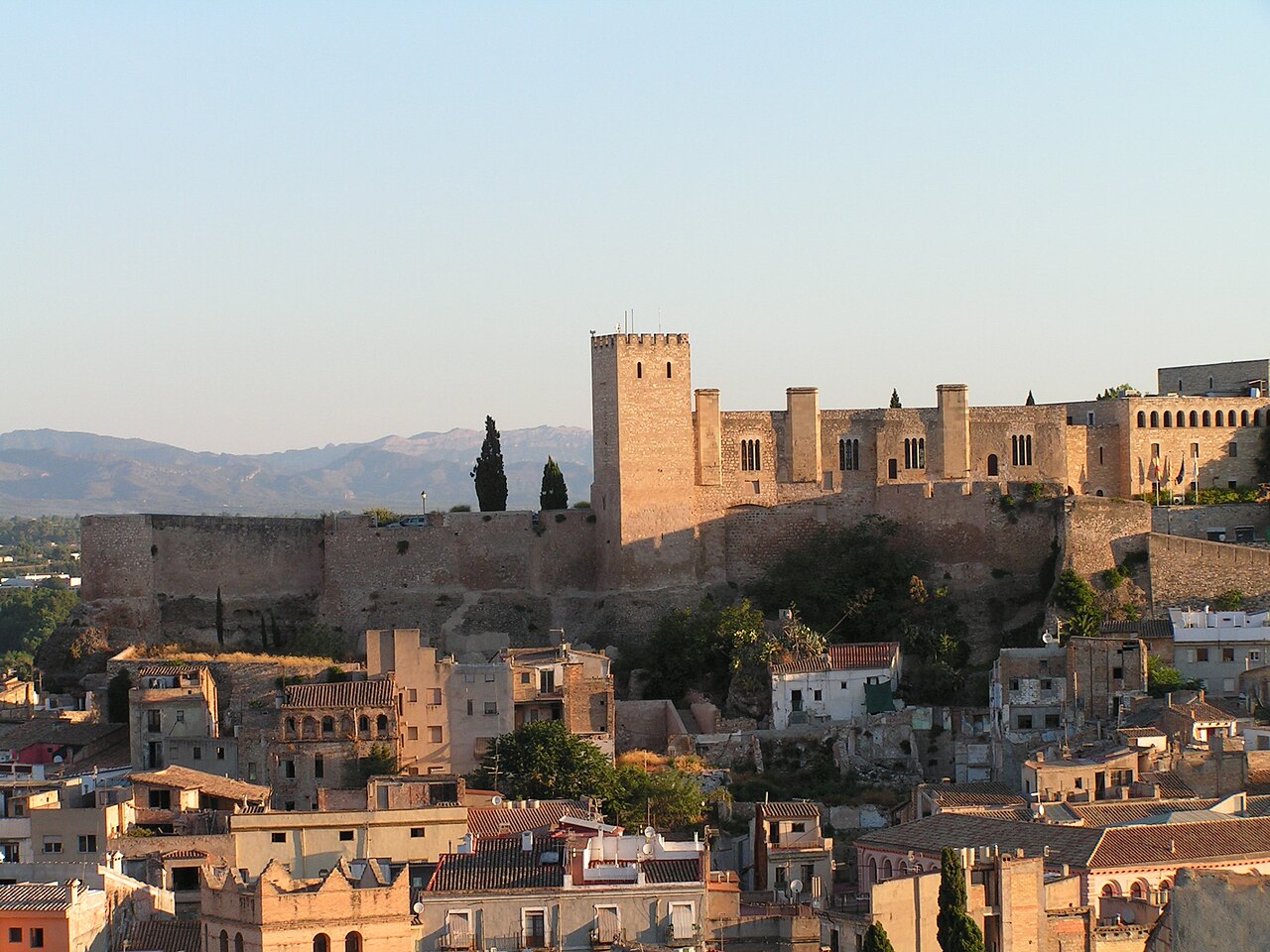
Castell d’Ulldecona
The Castell d’Ulldecona stands as a remarkable example of a fortified complex with a rich history spanning several millennia. Located near the village of Ulldecona in Spain, this hill castle occupies a strategic position on Puig del Castell, a small hill within the Serra Grossa mountain range by the Sénia River. This river historically marked the boundary between the regions of Catalonia and the Valencian Community, making the site a critical point for territorial control from ancient times through the medieval period.
The origins of the castle trace back to an Iberian settlement established between the 4th and 1st centuries BCE. The fertile land and commanding views from the hill made it an ideal location for early inhabitants. Archaeological evidence reveals that the site was initially a fortified village, with defensive walls and domestic structures typical of Iberian culture. This early occupation laid the groundwork for the site's enduring military and strategic significance.
Following a period of abandonment, the site was reoccupied in the 9th century CE during the era of Arab presence on the Iberian Peninsula. The Arabs constructed a fortress atop the remains of the earlier Iberian settlement, reinforcing its defensive capabilities. This fortress featured characteristic elements of Islamic military architecture, including robust perimeter walls and a circular tower designed for surveillance and defense.
Christian reconquest and the Hospitaller era
In the mid-12th century, the castle came under Christian control following the reconquest of southern Catalonia. In 1148, it was granted to the influential Montcada family of Tortosa, a noble lineage with significant regional power. Shortly thereafter, ownership transferred to the Order of the Hospital of Saint John of Jerusalem, commonly known as the Hospitallers. This transfer was formalized by royal decree from King Alfonso I in 1178, solidifying the castle's role as a military and religious stronghold.
By the late 13th century, the Castell d’Ulldecona had become the principal commandery of the Hospitallers in the territory surrounding the Ebro River. This development followed an exchange of holdings involving King Peter the Great and Ramon de Ribelles, the castellan of Amposta, highlighting the castle's increasing administrative and strategic importance. The Hospitallers fortified the castle further and established a religious complex within its walls, including a chapel dedicated to Santa Maria dels Àngels.
Settlement growth and population charters
The surrounding population experienced formal growth during the 13th century. In 1222, a population charter issued by Guillem Ramon de Montcada authorized new construction within the castle walls, encouraging settlement expansion. Later, in 1273, Fra Ramon Berenguer, master of the Hospitaller commandery of Amposta, granted another charter permitting residents to relocate from the hilltop down to the valley below. This relocation laid the foundation for the modern town of Ulldecona, which grew around the castle's protective presence.
Architectural features and defensive structures
The Castell d’Ulldecona complex today comprises three main surviving structures enclosed by a substantial defensive perimeter wall. This wall, constructed from large stone blocks, varies in thickness from one to one-and-a-half meters and reaches up to three meters in height on the northern side, where preservation is best. Portions of the wall remain on the eastern and southern sides, while the western section has largely disappeared due to erosion and time.
Notable towers
The site features two prominent towers: a circular tower and a square tower, each illustrating different phases and architectural influences.
The circular tower, built with medium-sized, smoothly cut ashlar masonry, has a slightly tapered form and includes a ground floor, first floor, and an upper terrace used historically for surveillance. The original entrance was on the first floor, accessible by a moveable ladder, a defensive measure to hinder attackers. Inside, both floors are covered with false vaults, arched ceilings that provide structural strength. The terrace features battlements, though these are now heavily damaged. The tower walls are about one meter thick and pierced with small loopholes for archers.
The square tower stands on a sloped platform and consists of a ground level plus two upper floors, topped by a terrace. Its entrance today is at slope level, but originally the main door was on the second floor, enhancing security. The lower floors are divided by a massive central wall into two rooms vaulted with barrel vaults. The upper floor, likely the lordly chamber, is supported by a pointed arch and contains windows, including a decorative coronella window with lobed arches facing east. Unlike the circular tower, the square tower's terrace lacks battlements. The walls here are considerably thick, up to three meters, made with smaller ashlar stones and bricks, with larger stones reinforcing corners.
Religious architecture
On the eastern side of the enclosure lies the former church dedicated to Santa Maria dels Àngels. This church integrates the defensive perimeter wall as its eastern wall and is oriented roughly northward. It has a rectangular plan with a straight barrel-vaulted ceiling segmented by transverse arches supported on pilasters. The semicircular apse at the eastern end is covered by a quarter-sphere vault.
The church's main entrance features a semicircular arch composed of wedge-shaped voussoirs and is crowned by a dripstone to divert rainwater. Above the entrance is a rose window, and the facade once bore a carved stone decoration now removed. Along the side wall, a lateral chapel nestles between exterior buttresses that reinforce the structure. The building uses irregular ashlar blocks with more regular stonework at corners and buttresses. Inside, the floor is lost, and only faint mural painting traces remain on the north wall. This church replaced an earlier chapel that stood inside the main tower and was in use around 1400.
Later history and preservation
By the mid-16th century, the castle had fallen into disuse and was largely in ruins, no longer permanently occupied. Despite this decline, it retained symbolic and some military significance, as evidenced by repair works documented in 1555. The religious complex continued to function, with the church serving as a parish center until 1440 and as a Hospitaller priory into the 18th century.
Following the Mendizábal reforms of 1836, which led to government confiscations of church properties, the castle passed into private hands. It remained privately owned until 1986, when the local council of Ulldecona acquired the site and began restoration efforts to preserve and rehabilitate the historic structures.
Today, Castell d’Ulldecona is recognized as a cultural heritage site of national interest in Catalonia and holds the status of Bien de Interés Cultural in Spain. Its layered history, combining Iberian, Arab, and Christian military architecture, alongside religious and administrative functions, makes it a significant monument for understanding the region's complex past.
Archaeological excavations continue to reveal insights into the site's long occupation, while the surviving towers, defensive walls, and church offer visitors a tangible connection to centuries of history. The castle's location on a hill overlooking the surrounding landscape underscores its enduring strategic and symbolic importance.
Visiting Castell d’Ulldecona
The castle is accessible via a local road that winds around the hill for approximately three kilometers southwest of the modern village of Ulldecona. Visitors can explore the remains of the perimeter walls, the distinctive circular and square towers, and the former church of Santa Maria dels Àngels. The site provides panoramic views of the surrounding countryside and the Sénia River valley, enriching the experience of this historic fortress.
Information on opening hours, guided tours, and visitor facilities is managed locally, reflecting the castle's status as a protected heritage site. The combination of natural beauty, architectural interest, and deep historical roots makes Castell d’Ulldecona a compelling destination for those interested in medieval fortifications and Iberian history.
Frequently asked questions (FAQ)
- How do I get to Castell d’Ulldecona?
- Castell d’Ulldecona is located about three kilometers southwest of Ulldecona village and is accessible via a local road winding around the hill. Visitors can reach the site by car or on foot from the village.
- What is the historical significance of Castell d’Ulldecona?
- The castle has a layered history from an Iberian settlement through Arab occupation to Christian and Hospitaller control, reflecting its strategic importance in Catalonia and the Ebro River region.
- Can I explore the towers and church at Castell d’Ulldecona?
- Yes, visitors can explore the remains of the circular and square towers, as well as the former church of Santa Maria dels Àngels, which showcases medieval religious architecture integrated with defensive structures.
- When was the castle built?
- The site was originally an Iberian settlement between the 4th and 1st centuries BCE, with a fortress constructed in the 9th century CE during the Arab period, and significant medieval modifications in the 12th and 13th centuries.
- Is Castell d’Ulldecona open to the public?
- The castle is a cultural heritage site managed by the local municipality. While it is accessible to visitors, specific opening hours and guided tours may vary, so checking with local tourist information is recommended.
Information
Sources & official resources
Verify the information above using these authoritative references.
Loading map...
Visitor reviews
No reviews yet. Been here? Write the first review and help other travelers!
Write the first reviewVisited this castle? Share your experience
Your review helps other travelers and adds first-hand knowledge to our encyclopedia.