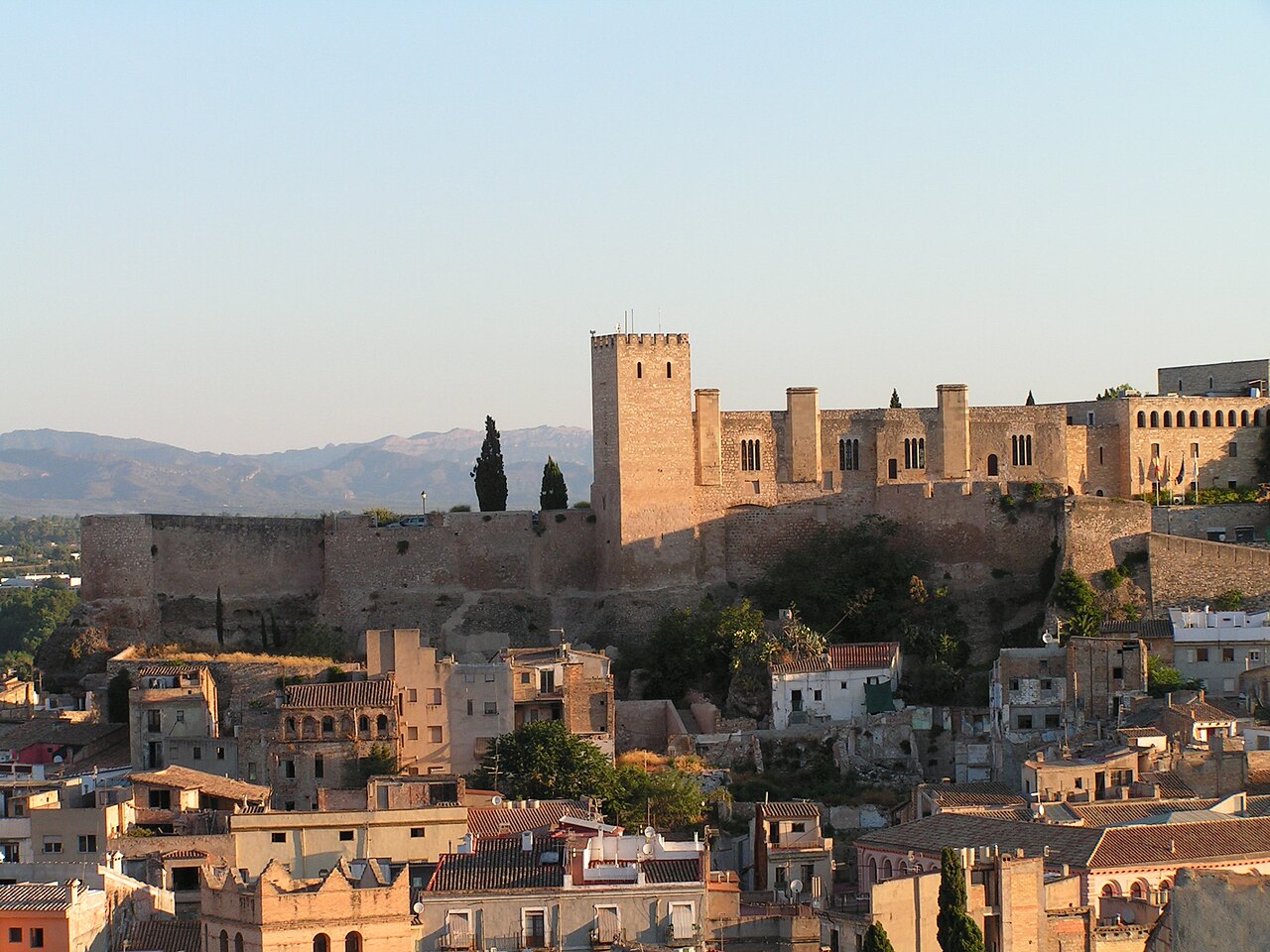
Castell d’Amposta
Castell d’Amposta stands as a significant medieval hill castle located in the town of Amposta, Spain. Its origins trace back to the Iberian period, where archaeological evidence reveals early defensive walls and storage pits, marking the site as a place of strategic importance long before the medieval era. Positioned atop a high river-facing terrace at the convergence of the Ebro River delta and a Quaternary geological terrace, the castle's location provided natural defensive advantages that were enhanced by complex fortifications over centuries.
Early history and strategic importance
The site initially served defensive and refuge purposes during the Andalusian period in the 10th century, functioning as a lookout and sanctuary for scattered local populations. The castle first enters written history in 1097, linked to Count Ramon Berenguer III, who granted the territory of Amposta to Count Artal of Pallars to establish a castle. Though it is unclear whether Ramon Berenguer III ever occupied the site, the castle’s significance grew following the conquest of the region by Ramon Berenguer IV.
In 1150, the castle and surrounding lands were granted to the Order of the Hospital of Saint John of Jerusalem, founding the commandery of Amposta and establishing the priorate known as Castellania d’Amposta. This marked the beginning of the castle's transformation into a Crusader fortress, with the Knights Hospitaller replacing earlier structures with a new stone castle that reflected their military architectural traditions.
Medieval construction and royal patronage
The construction of the stone castle was supported by royal grants, including funds and timber rights, emphasizing the castle’s strategic role in controlling river and sea access. By 1280, under King Peter the Great, the castle came under direct royal control, although the priorate retained its traditional name. The crown undertook renovations to strengthen the castle’s defenses, adding new towers and reinforcing walls, particularly those facing the river.
Throughout the 14th century, the castle was a contested stronghold, with its defense overseen by alcaids appointed by royal or local Tortosa authorities. In 1384, control passed to the Order of Saint George of Alfama, further reflecting the castle's military and administrative importance during this period.
Conflicts and decline
During the Catalan civil war, the castle was held by forces opposing King John II, enduring a prolonged siege from October 1465 to June 1466 before surrendering. After the war, the castle was granted to the Navarrese noble Pere de Peralta, who transferred some rights to the Archbishop of Zaragoza. From 1470, the city of Tortosa sought to lease the castle to control critical trade routes along the Ebro River.
The castle suffered further damage from pirate raids in the 16th century and gradually fell into ruin. Stones from the deteriorating structure were repurposed for local buildings, as documented by permits issued to the abbot of Benifassà for material removal.
Architectural features and surviving remains
Castell d’Amposta is notable for its adaptation to the river terrace landscape rather than the typical elevated upper and lower enclosure design seen in other military order castles along the Ebro River. The castle's defenses relied heavily on a complex system of dry moats arranged in an “L” shape, connecting to the river and creating multiple defensive enclosures.
Among the surviving features is a section of the original river-facing wall with a Gothic blind ogival arch over six meters high, constructed with precisely cut wedge-shaped stones called voussoirs. This arch likely provided structural support for the fortifications.
Adjacent to the entrance and near an earlier Andalusian wall fragment are six semi-underground rooms dating from the 14th or 15th century. Built with well-cut sandstone blocks and topped with stone slab floors, these rooms likely served as storage spaces linked to the castle’s provisioning and tithe collection functions.
A third moat isolates the eastern section known as Celòquia, the noble sector of the castle. Though largely ruined, this area has been the subject of modern reconstructions to better understand its layout.
The Hospital Tower, once guarding the main gate and located in the intermediate enclosure between the moats, survives only as foundations today. The first moat roughly follows the course of a local canal and Fossat street, while the second moat, carved into solid conglomerate rock and dating to the 10th century, measures about six meters deep and eleven meters wide.
Alongside the moat’s sloping side runs a narrow surviving chemin de ronde approximately 1.4 meters wide, used by defenders to patrol the perimeter.
At the junction of the two moats stands the Saint John Tower, a rectangular structure built between the late 14th and early 15th centuries. Measuring roughly 11.75 by 9.20 meters with walls 2.4 meters thick, this tower is constructed of ashlar stone blocks bonded with mortar. It currently stands about five meters high and forms the base for the nearby Cercós rice mill chimney.
Cultural significance and preservation
Unlike many castles of military orders in the region, Castell d’Amposta does not follow the typical concentric layout but instead capitalizes on its natural river terrace setting and intricate moat defenses. The limited remains from the Andalusian period suggest that later medieval builders largely replaced earlier structures rather than incorporating them.
Today, the castle remains in a state of ruins, with significant archaeological interest focused on understanding its historical phases and architectural evolution. The site offers valuable insights into the military, religious, and political history of the Ebro River region from the Iberian era through the medieval period.
Frequently asked questions (FAQ)
- What is the historical significance of Castell d’Amposta?
- Castell d’Amposta is a significant medieval fortress that dates back to the 12th century, playing a crucial role in the defense of the region during the Reconquista. Its strategic location allowed it to oversee the Ebro River, making it vital for trade and military movements in the area.
- When was Castell d’Amposta built?
- The construction of Castell d’Amposta began in the early 12th century, around 1130, under the control of the Knights Templar. Over the years, it underwent various modifications and expansions, reflecting the architectural styles of different periods.
- What are the opening hours for Castell d’Amposta?
- Castell d’Amposta is open to visitors from 10 AM to 6 PM, Tuesday through Sunday. It is closed on Mondays and certain public holidays, so it's advisable to check the official website for any updates before planning your visit.
- Can I buy tickets in advance for Castell d’Amposta?
- Yes, tickets for Castell d’Amposta can be purchased in advance through the official website or at the entrance. Buying tickets online is recommended during peak tourist seasons to avoid long queues.
- Is it possible to access Castell d’Amposta with a wheelchair?
- Access to Castell d’Amposta is limited for visitors with mobility impairments due to its historical structure and terrain. However, efforts have been made to improve accessibility in certain areas; it’s best to contact the castle administration for detailed information.
- When is the best time to visit Castell d’Amposta?
- The best time to visit Castell d’Amposta is during the spring and autumn months when the weather is mild, making it comfortable for exploring the grounds. Summer can be quite hot, while winter may bring colder temperatures.
- What nearby attractions can I visit while at Castell d’Amposta?
- While visiting Castell d’Amposta, you can explore the beautiful Ebro Delta Natural Park, known for its stunning landscapes and rich biodiversity. Additionally, the town of Amposta offers charming streets, local cuisine, and cultural sites to enhance your trip.
- How do I get to Castell d’Amposta from nearby cities?
- Castell d’Amposta is easily accessible by car and public transport. It is located approximately 30 kilometers from Tortosa and can be reached by taking the N-340 road or via local bus services connecting the region.
- What architectural styles can be seen at Castell d’Amposta?
- Castell d’Amposta showcases a blend of Romanesque and Gothic architectural styles, reflecting the various periods of its construction and renovations. The fortress features thick stone walls, original towers, and stunning views of the surrounding landscape, making it a remarkable example of medieval military architecture.
Information
Website
Visit websiteSources & official resources
Verify the information above using these authoritative references.
Loading map...
Visitor reviews
No reviews yet. Been here? Write the first review and help other travelers!
Write the first reviewVisited this castle? Share your experience
Your review helps other travelers and adds first-hand knowledge to our encyclopedia.