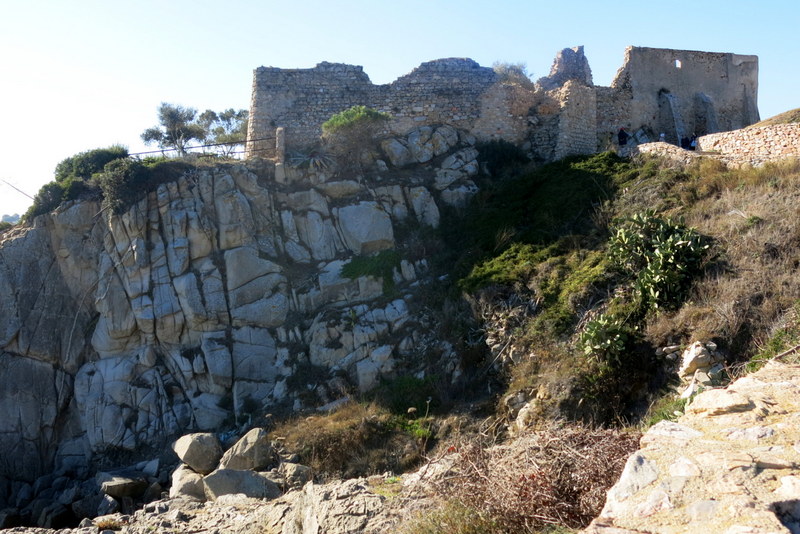
The Castell de Vila-romà stands as a significant medieval hill castle located near the municipality of Palamós in Catalonia, Spain. Its strategic position on a terrace on the southern side of Montagut provided a commanding view of the surrounding landscape, essential for defense and control during the Middle Ages. The castle's history intertwines with the region's medieval power struggles and territorial administration, reflecting broader political dynamics of Catalonia and the Crown of Aragon.
Early origins and historical context
The name Vila-romà first appears in written records in the 12th century, specifically as "Villa Romani" in 1161 and "Villa Romanum" in 1190. These references suggest the presence of a small settlement possibly linked to an earlier Roman villa or even a Visigothic habitation, as Roman-era remains have been found nearby. This points to a continuity of occupation in the area from antiquity through the medieval period.
The earliest documentation of the fortress itself dates from 1276, when Bishop Pere de Castellnou of Girona purchased the castle from the heirs of Pere Alemany for 45,000 sous. Shortly after, in 1279, King Pere II of Aragon acquired the territory of Palamós, then subordinate to the parish of Vila-romà, for 6,000 sous barcelonins. This transaction highlights the castle's importance in regional governance and control of coastal access.
Historical accounts credit Bernat Amat de Cardona, cousin of Count Ponç Hug of Empúries, with completing the castle's construction. By 1310, the Bishop of Girona held dominical rights over Vila-romà, although high jurisdiction remained with the Crown of Aragon, which also controlled the nearby port of Palamós. In 1371, King Pere III "the Ceremonious" incorporated the castle firmly into the Crown's domain. Later, ownership passed to the Duke of Sessa, who also controlled the nearby castle of Calonge.
Architectural features and structural remains
The castle occupies a natural terrace, with its ruins primarily composed of uncut granite and slate stones bonded with lime mortar. The masonry includes sections of opus spicatum or herringbone pattern, a technique notable in medieval construction. The remaining structures reveal a fortress built for both defense and habitation, with walls approximately 1.2 meters thick.
A prominent surviving element is a rectangular wall about 11 meters tall and 5.5 meters long, which likely formed the eastern face of the main tower or keep. Near its summit, an entrance was positioned about three meters above ground level, accessible perhaps by ladder or wooden stairs, typical of medieval defensive design. The arch of this doorway retains four voussoirs, wedge-shaped stones that are part of the arch's inner curve.
Attached to the base of this tower wall is a vaulted chamber covered by a barrel-shaped arch and coated with reddish stucco, interpreted as a cistern for water storage. This feature underscores the castle's self-sufficiency in times of siege.
The curtain walls remain well preserved on the northern and southwestern sides, including a transverse wall that runs horizontally across the site. This wall is believed to be a later addition from the late medieval period, reflecting the castle's phased construction and adaptation over time.
Along the northern curtain wall, multiple ancillary rooms form a continuous complex with the outer defenses, indicating a well-organized internal layout. On the southern side, remnants of floors with semicircular arches survive, offering insights into the castle's internal divisions and architectural style.
The main entrance likely stood on the southeast side, flanked by two rectangular towers approximately seven meters high. These towers show modifications typical of late medieval construction, especially in their upper sections. The northeast tower is particularly notable, with walls rising close to ten meters, topped by rectangular battlements and pierced by arrow slits for defense. The lower part of this tower retains the base of a vault, suggesting an internal covered chamber.
Historical significance and decline
The castle's role evolved over centuries, serving as a local stronghold and administrative center. Its ownership and control reflected the shifting power structures within Catalonia and the Crown of Aragon. The castle was integrated into royal domains in the 14th century and later came under noble possession.
Its operational history ended during the early 19th century when, in 1812, the castle was deliberately destroyed during the French occupation amid the Peninsular War. The walls gradually deteriorated after this event, leaving the site in ruins.
Modern conservation efforts have focused on preserving the remaining structures. Preventive work was carried out in 2007, followed by cleaning and maintenance in 2015 by local heritage organizations. These actions aim to stabilize the ruins and facilitate public access while respecting the site's historical integrity.
Archaeological potential and challenges
Dating the castle precisely is difficult without extensive archaeological excavation. The foundation and many wall segments appear to date from around the year 1000, suggesting an early medieval origin. Later additions, such as the transverse wall, certain vaults, and modifications around the southeastern entrance, reflect ongoing development during the late medieval period.
Further archaeological study could reveal more about the castle's construction phases, daily life, and its role in regional history. The presence of Roman and Visigothic remains nearby adds to the site's cultural significance and complexity.
Frequently asked questions (FAQ)
- What is the historical significance of Castell de Vila-romà?
- Castell de Vila-romà is a notable example of medieval architecture in Spain, dating back to the 10th century. It played a crucial role in the defense against invasions and served as a residence for local nobility, reflecting the rich history of the region.
- When was Castell de Vila-romà built?
- The construction of Castell de Vila-romà began in the late 10th century and continued over several centuries. Its design evolved through various architectural styles, making it a fascinating study of historical building techniques.
- Can I visit Castell de Vila-romà?
- Yes, Castell de Vila-romà is open to visitors, allowing you to explore its impressive towers and fortifications. Guided tours are available to provide insights into its history and architecture.
- What are the opening hours for Castell de Vila-romà?
- Castell de Vila-romà is typically open to the public from 9 AM to 6 PM, but hours may vary seasonally. It's recommended to check the official website for the most accurate and up-to-date information.
- Is it possible to access Castell de Vila-romà with mobility issues?
- While Castell de Vila-romà has some pathways that may be challenging for those with mobility issues, efforts have been made to improve accessibility. It is advisable to contact the site in advance to inquire about specific accommodations.
- What is the best time to visit Castell de Vila-romà?
- The best time to visit Castell de Vila-romà is during the spring and fall when the weather is mild and pleasant. These seasons also provide stunning views of the surrounding landscape and a more enjoyable experience without the summer crowds.
- Are there any nearby attractions to visit?
- Yes, nearby attractions include the charming village of Vila-romà and several hiking trails that offer scenic views of the countryside. Additionally, there are local museums and cultural sites that showcase the rich heritage of the area.
- What are the ticket prices for Castell de Vila-romà?
- Ticket prices for Castell de Vila-romà are generally affordable, with discounts available for students and seniors. Family passes may also be offered, so check the official website for current pricing details.
Information
Loading map...
Visitor reviews
No reviews yet. Been here? Write the first review and help other travelers!
Write the first reviewVisited this castle? Share your experience
Your review helps other travelers and adds first-hand knowledge to our encyclopedia.