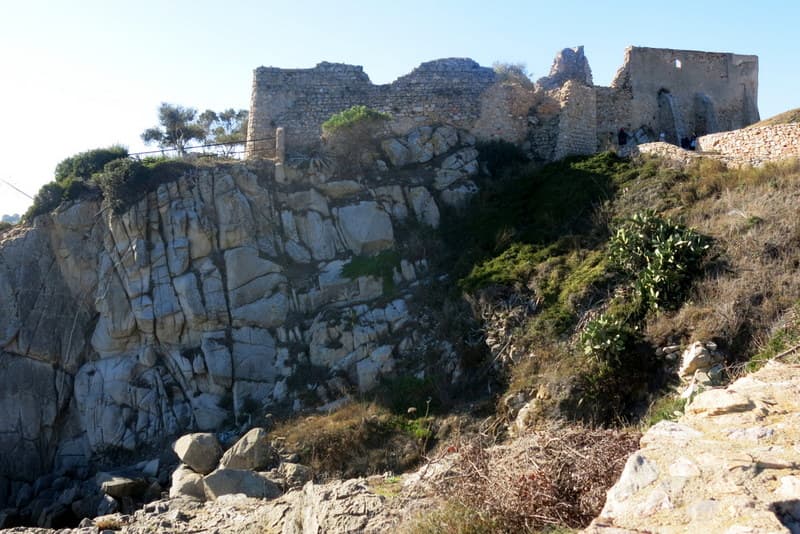
Castell de Sant Esteve de Mar
The Castell de Sant Esteve de Mar is a remarkable example of a medieval hill castle perched on a cliff overlooking the Mediterranean coast in Palamós, Spain. This site embodies a rich historical continuum, beginning as an Iberian settlement, evolving into a Roman villa, and ultimately transforming into a fortified castle during the 12th century. Its strategic location on the rugged coastline allowed it to serve both as a defensive stronghold and a symbol of local power throughout the medieval period.
Historical significance and ownership
The earliest documentary reference to the castle dates back to 1063, when two castles were mentioned in the area, including one named "Sanctus Stephanus de Peculiare," linked to the monastery of Sant Pere de Galligants. This early mention highlights the site's importance even before the current castle's construction. The castle became a focal point of feudal authority and changed hands several times over the centuries.
In 1277, the castle and its surrounding lands were sold by Dalmau de Palol to King Peter II of Barcelona (also known as Peter III of Aragon) for 7,500 sols barcelonins. This purchase was part of a strategic plan to establish the royal port of Palamós, marking a significant shift from purely military to economic and maritime importance.
Subsequent owners included notable feudal lords such as Simon de Geronella, Jaume de Cornellà, and the Pallarès family. The last private owner before the 15th century was Berenguer de Cruïlles, who acquired the castle for 20,000 sols barcelonins. Later, in 1484, it passed to Galceran de Requesens, the first count of Palamós, further cementing its noble associations.
Role during conflicts and decline
The castle's military significance was severely tested during the 15th-century War of the Remences, a peasant revolt in Catalonia. The fortress was nearly destroyed in this conflict and subsequently abandoned as a military installation. Despite this, the site was adapted into a masia (farmhouse) during the 16th and 17th centuries, blending agricultural use with ongoing coastal defense responsibilities.
Throughout the early modern period, the castle's ruins served as a lookout and defensive post against North African pirates and corsairs, a persistent threat to the Catalan coast. The defense was a communal effort, with the local parishes of Palamós, Vila-romà, and Vall-llobrega sharing the costs of gunpowder, artillery, and repairs. Records from 1568 document maintenance expenses, and guards were still posted as late as 1650.
Even after pirate raids subsided, the castle's strategic position remained important for monitoring threats such as English naval ships, smugglers, and vessels potentially carrying plague. Defensive duties ceased by the late 18th century, leaving the site solely for agricultural use.
Architectural features and archaeological remains
The ruins reveal a fortified complex characterized by several rectangular towers and connecting walls. Access is via a path from La Fosca beach, allowing visitors to explore the castle's defensive layout. The eastern side features a low rectangular tower partly carved from the natural rock of the cliff, with visible evidence of a vaulted ceiling springing.
Behind this tower is a slanted defensive wall approximately five meters high, demonstrating the castle's robust fortifications. To the north lies another rectangular tower aligned with the wall's height, while to the south, a tower built from larger stones suggests a later phase of construction or reinforcement.
Adjacent to the farmhouse ruins built against the fortress remains, another rectangular tower is preserved. The original gateway has been altered and obscured by later agricultural buildings, reflecting the site's evolving use over time.
Archaeological excavations have uncovered pottery fragments and opus signinum floors beneath the castle, confirming the presence of a Roman villa predating the medieval fortress. These findings attest to the site's long-standing habitation and strategic importance.
Preservation and modern conservation efforts
After the farmhouse was abandoned in the mid-20th century, the castle suffered from natural weathering and neglect due to its exposed coastal location. In 2009, ownership transferred to the town of Palamós, initiating a new phase of conservation.
The Programa Romànic Obert, a collaboration between the Catalan government and La Caixa bank, focused on stabilizing and preserving the ruins. Between 2011 and 2015, extensive clearing, debris removal, and structural consolidation were undertaken to secure the remaining masonry and prevent further deterioration.
Today, the ruins are fenced off to protect the site, offering visitors a glimpse into a layered history that spans from Iberian settlement through Roman occupation to medieval fortification and later agricultural adaptation. The Castell de Sant Esteve de Mar stands as a testament to the region's complex historical narrative and architectural evolution.
Frequently asked questions (FAQ)
- What is the historical significance of Castell de Sant Esteve de Mar?
- Castell de Sant Esteve de Mar is a notable example of medieval architecture in Catalonia, representing the region's rich history and strategic importance during the Middle Ages. It served as a fortress and a lookout point for the local fishing community, offering insight into the defensive structures of the time.
- When was Castell de Sant Esteve de Mar built?
- The castle was constructed in the 11th century, making it one of the oldest structures in the area. Its long history reflects the evolution of architecture and military design over the centuries.
- What are the opening hours for Castell de Sant Esteve de Mar?
- The castle is open to visitors from 10 AM to 6 PM daily, with extended hours during the summer months. It is advisable to check the official website for any seasonal changes or special events that may affect visiting hours.
- Can I visit Castell de Sant Esteve de Mar with children?
- Yes, Castell de Sant Esteve de Mar is family-friendly and welcomes visitors of all ages. The site offers educational insights and exploration opportunities that children will find engaging, making it a great outing for families.
- Is it possible to access Castell de Sant Esteve de Mar by public transport?
- Yes, the castle is accessible via local buses that connect Palamós to nearby towns. However, it is recommended to check the local transportation schedules, as they may vary.
- What is the best time to visit Castell de Sant Esteve de Mar?
- The best time to visit is during the spring and fall when the weather is pleasant and the tourist crowds are smaller. This allows for a more enjoyable experience while exploring the castle and its surroundings.
- Are there any nearby attractions to Castell de Sant Esteve de Mar?
- Yes, visitors can explore the beautiful beaches of Palamós, the charming old town, and other historical sites in the vicinity. These attractions complement the experience at the castle and enhance your visit to the area.
- What are the ticket prices for visiting Castell de Sant Esteve de Mar?
- Tickets for adults are priced reasonably, with discounts available for students and seniors. Children under a certain age may enter for free, making it an affordable option for families.
- How do I get more information about events at Castell de Sant Esteve de Mar?
- You can find information about upcoming events and activities on the official website of the castle or by following their social media channels. These platforms often provide updates on special tours, exhibitions, and cultural events.
Photo gallery

Information
Website
Visit websiteSources & official resources
Verify the information above using these authoritative references.
Loading map...
Visitor reviews
No reviews yet. Been here? Write the first review and help other travelers!
Write the first reviewVisited this castle? Share your experience
Your review helps other travelers and adds first-hand knowledge to our encyclopedia.



