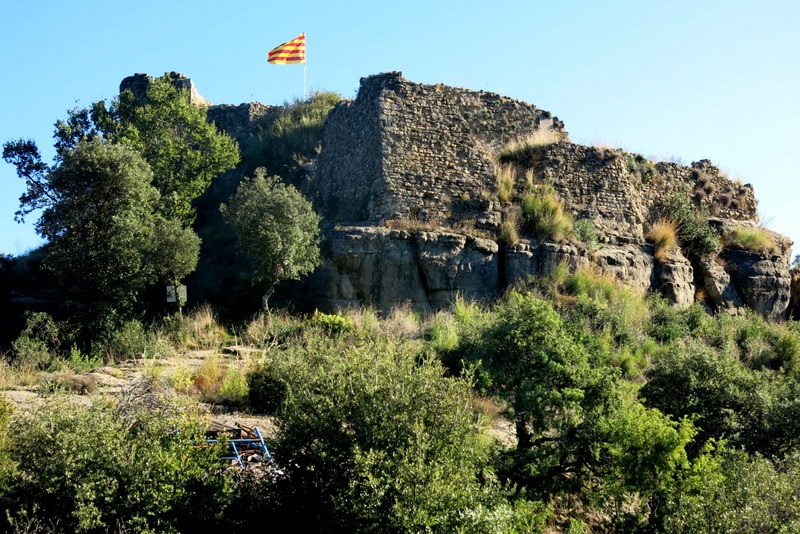
Castell de Falgons
Castell de Falgons stands as a significant medieval hill castle located in the municipality of Sant Miquel de Campmajor, in the Catalonia region of Spain. This fortress is deeply entwined with the history of the Cartellà family, a noble lineage whose origins are steeped in legend dating back to the time of Charlemagne in the 8th and early 9th centuries. Although early documentary evidence is scarce, the Cartellà family emerges in historical records from the 9th century onward, marking their enduring influence in the region.
The earliest known figure associated with the castle is Galceran I, mentioned in 823, highlighting the family's early prominence. By the late 10th century, Guillem de Cartellà participated in the pivotal reconquest of Barcelona in 985, underscoring the family's military role in the Christian reconquest of Iberian territories. Around 1010, Galceran de Cartellà continued this martial tradition through combat against the caliphate. By the early 12th century, the Cartellà family had firmly established control over Castell de Falgons, alongside other fortifications such as Hostoles and Rocacorba.
The castle's historical evolution and family legacy
During the early 13th century, the castle was under the lordship of Pere Galceran I de Cartellà (active 1208–1236). One of his descendants, Galceran V, founded the Cartellà-Falgons branch, cementing the family's association with the site. In 1251, the castle came under the jurisdiction of the nearby castle of Finestres, reflecting the feudal relationships of the time.
In the late 13th and early 14th centuries, Guillem Galceran II de Cartellà (1232–1322) gained renown as a leader of the almogàvers, the famed Catalan light infantry known for their military prowess. He notably allied with Roger de Llúria during the conquest of the Kingdom of Sicily. The chronicler Ramon Muntaner praised him as one of the finest knights of his era, highlighting the family's distinguished martial heritage.
Over time, the Cartellà family transformed the site from a large manor into a fortified castle that served as the center of their barony. Between the early 15th and late 16th centuries, family members were interred at the parish church of Sant Vicenç de Felegoso, which appears in 14th-century census documents as Sant Vicenç de Fulgonitus. In 1463, Pere de Cartellà was recorded as a vassal of the Bishop of Girona, obligated to pay tithes, illustrating the castle's ecclesiastical ties. By 1523, Pere Galceran de Cartellà supported the Catholic Monarch Ferdinand in the campaign that culminated in the conquest of Granada. The Cartellà family's lordship over Castell de Falgons persisted into the 18th century, marking centuries of influence.
Architectural features and castle layout
The castle's plan is roughly square, reflecting its complex history of adaptation and fortification. Originally a large residential manor, it evolved into a fortified stronghold through multiple phases of renovation aimed at strengthening defenses and accommodating the needs of its occupants.
High perimeter walls constructed of finely worked ashlar stone blocks encircle the castle, demonstrating skilled medieval masonry. Each corner is reinforced with defensive towers, though their states vary: the southwest tower is partially ruined, with only a wall section surviving, while the southeast and northwest towers remain mostly intact but have lost their original height.
Within the walls lies a spacious central courtyard, the heart of the castle's internal life. A staircase with semicircular arches provides access to upper rooms. Surrounding the courtyard were essential functional spaces including the chapel of St. Anton, stables, and service quarters, underscoring the castle's role as both a military and domestic center. The chapel highlights the religious dimension of the castle's history.
The main entrance is situated on the principal façade, featuring a semicircular arch framed by wedge-shaped voussoirs. Above the doorway, the Cartellà family coat of arms prominently asserts ownership. Windows and other openings are rectangular with simple, sturdy designs, featuring single stone lintels and supporting stones beneath the sills.
Defensive considerations are evident throughout the castle's design. Loopholes, narrow vertical slits for archers, are preserved along the ground-floor walls, allowing defenders to observe and repel attackers while remaining protected. The courtyard's architectural layout follows typical medieval patterns, though many doors and windows date to later 15th and 16th-century modifications.
Archaeological insights and construction phases
Archaeological studies, notably by Lluís G. Constans i Serrats, have dated significant portions of the castle's towers and wall foundations to the 13th century. These elements attest to the medieval origins of the fortress and its early defensive purpose. The blend of original stonework and later renovations offers a layered architectural narrative revealing the castle's evolving function and the heritage of the Cartellà family.
Castell de Falgons in the context of Catalan heritage
Recognized today as a cultural heritage site of national importance in Catalonia, Castell de Falgons embodies the historical and architectural legacy of the region. Its connection to the Cartellà family, who played significant roles in military campaigns and regional governance, enriches its historical value.
The castle's survival, though partial in some areas, provides valuable insights into medieval fortification strategies and noble residence design in Catalonia. Its combination of residential, military, and religious functions exemplifies the multifaceted role of hill castles in medieval society.
Visitors to the site can appreciate the castle's strategic location, robust defensive features, and the tangible links to Catalonia's medieval past. Castell de Falgons remains a testament to the enduring legacy of the Cartellà family and the historical narrative of the region.
Frequently asked questions (FAQ)
- What is the historical significance of Castell de Falgons?
- Castell de Falgons, dating back to the medieval period, played a crucial role in the defense of the region during various conflicts. Its architecture reflects the transition from Romanesque to Gothic styles, showcasing the evolution of defensive structures in Spain.
- When was Castell de Falgons built?
- The construction of Castell de Falgons began in the 10th century, and it has undergone various renovations and restorations throughout the centuries. Its enduring presence offers a glimpse into the historical timeline of medieval fortifications in Catalonia.
- How do I get to Castell de Falgons?
- Castell de Falgons is located in Sant Miquel de Campmajor, easily accessible by car from nearby cities. Public transport options may be limited, so checking local bus schedules or considering a guided tour could enhance your visit.
- What are the opening hours for Castell de Falgons?
- Castell de Falgons is generally open to visitors from 10 AM to 6 PM, but it is advisable to check their official website or contact them directly for the most current hours. Some days may have extended or reduced hours based on seasonal events or holidays.
- Is it possible to tour Castell de Falgons on my own?
- Yes, visitors can explore Castell de Falgons on their own, but guided tours are also available for those seeking a more in-depth understanding of its history and architecture. Self-guided tours allow for personal exploration at your own pace.
- Can I take photographs inside Castell de Falgons?
- Photography is generally allowed in most areas of Castell de Falgons, but it's best to confirm any specific restrictions upon your arrival. Capturing the stunning architecture and scenic views is a popular activity among visitors.
- What is the best time to visit Castell de Falgons?
- The best time to visit Castell de Falgons is during the spring and fall when the weather is mild and pleasant, making for a comfortable exploration experience. Additionally, these seasons often feature fewer crowds compared to the summer months.
- Are there any nearby attractions to Castell de Falgons?
- Yes, visitors can enjoy nearby attractions such as the picturesque village of Sant Miquel de Campmajor and the stunning landscapes of the surrounding countryside. Exploring these areas can provide a fuller experience of the region's rich history and natural beauty.
- What are the ticket prices for Castell de Falgons?
- Ticket prices for Castell de Falgons are generally reasonable, but it is recommended to check their official website for the latest pricing and any discounts available for students or groups. Special events may also have different pricing structures.
Information
Website
Visit websiteSources & official resources
Verify the information above using these authoritative references.
Loading map...
Visitor reviews
No reviews yet. Been here? Write the first review and help other travelers!
Write the first reviewVisited this castle? Share your experience
Your review helps other travelers and adds first-hand knowledge to our encyclopedia.