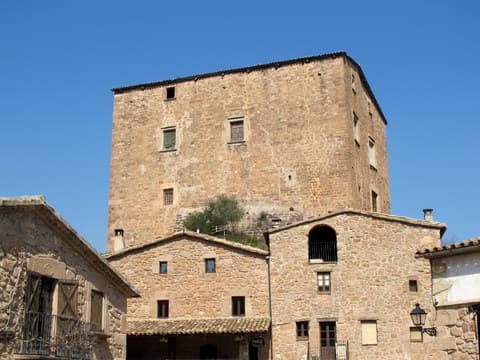
Castell de Rajadell
Castell de Rajadell stands as a remarkable example of a medieval hill castle located in the municipality of Rajadell, within the historic region of Catalonia, Spain. Its origins date back to the early medieval period, with construction phases possibly beginning as early as 961 A.D. or 1063 A.D., during the turbulent era of the Reconquista in the Kingdom of Aragon. Founded by the noble Rajadell family, the castle served dual roles as a fortified residence and a strategic military base, anchoring both the family's dominion and the local community.
Historical significance and lineage of the rajadell family
The Rajadell family were prominent feudal lords whose influence extended beyond the immediate vicinity of the castle. They actively participated in military campaigns across diverse regions including Provence, Navarra, Almería, Sardinia, and Mallorca. This wide geographical involvement underscores the family's military and political importance during the medieval period. The castle itself was not merely a military installation but also a center of local governance and social life, with the nearby church and the fortress together forming the nucleus of the village of Rajadell.
During the Catalan Civil War (1462–1472), the Rajadell family sided against King John II of Aragon, resulting in damage to both the castle and the adjacent church. The conflict's aftermath saw Joan Berenguer de Rajadell undertake restoration efforts, reaffirming the family's enduring presence and influence in the region. In the 14th and 15th centuries, the castle extended its protective role to a nearby monastery of canonesses dedicated to Santa Llúcia de Rajadell, highlighting the close ties between noble authority and ecclesiastical institutions.
By the early 16th century, ownership of the castle shifted when the Rajadell family sold it at a public auction to Francesc de Cruïlles. Subsequent proprietors included Bernat Aimeric and, in the 18th century, the Pignatelli family. The castle later passed into private hands by the late 19th century. Its strategic and symbolic importance continued into the 20th century when, during the Spanish Civil War, the castle was requisitioned by a revolutionary committee, leading to the loss of many valuable interior items.
Recognized for its cultural and historical value, Castell de Rajadell was officially declared a cultural heritage site of national interest in 1988, ensuring its protection and acknowledgment within Spain's rich architectural legacy.
Architectural features and layout
The castle is characterized by a nearly square plan, typical of a large Gothic fortified manor house. Its design balances defensive robustness with functional living spaces, featuring three main sections arranged to maximize protection while allowing for openings on all sides without compromising its fortress-like appearance. Positioned prominently atop a hill adjacent to the village church, the castle marks the historic heart of Rajadell.
The complex comprises rooms from multiple historical periods, reflecting its long occupation and numerous renovations. Key spaces include a small underground chamber and a dungeon, which was later adapted into a wine cellar. Other essential facilities within the castle include an armory, bedrooms, stables, a kitchen, and a dining hall. Additionally, the residence of the estate manager, known as the masover, was integrated into the castle's layout, illustrating the multifunctional nature of the complex.
Architectural styles and periods
The castle's fabric reveals a blend of architectural styles spanning several centuries. Early construction phases exhibit Romanesque features, indicative of the castle's origins in the 10th or 11th centuries. Subsequent additions and modifications introduced Gothic elements, likely dating from the 13th or 14th centuries, which enhanced both the defensive and residential qualities of the castle. Later renovations in the 17th century added further layers of architectural complexity, although precise dating of these changes is challenging due to the castle's extensive history of repairs and adaptations.
Defensive and residential functions
As a fortified manor house, Castell de Rajadell was designed to serve both as a military stronghold and a noble residence. Its defensive features include thick stone walls, battlements, and strategically placed openings for surveillance and defense. The castle's elevated position atop a hill provided commanding views of the surrounding landscape, enhancing its strategic value.
The residential quarters were arranged to accommodate the lord's family and retainers, with specialized rooms such as the kitchen and dining hall supporting daily life. The presence of stables and an armory reflects the castle's readiness for military engagements, while the dungeon and underground chambers highlight its role in security and storage.
Current condition and preservation challenges
Today, Castell de Rajadell stands in a state of notable deterioration, with many of its structures at risk of collapse. Despite this, the castle retains core elements that vividly illustrate its medieval character and historical functions. Preservation efforts face challenges due to the building's complex history and the extent of damage sustained over centuries, including conflicts and neglect.
Its designation as a cultural heritage site underscores the importance of safeguarding this architectural and historical treasure. The castle remains a significant point of interest for historians, architects, and visitors seeking to explore Catalonia's medieval past and the legacy of noble families like the Rajadells.
The castle's role in the local community and cultural heritage
Castell de Rajadell has long been central to the identity and history of the village of Rajadell. Alongside the adjacent church, it formed the foundation of the settlement, influencing its development and social structure. The castle's protection of the nearby monastery of canonesses further illustrates its integral role in the religious and cultural life of the region.
Today, the castle's ruins serve as a tangible link to the medieval era, attracting visitors interested in history, architecture, and heritage tourism. Its story reflects broader themes of feudal power, military conflict, religious influence, and architectural evolution in Catalonia and Spain at large.
Frequently asked questions (FAQ)
- How do I visit Castell de Rajadell?
- Castell de Rajadell is located in the municipality of Rajadell, Catalonia. Visitors can explore the castle ruins by traveling to the village and accessing the site on foot. It is advisable to check local tourism information for any guided tours or access restrictions.
- What is the historical significance of Castell de Rajadell?
- Castell de Rajadell was built by the noble Rajadell family during the early Reconquista period and played a key role in regional military campaigns and local governance. It also protected a nearby monastery and witnessed significant events such as the Catalan Civil War.
- Is Castell de Rajadell accessible for visitors with mobility issues?
- Due to its hillside location and the castle's current ruined condition, access can be challenging for visitors with mobility impairments. The terrain is uneven and may require assistance or specialized equipment for safe exploration.
- When was the castle built?
- The castle's origins trace back to either 961 or 1063 A.D., with early Romanesque architectural features indicating its medieval foundation during the early Reconquista.
- Can I see Romanesque and Gothic architecture at Castell de Rajadell?
- Yes, the castle showcases a blend of Romanesque and Gothic architectural elements, reflecting its construction and renovation phases from the 10th through the 14th centuries.
Photo gallery

Information
Sources & official resources
Verify the information above using these authoritative references.
Loading map...
Visitor reviews
No reviews yet. Been here? Write the first review and help other travelers!
Write the first reviewVisited this castle? Share your experience
Your review helps other travelers and adds first-hand knowledge to our encyclopedia.


