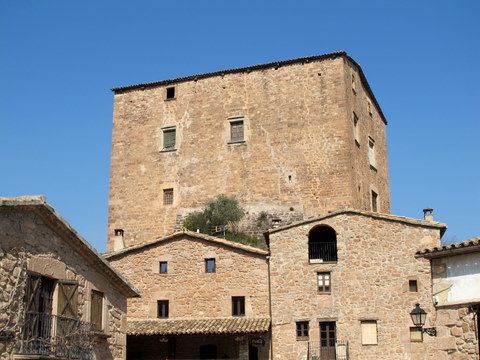
Castell de Fals
The Castell de Fals is a remarkable medieval hill castle located in the municipality of Fals, Catalonia, Spain. This fortress stands as an enduring symbol of the region's feudal history and architectural heritage, reflecting centuries of military, residential, and religious functions. Perched strategically on rocky terrain overlooking the Fonollosa stream, the castle controlled an important section of the royal road connecting Barcelona to Cardona, underscoring its strategic significance during the Middle Ages.
Historical origins of the Castell de Fals trace back to the late 10th century, between 995 and 996, when it was first documented under various names such as Falcas, Falchs, and Falcs. The castle was initially held by the Fals family, feudal vassals who served as castellans. Notably, Bonfill de Fals, mentioned in 1021, pledged allegiance to Bermon, the viscount of Cardona, establishing the castle's early alignment with the powerful Cardona lordship. Throughout the 12th and 13th centuries, the fortress remained under the stewardship of successive members of the Fals lineage, including Arnau Bernat de Falcs, Ponç de Falcs, Elissèn de Falcs, and Guillem de Falcs. This continuity highlights the castle's role as a family stronghold and a key defensive site within the feudal hierarchy.
Architectural development and features
Defensive towers
The castle complex prominently features two cylindrical defensive towers that illustrate its architectural evolution over several centuries. The older tower, dating from the early 11th century, rises approximately 19.5 meters with an exterior diameter of 9 meters. It is built directly on solid rock and showcases construction techniques typical of the period: the lower portion uses large, roughly shaped stones bonded with lime-rich mortar, while the upper sections incorporate smaller, finely cut stones, possibly from later repairs or enhancements. The original entrance was located about 8 meters above ground level on the northwest side, accessed via an opening framed by upright stone slabs and a flat stone lintel. Inside, the tower contains two false domes, curved structural elements supporting the floors above, and may have originally housed additional storeys.
The second tower, constructed between the late 13th and early 14th centuries, is slightly shorter, standing around 17 to 18 meters tall with a 9-meter diameter and thick walls approximately 2.47 meters wide. This tower exemplifies advanced masonry techniques of the period, featuring well-cut stones laid in horizontal courses, some bearing mason's marks that identify the craftsmen or workshops involved. Internally, it is divided into three levels and topped by a terrace. Surrounding this tower is a later defensive wall equipped with narrow loopholes designed for firearms, indicating adaptations made in response to the advent of gunpowder weaponry in medieval warfare.
Religious structures
Adjacent to the towers lies the former parish church of Sant Vicenç, an integral component of the castle complex. The church follows a traditional Latin cross floor plan, oriented east to west, with a rectangular nave terminating in a quadrangular presbytery and a sacristy located behind. Although the church has suffered significant deterioration of its vaults and roof, leading to its abandonment for regular religious services, it remains culturally significant. Since the early 2000s, restoration efforts led by the Local Architectural Heritage Service of the Diputació de Barcelona have sought to preserve the church's medieval fabric. The church also hosts the annual Bages living nativity scene, a tradition that has continued for over three decades, highlighting the site's ongoing cultural relevance.
Historical significance and feudal legacy
The Castell de Fals played a pivotal role within the feudal domain of the lords of Cardona. In 1314, the castle was incorporated into the viscountcy established by Ramon Folc VI of Cardona, marking its transition from a family-held fortress to a formal noble administration under the viscounts, later counts and dukes of Cardona. This affiliation lasted until the abolition of feudal jurisdictions in the region. The castle's strategic position allowed it to control movement along the royal road, contributing to regional security and administration.
Religious life was closely intertwined with the castle's history. The church of Sant Vicenç, mentioned as early as 1042, served as the local parish church, reinforcing the castle's role as a center of both secular and ecclesiastical power in the medieval period.
Current condition and preservation efforts
Today, the Castell de Fals stands as a well-preserved medieval hill castle complex, recognized as a site of national cultural heritage in Catalonia. The ensemble includes the two cylindrical towers, the church of Sant Vicenç, and an adjacent rectory building, all perched on rocky ground separated from the nearby village by a ravine. The castle's preservation reflects both its historical importance and the ongoing commitment to maintaining Catalonia's medieval architectural legacy.
Restoration initiatives have focused on stabilizing the church structure and conserving the masonry of the towers and defensive walls. These efforts ensure that the castle remains accessible for educational and cultural activities, allowing visitors to appreciate the architectural and historical richness of this medieval fortress.
Visiting Castell de Fals
Visitors to Castell de Fals can explore the evocative ruins of the towers and the church, gaining insight into medieval military architecture and feudal history. The site's location offers scenic views of the surrounding Catalan landscape, enhancing the visitor experience. While the church is no longer active for worship, its cultural events, such as the living nativity scene, provide unique opportunities to engage with local traditions.
The castle's proximity to the village of Fals makes it accessible for day trips, and its status as a cultural heritage site ensures ongoing preservation and interpretation efforts. Visitors interested in medieval history, architecture, and Catalan heritage will find Castell de Fals a compelling destination.
Frequently asked questions (FAQ)
- How do I get to Castell de Fals?
- Castell de Fals is easily accessible by car and is located just a short drive from the nearest major city, making it convenient for visitors. Public transportation options are also available, with bus services connecting to Fals. For the best experience, consider using GPS navigation to reach the castle directly.
- What is the historical significance of Castell de Fals?
- Castell de Fals dates back to the medieval period and played a crucial role in the region's defense against invasions. Its strategic location allowed it to serve as a fortress for local rulers, contributing to its historical importance. Today, it stands as a testament to the architectural and cultural heritage of Spain.
- When was Castell de Fals built?
- The construction of Castell de Fals began in the late 12th century and continued into the 13th century. Over the years, it has undergone various renovations, but many of its original features remain intact. This long history adds to its charm and allure for visitors interested in medieval architecture.
- Can I take guided tours of Castell de Fals?
- Yes, guided tours are available for visitors who wish to explore the history and architecture of Castell de Fals in depth. These tours are typically led by knowledgeable guides who can share fascinating insights and stories about the castle. Be sure to check the availability of tours in advance to secure your spot.
- Why is Castell de Fals a popular tourist destination?
- Castell de Fals attracts visitors for its stunning architecture, rich history, and picturesque surroundings. The castle offers breathtaking views of the surrounding landscape, making it a perfect spot for photography and sightseeing. Additionally, its proximity to other attractions in the area enhances its appeal as a must-visit location.
- Is it possible to visit Castell de Fals with children?
- Absolutely! Castell de Fals is a family-friendly destination, with many areas suitable for children to explore. The castle's fascinating history and engaging architecture can spark children's imagination, making it an educational outing for families. Just be sure to supervise younger children on the castle grounds.
- What are the opening hours for Castell de Fals?
- Castell de Fals is typically open to visitors from 10 AM to 6 PM, but hours may vary depending on the season or special events. It is advisable to check the official website or contact the castle directly for the most up-to-date information on opening hours. Planning your visit accordingly will ensure you have ample time to explore.
- What are the ticket prices for Castell de Fals?
- Ticket prices for Castell de Fals are generally affordable, with discounts often available for students, seniors, and children. Admission fees help maintain the castle and fund preservation efforts. Always check the official site for current pricing and any special promotions that may be offered during your visit.
- What are some nearby attractions to Castell de Fals?
- In addition to Castell de Fals, visitors can explore other historical sites and natural parks in the area. The charming village of Fals offers local shops and restaurants that enhance the experience. Don't miss the opportunity to enjoy the beautiful landscape and nearby hiking trails, making it an ideal day trip destination.
Information
Website
Visit websiteSources & official resources
Verify the information above using these authoritative references.
Loading map...
Visitor reviews
No reviews yet. Been here? Write the first review and help other travelers!
Write the first reviewVisited this castle? Share your experience
Your review helps other travelers and adds first-hand knowledge to our encyclopedia.