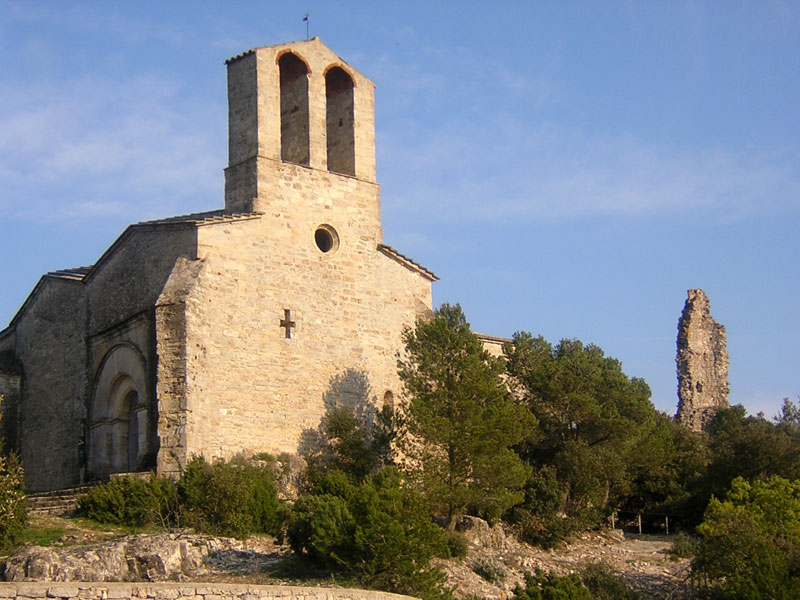
Castell de Mediona
Castell de Mediona stands as a remarkable example of a medieval hill castle located in the municipality of Sant Joan de Mediona, within the historic region of Catalonia, Spain. Its origins trace back to the early Middle Ages, making it a significant fortress that witnessed the turbulent history and power struggles of medieval Catalonia. The castle’s strategic hilltop position provided natural defense advantages and allowed control over surrounding lands, which was crucial during the era of feudal conflicts and territorial expansions.
Early history and medieval significance
The earliest documented mention of the settlement named "Mediona" dates to the year 954, while the castle itself first appears in records by 1011. This early documentation is tied to a donation involving lands and a mill near the Bitlles river, indicating the castle’s role in managing local resources and asserting territorial control. The castle was intimately connected with the noble Mediona family, notably with figures such as Guifred (Guillem) de Mediona, who was the son of Sisemund de Oló and grandson of the Girona viscount Guiniguís Mascaró. Guifred was entrusted in 1015 by Bishop Borrell of Vic to repopulate and defend frontier areas of the diocese, highlighting the castle’s military and administrative importance. His death in 1032 during combat against Saracen forces underscores the ongoing conflicts that shaped the region.
By the mid-11th century, governance of the castle was held by Ramon de Mediona, with his brother Bernat serving as castellan. Their involvement in regional power struggles is illustrated by Ramon’s alliance with Mir Geribert against Count Ramon Berenguer I of Barcelona, reflecting the complex feudal dynamics of the period.
Ownership transitions and political alliances
During the 12th century, ownership of Castell de Mediona shifted to the noble Cabrera family, though the Mediona family remained influential as castellans. A notable political event occurred in 1194 when Ponç de Cabrera pledged the castle to King Alfonso II, signaling a realignment of feudal loyalties. Later, in 1226, Viscount Guerau IV of Cabrera transferred authority over the castle to the Knights Templar, a powerful military and religious order active in medieval Europe. This transfer reflects the castle’s strategic and symbolic significance during the height of the Crusades and the Templars’ influence.
In 1242, the castle came under the lordship of the Cardona family, who maintained broad jurisdictional rights until the decline of the feudal system in the 19th century. The position of castellan passed to Bernat de Barberà in 1266, with his descendants holding the role until 1616. Subsequently, the castellanship was sold to Joan Ferrer, a merchant, whose family continued in this capacity through the 19th century. These shifts illustrate the castle’s enduring role as a center of local power and administration over several centuries.
Architectural evolution and fortifications
Early construction and defensive features
The architectural remains of Castell de Mediona reveal a complex evolution reflecting changing military technologies and styles over centuries. The initial construction featured a rectangular fortified enclosure with thick stone walls designed to withstand assaults. Among the oldest surviving structures is a semicircular watchtower measuring approximately five meters long and three meters wide. This tower served as an early defensive lookout, although it shows damage at the first-floor level. Adjacent to this tower, a surviving eastern enclosure wall about 1.2 meters thick indicates the robust nature of the original fortifications.
Expansions and medieval enhancements
Early expansions extended the enclosure eastward along the hilltop, where archaeological evidence reveals the remains of a second watchtower and a cistern for water storage. Some walls from this phase exhibit opus spicatum stonework, a distinctive herringbone pattern dating to the 10th century, suggesting these sections belong to the castle’s earliest construction period and were later enlarged.
A significant construction phase occurred in the late 13th or early 14th century, marked by the addition of defensive walls on the southwest side. These walls connected the original watchtower to a bastion built from rammed earth on a stone foundation. The bastion, approximately 2.4 meters long, 1.2 meters wide, and 1.2 meters high, featured arrow slits and drainage systems, indicating advanced defensive design. This bastion linked to a rectangular Gothic hall characterized by five pointed arches, showcasing the Gothic architectural style prevalent during this period.
Later medieval modifications
Between the late 14th and 15th centuries, the Gothic hall and bastion underwent partial demolition or remodeling. The 15th century saw the construction of two notable square towers: one at the southwest end rising at least two stories high, and another adjacent to the main entrance gate on the northeast side along the ascent by the Mediona river. Ceramic fragments found on-site date these towers precisely to the 15th century, highlighting continued military and residential enhancements.
The church of santa maria within the castle
Within the fortified walls stands the church of Santa Maria, a significant religious structure dating to the 14th century. It features a single nave covered by a pointed Gothic vault and concludes in a polygonal apse, reflecting the Gothic architectural influence. The church is renowned for housing the Christ of Mediona, a locally venerated religious icon. Despite suffering fire damage during the Spanish Civil War in 1936, the church was carefully reconstructed by 1940, preserving its spiritual and cultural importance within the castle complex.
Cultural heritage and current status
Today, the remains of Castell de Mediona stand as a testament to the region’s rich medieval heritage and architectural evolution. Although partially ruined, the site offers valuable insights into the defensive strategies, feudal politics, and religious life of medieval Catalonia. The castle’s layered construction phases, from early medieval stonework to Gothic fortifications and ecclesiastical architecture, make it an essential subject for historians and visitors interested in Spain’s medieval past.
Its location in the Catalan countryside, combined with the surviving architectural features, provides a compelling destination for those exploring the history of hill castles in Spain. Efforts to preserve and study the site continue to enhance understanding of its historical significance and architectural complexity.
Frequently asked questions (FAQ)
- How do I get to Castell de Mediona?
- Castell de Mediona is located in Sant Joan de Mediona, Catalonia, Spain. It is accessible by local roads, and visitors can reach it by car or regional transport followed by a short walk uphill.
- What is the historical significance of Castell de Mediona?
- Castell de Mediona played a crucial role in medieval Catalonia as a fortified stronghold for the Mediona family and later noble houses. It was involved in regional defense, feudal conflicts, and was associated with the Knights Templar and prominent noble families.
- Can I visit the church of Santa Maria within the castle?
- Yes, the church of Santa Maria is part of the castle complex. It was reconstructed after damage in 1936 and remains a site of local religious importance, accessible to visitors interested in its Gothic architecture and historical significance.
- What architectural styles are present at Castell de Mediona?
- The castle features architectural elements from the early medieval period and significant Gothic additions, including fortified walls, watchtowers, a bastion, and a Gothic hall and church with pointed arches and vaults.
- Is Castell de Mediona suitable for families and children?
- The castle ruins are outdoors and involve uneven terrain and some steep paths. Families with children should exercise caution and wear appropriate footwear when exploring the site.
Information
Sources & official resources
Verify the information above using these authoritative references.
Loading map...
Visitor reviews
No reviews yet. Been here? Write the first review and help other travelers!
Write the first reviewVisited this castle? Share your experience
Your review helps other travelers and adds first-hand knowledge to our encyclopedia.