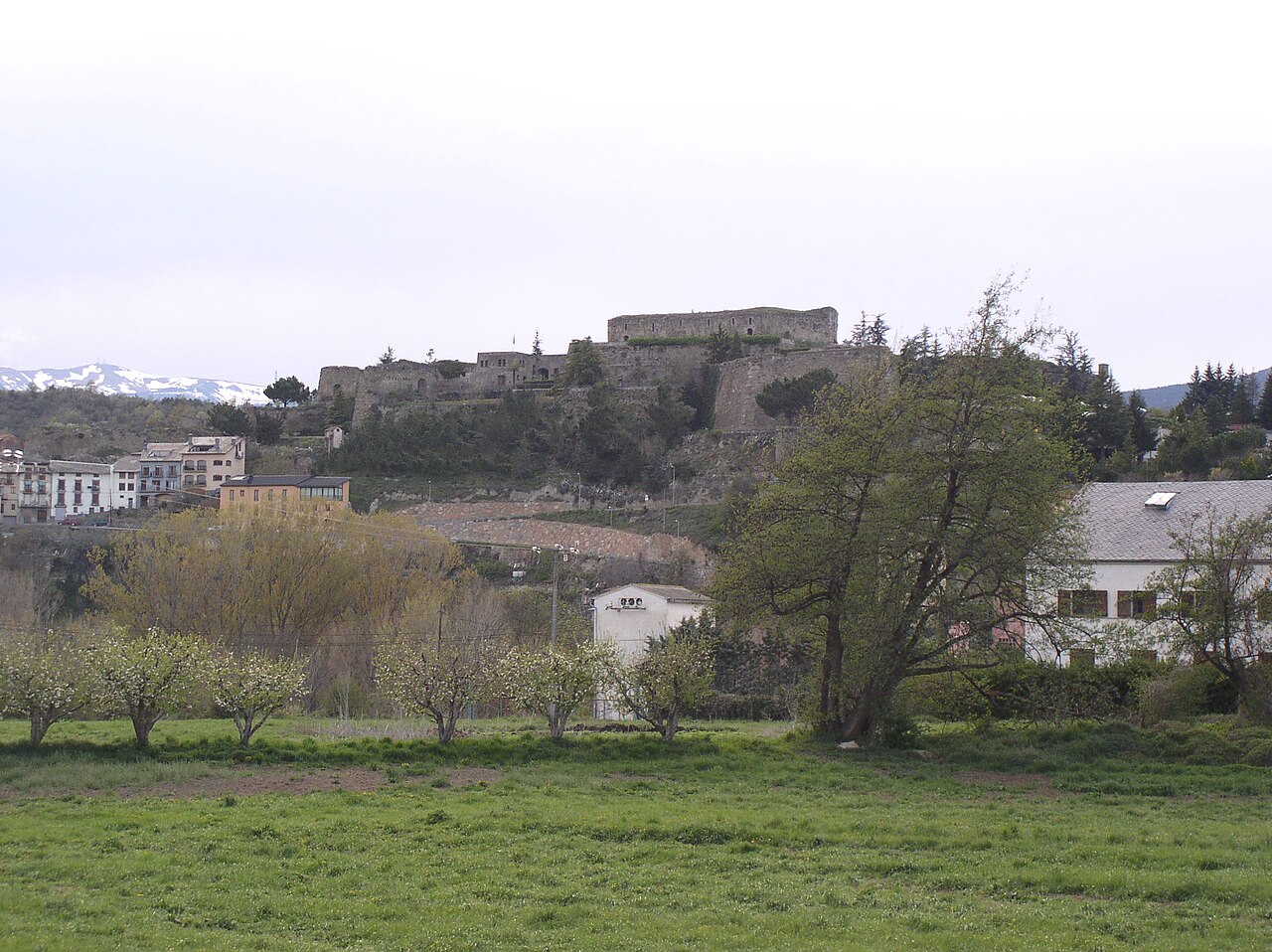
Castell de Bielsa
Castell de Bielsa, historically known as Castell de Malmercat, is a significant medieval hill castle located within the municipality of Soriguera in Spain. Its origins trace back to the early 12th century, making it a notable example of early medieval fortification in the region. The castle's strategic position atop a hill provided defensive advantages, overseeing the surrounding territory and controlling local routes.
Historical background and ownership lineage
The first documented mention of the castle dates to 1122, when a knight named Ramon Enard referenced the fortress in his will, bequeathing his property in Malmercat to the nearby church of Sant Andreu. This early record situates the castle as a central fixture in the medieval community that formed around it.
Throughout the 12th to 14th centuries, the castle was held by the Malmercat family, a noble lineage that retained a degree of autonomy within the feudal structure. Initially vassals to the County of Pallars, they later owed allegiance to the Viscounty of Vilamur. By 1338, Pere de Malmercat had expanded his influence, controlling not only Castell de Bielsa but also several other fortresses including those at Llavorsí, Boldís, and Tavascan, as well as the castellanies of Tornafort and Montenartró.
The castle's military significance is underscored by the 1373 assault led by Roger, the illegitimate brother of Count Hug Roger II of Pallars Sobirà. Roger's forces captured the fortress and looted its valuables. Despite subsequent legal attempts by the Malmercat heirs to regain control, the castle was formally recognized as a domain of the Count of Pallars by 1381, with records noting a small population of five hearths, indicating a modest community.
In the 16th century, ownership passed to the Copons family of Lleida, who were thereafter known as the Copons de Malmercat. Later in the century, the Toralla family of Pallars acquired the castle, adding it to their holdings which included the nearby castle of Glorieta and the village of Montesclado.
By the 19th century, the estate changed hands through marriage, moving from the Copons de Malmercat family to the Castillon family and subsequently to the Bielsa family. The last private owner was Ramón José de Bielsa y de Castillón, who died in 1935. Notably, in 1916, he sold the castle and its lands to Dr. Pelayo Fontsarè Eberhart, a resident of the nearby town of Sort.
Architectural features and construction details
The castle exemplifies early medieval construction techniques, combining well-cut ashlar stones at the corners with smaller, roughly hewn stones filling the walls. This method, typical of the 11th and 12th centuries, reflects a pragmatic approach to fortification, balancing strength with available resources.
A prominent feature is the long western exterior wall, which remains largely intact and exhibits minimal alterations. Adjacent to this wall is the base of a circular tower standing nearly two meters tall, which historically controlled access to the main entrance and served a defensive role.
The western wall also contains original arrow slits, narrow vertical openings designed for archers to defend the castle while minimizing exposure. Over time, modifications introduced additional openings to adapt the structure to evolving needs.
Historical evidence suggests the presence of a small moat near the western sector, now filled in, indicating efforts to enhance the castle's defenses against siege.
Interior spaces and functional areas
Inside, the castle once featured a grand hall on the second floor, remembered by early 20th-century villagers as a venue for community dances. This hall includes three large windows that survive today, offering insight into the castle's residential functions beyond military purposes.
The complex also housed a chapel dedicated to Saint Eulàlia, historically connected to the main bedroom chamber. This small religious space underscores the integration of spiritual life within the fortress. Currently deconsecrated, the chapel serves as storage, reflecting changing uses over time.
Later history and current condition
Following its period as a noble residence, the castle's role diminished. It is no longer a full-time residence and is partly used for agricultural storage or as temporary housing. Ownership is divided, which has impacted preservation efforts.
Despite these changes, several original structural elements remain visible, providing valuable insight into medieval fortification and domestic architecture. The castle stands as a testament to the region's feudal history and architectural evolution from the early medieval period onward.
Cultural and regional significance
Castell de Bielsa holds an important place in the history of the Pallars region, reflecting the shifting allegiances and power dynamics of medieval Catalonia. Its enduring presence offers scholars and visitors a tangible connection to the medieval nobility and their fortified residences.
The castle's architectural features, combined with its documented history, make it a valuable site for understanding the development of hill castles in Spain during the high medieval period. It contributes to the broader narrative of feudal fortifications that shaped the political and social landscape of the area.
Frequently asked questions (FAQ)
- When was Castell de Bielsa originally built?
- Castell de Bielsa was constructed during the early 12th century, with the first recorded mention in 1122.
- What families historically owned Castell de Bielsa?
- The castle was originally held by the Malmercat family from the 12th to the 14th centuries, later passing to the Copons family, the Toralla family, and eventually the Bielsa family.
- What are the notable architectural features of Castell de Bielsa?
- Notable features include the long western exterior wall, a circular tower base, original arrow slits, and a chapel dedicated to Saint Eulàlia.
- Is Castell de Bielsa open to the public for visits?
- Currently, the castle is privately owned with divided ownership and is not regularly open to the public, but parts of it are used for agricultural storage and temporary housing.
- What historical events impacted Castell de Bielsa?
- A significant event was the 1373 assault led by Roger, brother of Count Hug Roger II, who captured and looted the castle.
Information
Website
Visit websiteSources & official resources
Verify the information above using these authoritative references.
Loading map...
Visitor reviews
No reviews yet. Been here? Write the first review and help other travelers!
Write the first reviewVisited this castle? Share your experience
Your review helps other travelers and adds first-hand knowledge to our encyclopedia.