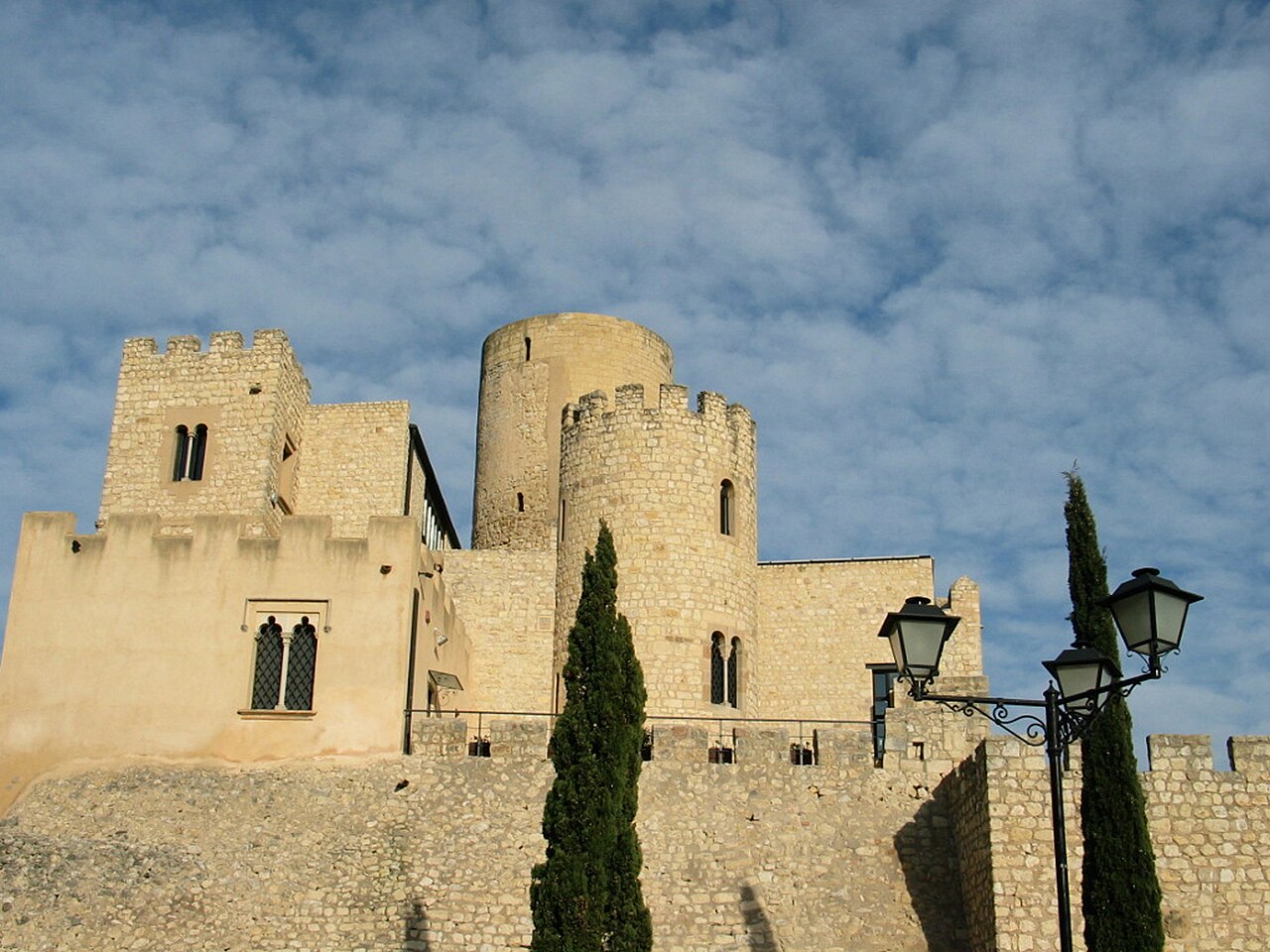
Castell de Canyelles
The Castell de Canyelles stands as a remarkable example of medieval military architecture in Catalonia, Spain. Situated strategically on a hilltop, this castle commands panoramic views over the surrounding landscape, underscoring its historical role as a defensive stronghold and watchtower. While the majority of the visible structure dates from the 15th century, its origins trace back to a defensive tower documented as early as the late 10th century, highlighting its long-standing significance in regional defense.
Located in the municipality of Canyelles, the castle's early history is intertwined with the turbulent frontier between the Carolingian Christian domains and the Islamic territories of the Iberian Peninsula. The first known record from 976 AD mentions a tower serving as an outpost linked to the nearby Castell d’Olèrdola. This position was crucial in controlling access between the coastal area near Vilanova i la Geltrú and the inland town of Vilafranca del Penedès, a key passageway for trade and military movements.
Historical background and strategic importance
The castle's location on a hill made it an ideal site for surveillance and defense during the Middle Ages. Initially, it functioned as an auxiliary fortification supporting the larger fortress of Olèrdola. The region's political landscape shifted significantly in the early 12th century when Almoravid forces took control around 1107, leading to widespread depopulation and the decline of Olèrdola. In this context, Canyelles gained greater strategic value, overseeing a vital corridor connecting coastal and inland territories.
Throughout the medieval period, the castle was held by the Barons of Canyelles, a noble lineage that exercised local authority including toll collection from a nearby stream. Notable figures include Dalmau Canyelles, recorded as castellan of Vilafranca in 1200, and Guillem de Sagarriga, who was granted the castle by King Joan I in 1393. Ownership later passed through noble families such as the Marquet and Terrè lineages, reflecting the castle's continued importance in regional governance.
Architectural features and structural elements
The most prominent surviving feature of the castle is its tall circular tower, constructed primarily from roughly shaped stones laid in horizontal courses. This tower is integrated into the curtain wall and is located adjacent to the church of Santa Magdalena, illustrating the close relationship between military and religious structures at the site. The tower's walls are notably thick, measuring approximately 1.35 meters at the base and tapering to about 0.8 meters near the top.
The tower's interior diameter exceeds two meters, and it features narrow loopholes (or espitlleres) that provided both light and ventilation while serving defensive functions. The main entrance was likely positioned on the first floor, a common medieval design intended to enhance security by limiting direct ground-level access. This architectural choice reflects the military priorities of the time, emphasizing defense and control.
East of the tower, a curved section of wall remains partially intact, measuring approximately 1.2 meters thick. This fragment is interpreted as part of the original medieval fortress's defensive enclosure. The castle complex also includes a porch with two flat arches in front of the church, featuring built-in benches and a terrace above. These elements date from the 19th-century restoration period and demonstrate the site's adaptive reuse over time.
Church of santa magdalena and religious significance
The church of Santa Magdalena was established adjacent to the castle in 1627 by Bishop Joan Sentís, marking an expansion of religious life at the site. The church's proximity to the castle reflects the intertwined nature of military and spiritual authority in the region. A porch attached to the church provides a sheltered space for gatherings and is notable for its architectural integration with the castle's defensive structures.
Restoration and modern history
In the 19th century, the castle underwent significant restoration under the direction of the Bouffard family between 1852 and 1858. These works included modifications to the castle walls and enlargement of the chapel's sacristy, blending new construction with the medieval fabric. Additional walls were added at the front of the site, enhancing its defensive appearance while accommodating new functional needs.
Throughout the 20th century, ownership of the castle changed hands several times. In 1920, it was purchased by Josep Escuder i Ferrer, and later acquired by the Reguera family in the 1930s, who primarily used the estate for agricultural purposes. Renovations in 1982 by Miquel Salinas i Bofill adapted the fortress for residential use, reflecting evolving attitudes toward heritage conservation and adaptive reuse.
Most recently, in 2024, Dr. Marisa López-Teijón became the owner with a commitment to preserving the castle's historical significance and reintegrating it into the cultural heritage of the community. The castle remains a dominant feature on the local skyline, occupying the highest point in the village and symbolizing centuries of layered history.
Cultural heritage and significance
The Castell de Canyelles is officially recognized as a cultural heritage monument of national importance within Catalonia and Spain. Its enduring presence illustrates the evolution of medieval fortifications adapted to changing military, religious, and residential functions over centuries. The castle's architecture, historical associations with noble families, and its strategic location contribute to its significance as a landmark of regional identity and heritage.
Visitors to the site can appreciate the blend of medieval military architecture and later modifications, including the integration of religious structures like the church of Santa Magdalena. The castle's preservation efforts highlight the challenges and successes of maintaining historical monuments in a modern context, offering insights into Catalonia's rich medieval past and its ongoing cultural legacy.
Frequently asked questions (FAQ)
- When was Castell de Canyelles originally built?
- The earliest fortification at Castell de Canyelles dates back to the late 10th century, with significant construction occurring in the 15th century.
- What architectural features are notable at Castell de Canyelles?
- Notable features include a tall circular tower with thick stone walls, narrow defensive loopholes, and a partially preserved curtain wall integrated with the church of Santa Magdalena.
- Who were the historical owners of Castell de Canyelles?
- The castle was traditionally held by the Barons of Canyelles and later noble families such as the Marquet and Terrè lineages, including notable figures like Dalmau Canyelles and Guillem de Sagarriga.
- Is Castell de Canyelles open to the public?
- Public access information is limited; visitors should check locally for current visiting hours and any guided tours available.
- What is the significance of the church of Santa Magdalena at the castle?
- The church, established in 1627 adjacent to the castle, reflects the close relationship between military and religious functions at the site, serving as a parish church founded by Bishop Joan Sentís.
Information
Website
Visit websiteSources & official resources
Verify the information above using these authoritative references.
Loading map...
Visitor reviews
No reviews yet. Been here? Write the first review and help other travelers!
Write the first reviewVisited this castle? Share your experience
Your review helps other travelers and adds first-hand knowledge to our encyclopedia.