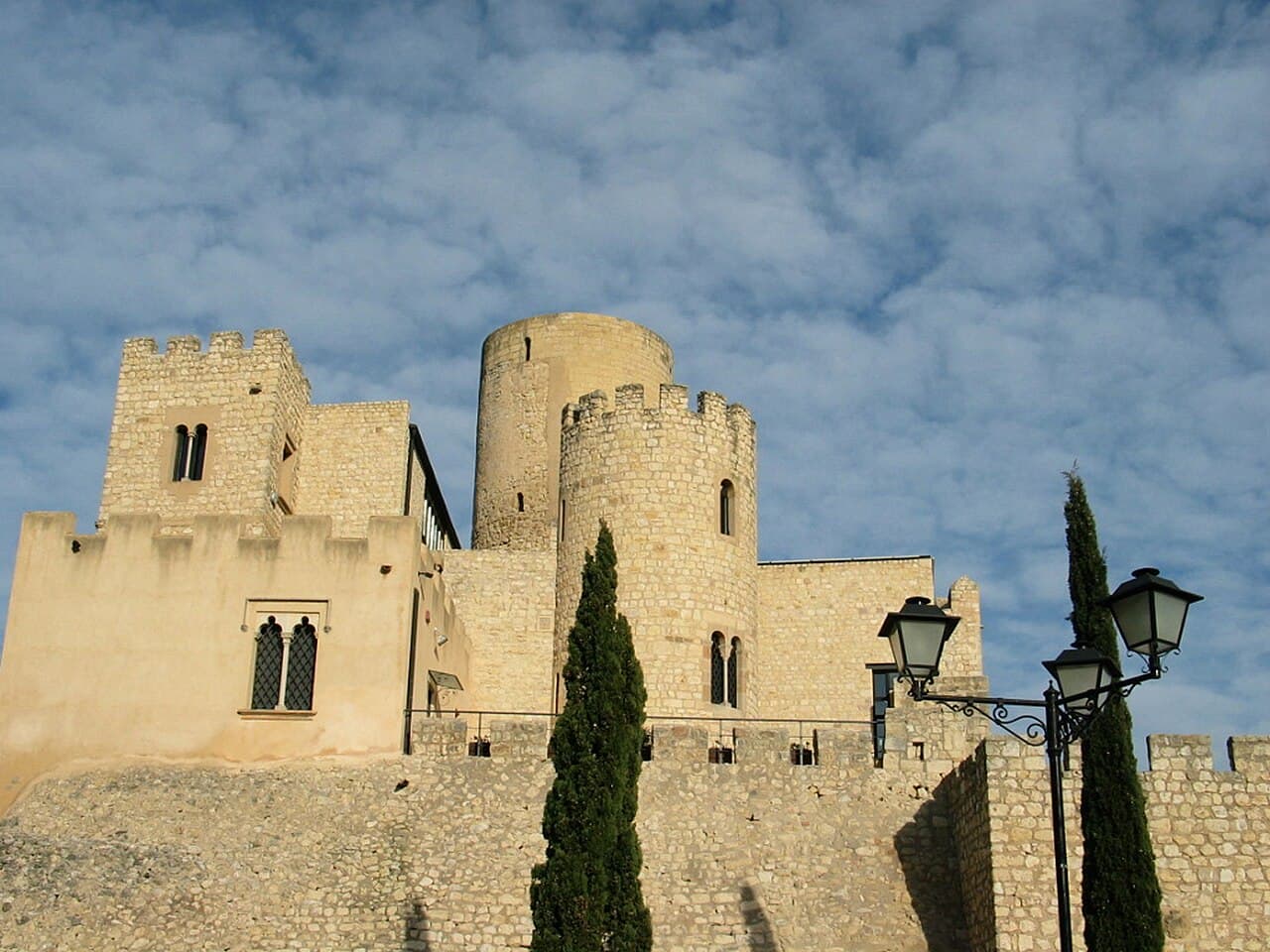
Castell de Castellet
Castell de Castellet stands as a remarkable example of a hill castle with a long and complex history spanning over a millennium. Located in the municipality of Castellet in Catalonia, Spain, this fortress-palace was originally constructed in the late 10th century as part of the Christian defensive frontier known as the Marca Hispánica. The castle played a crucial role during the Reconquista, serving as a military stronghold guarding the border between Christian and Muslim territories in the Iberian Peninsula.
Founded in 977 by the descendants of Sunyer, the castle initially functioned primarily as a fortified outpost, housing soldiers and storing arms and provisions behind its protective walls. Its strategic location atop a hill overlooking the eastern plain of Penedès and the Foix River bend provided commanding views of the surrounding landscape, including the Montmell mountain range and Montserrat. This vantage point enabled effective surveillance and defense against incursions.
Medieval origins and military architecture
The earliest core of Castell de Castellet includes a fortified three-story house known as the domicilium, a keep or master tower, a watchtower, and a small enclosing wall. These features date primarily to the 10th and 12th centuries. The master tower, constructed in the 12th century, remains the most intact medieval structure. It rises approximately 15 meters with thick walls about 1.5 meters wide, built from large, well-cut rectangular stone blocks. The tower features semicircular-arched windows and retains its original entrance on the southwest side, which aligns with the modern restored portal.
Throughout the 11th and 12th centuries, the castle was part of a network of fortifications that gradually pushed Muslim powers southward. Its military significance was paramount during this period, with the keep serving as the main defensive and administrative stronghold. The watchtower and walls provided additional layers of protection, while a cistern within the courtyard ensured a reliable water supply during sieges.
Transition to a noble residence and architectural evolution
As the frontier shifted south and the castle's military role diminished, Castell de Castellet evolved into a noble residence. From the late 11th century onward, significant expansions transformed the fortress-palace to meet the needs of its aristocratic owners. A notable 13th-century addition was the construction of a Catalan Gothic palace that connected to the domicilium and keep through a solid wall designed to withstand artillery attacks, reflecting the changing nature of warfare and defense.
The castle's layout became increasingly complex, with multiple enclosures defined by sturdy stone walls. The 14th-century eastern wall formed an L-shaped main enclosure featuring battlements and round loopholes for archers and artillery. This enclosure was fortified by two corner towers. Below it, a 13th-century talus wall made of large ashlar blocks enclosed a second eastern courtyard, while to the north, another fortified enclosure was marked by a wall and tower.
The main entrance on the southern side is distinguished by a semicircular-arched portal topped with a machicolation, an opening through which defenders could drop projectiles or boiling substances on attackers. Romanesque and Gothic architectural elements such as windows and crenellated battlements remain visible throughout the castle, underscoring its medieval character.
Ownership history and regional significance
Over the centuries, Castell de Castellet passed through the hands of at least 44 noble families, beginning with the descendants of its founder Sunyer. Prominent families included the Sant Martí, Castellet, Torrelles, Desplà, Requesens, Peralta, Aguilar, Icart, and Queralt lineages. The castle's history is intertwined with regional conflicts such as the Catalan civil war (1462–1472), during which it played a role in the shifting allegiances and power struggles of the time.
Its position near important Catalan trade routes and regional capitals enhanced its value beyond military functions, establishing it as a feudal seat and noble residence. However, from the 16th century onward, the castle entered a prolonged period of decline, reflecting broader political and social changes in the region.
20th-century restoration and modern interventions
In 1927, Josep de Peray i March acquired Castell de Castellet and initiated extensive restoration efforts between 1928 and 1929. These works rebuilt parts of the castle and introduced modernist stylistic elements, blending historical architecture with early 20th-century artistic expression. Notably, three modernist interior rooms adjacent to the domicilium feature decorative floors with heraldic symbols and mythological motifs.
The restoration also included rebuilding the master tower to a height of approximately 13 meters, slightly less than its medieval maximum. New perimeter walls and a frontal staircase were added, which now serves as the primary access to the castle. These interventions, while not strictly archaeological reconstructions, have contributed to the castle's preservation and accessibility.
Subsequent owners included Josep Anton de Peray i Batlle and the Hospital de Nens de Barcelona. Since 2001, the castle has been managed by the Fundació Abertis, which continues restoration and maintenance efforts to protect this cultural heritage site.
Archaeological significance and ancient heritage
Beyond its medieval history, Castell de Castellet occupies a site with a rich archaeological record extending back to the 4th century BCE. Excavations have uncovered remains of Iberian settlements, Greek pottery, and structures from an Andalusian phase, indicating continuous human occupation for over 2,500 years. These findings highlight the long-term strategic and cultural importance of the location well before the castle's medieval construction.
Architectural features and layout
The castle complex comprises multiple layers of fortifications and residential buildings arranged across several courtyards. The earliest structures include the domicilium and master tower, surrounded by a small defensive wall. The 13th-century Catalan Gothic palace expanded the residential quarters, while the 14th-century walls and towers enhanced the defensive perimeter.
The master tower, with its thick stone walls and semicircular windows, remains a dominant feature. The castle's battlements, crenellations, and machicolations demonstrate typical medieval defensive architecture designed to repel attackers. The cistern within the courtyard ensured water supply during sieges, a vital feature for sustaining defenders.
Modernist elements introduced in the 20th century coexist with the medieval fabric, creating a unique blend of historical periods. The double line of perimeter walls and frontal staircase improve access and presentation, while the interior decorative motifs reflect the artistic tastes of the restoration era.
Frequently asked questions (FAQ)
- What is the historical significance of Castell de Castellet?
- Castell de Castellet is a significant historical fortress that dates back to the 10th century. It played a crucial role in the defense of the region against invasions and has been a witness to various historical events throughout the centuries, reflecting the architectural evolution of medieval Spain.
- When was Castell de Castellet built?
- The construction of Castell de Castellet began in the 10th century, during the period of Muslim rule in the Iberian Peninsula. It was strategically built to serve as a lookout and defensive structure, showcasing the military architecture of its time.
- Can I visit Castell de Castellet?
- Yes, Castell de Castellet is open to visitors, allowing them to explore its rich history and stunning architecture. Guided tours are available, providing insights into the castle's past and its significance in Spanish history.
- What are the opening hours of Castell de Castellet?
- Castell de Castellet is typically open to the public from 10 AM to 6 PM, but hours may vary seasonally. It is advisable to check the official website or contact the castle directly for the most accurate and up-to-date information before your visit.
- Is it possible to explore the interior of Castell de Castellet?
- Yes, visitors can explore certain areas of the interior of Castell de Castellet, including the main hall and towers. However, access may be limited to guided tours to preserve the structure and enhance the visitor experience.
- What is the best time to visit Castell de Castellet?
- The best time to visit Castell de Castellet is during the spring and fall months when the weather is mild and pleasant. This allows for a more enjoyable exploration of the castle and its surroundings without the summer crowds.
- Are there any nearby attractions to Castell de Castellet?
- Yes, there are several nearby attractions, including the beautiful natural park of Montserrat and the charming town of Manresa. These sites complement the visit to the castle by offering additional cultural and natural experiences.
- How much are the ticket prices for Castell de Castellet?
- Ticket prices for Castell de Castellet are generally affordable, with discounts available for students, seniors, and children. It is advisable to check the official website for the latest pricing and any special promotions that may be available.
- How do I get to Castell de Castellet?
- Castell de Castellet is accessible by car, with parking available nearby. Public transportation options may include buses or trains to the nearest town, followed by a short taxi ride or hike to the castle.
Photo gallery

Information
Website
Visit websiteSources & official resources
Verify the information above using these authoritative references.
Loading map...
Visitor reviews
No reviews yet. Been here? Write the first review and help other travelers!
Write the first reviewVisited this castle? Share your experience
Your review helps other travelers and adds first-hand knowledge to our encyclopedia.

