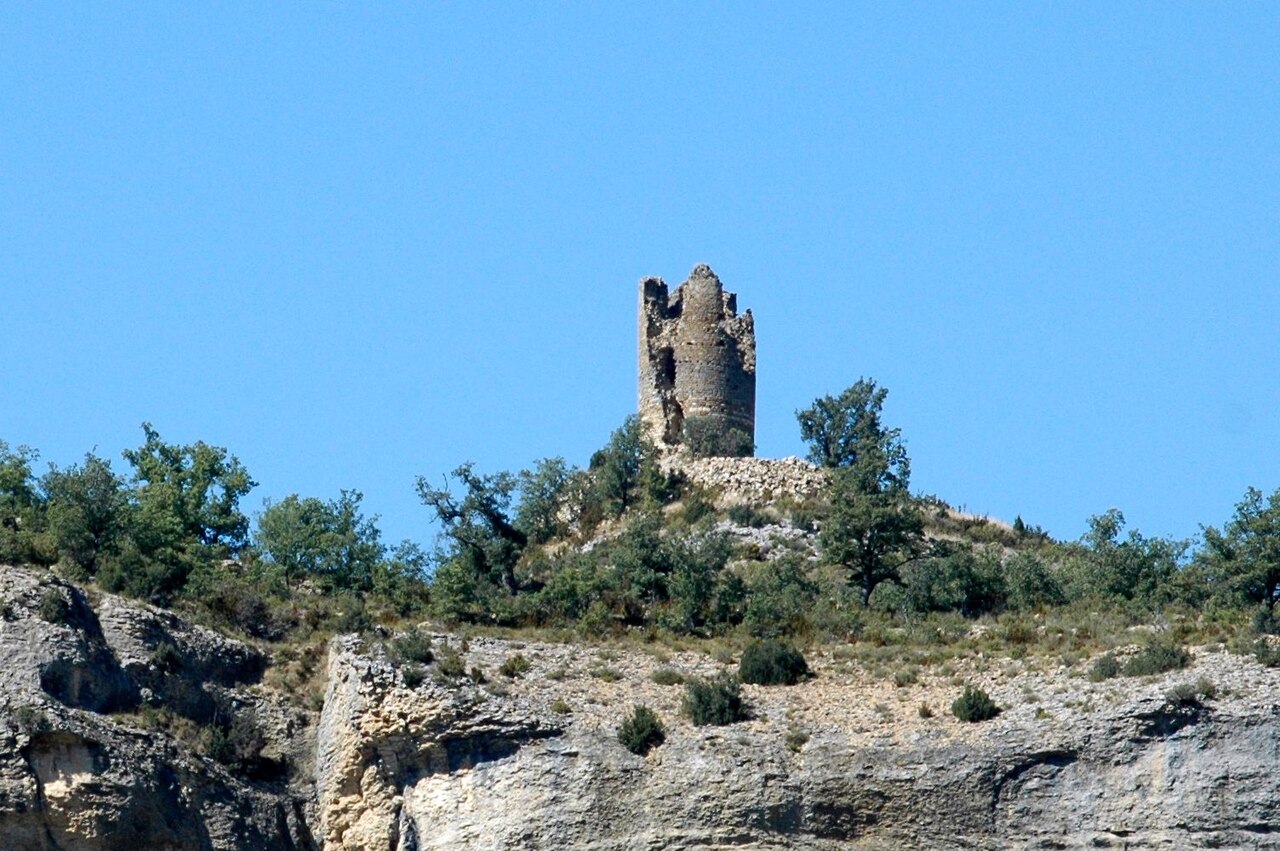
Talarn Castle
Talarn Castle stands as a significant medieval hill fortress located in the municipality of Talarn within the historic region of Pallars Jussà, Spain. Its origins trace back to the mid-11th century, making it an enduring symbol of the region's complex feudal and political history. The castle's strategic position atop the highest and most eastern point of the medieval walled town provided commanding views over the surrounding landscape, underscoring its military and administrative importance through centuries.
Early history and feudal significance
The earliest documented mention of Talarn Castle dates to 1055 and 1056, where it was recognized as marking a northern boundary between the castles of Mur and Llimiana. This positioning highlights its role as a frontier fortress during the early medieval period. In 1064, Count Ramon VI of Pallars Jussà entrusted the castle to his cousin Artau I of Pallars Sobirà as a pledge, demonstrating the castle's strategic and familial importance within the local nobility.
By 1079, the castle was granted in fief to the castellan Ginaman Hug, which established a feudal governance structure that emphasized Talarn's jurisdictional reach. The 13th century saw the rise of notable castellans from the Mur and Vilamur families, further embedding the castle within the noble power networks of the region.
In 1338, Arcard de Talarn paid homage to King Peter III of Aragon, formally acknowledging royal authority over the fortress. This act exemplifies the intertwining of local lordship with the broader Crown of Aragon's political framework. Financial difficulties in the early 14th century led to the frequent pawning of Talarn and the nearby Orrit castles, culminating in their sale by King Peter IV to Arnau Roger, Count of Pallars, in 1357 for 71,000 sous. This transaction transferred firm control of Talarn Castle to local nobility, consolidating its regional significance.
Military and administrative roles through the centuries
Talarn Castle's military importance persisted into the late medieval period. In 1455, it was designated the capital of the sotsvegueria, a sub-delegation of Pallars, with the sotsveguer (deputy governor) residing in the town. The requirement that this official be a native of Talarn reinforced the castle's role as a regional administrative center.
The castle endured sieges and captures during periods of conflict, notably in 1476 when mercenary forces led by Lluís de Mudarra seized it. Later, in 1562, Huguenot troops under the Count of Foix captured the fortress, reflecting the turbulent religious and political struggles of the time.
In the 18th century, King Philip V established Talarn as the seat of a corregimiento, an administrative division under the Spanish Crown, which lasted until 1834 when the corregimiento was relocated to Tremp. This administrative evolution illustrates Talarn's continued importance in regional governance well into the modern era.
Architectural features and castle remains
The castle was constructed primarily as a hill castle, taking advantage of its elevated position for defense and surveillance. The surviving ruins include the notable Prison Tower, a circular structure approximately 2.7 meters in diameter and 6 meters tall, with walls up to 1.8 meters thick. This tower features two ledges at heights of 2.9 and 3.9 meters, indicative of its use for containment and defense. Architectural analysis dates this tower to the 11th century, aligning with the castle's earliest historical records.
Adjacent to the Prison Tower are remnants of the castle's original church, though these are heavily obscured by later constructions on the site. These fragments attest to the castle's religious functions within the fortress complex, a common feature in medieval castles that served both military and ecclesiastical roles.
Fortified village and defensive network
At the base of the castle, a fortified village developed, initially as a castral settlement centered around the castle itself. Over time, the castle's walls were extended to enclose the medieval houses, creating a protective perimeter for the inhabitants. This village became a residence for regional nobility, who modernized medieval homes and built manor houses, reflecting evolving social and architectural trends.
The fortified village includes several towers dating from the 13th to 14th centuries, constructed after the original castle. The Soldevila Tower to the east showcases advanced masonry with large, well-laid ashlar blocks, while the Caps Tower to the west contrasts with its use of smaller, irregular stones. Additional tower remains include an almost vanished angle tower north of the Caps Tower and a rounded masonry fragment behind the church of Saint Martin, indicating a complex defensive network.
Medieval urban layout and street plan
The village's street layout preserves much of its medieval character, organized around three primary thoroughfares. The central street, known as "del Mig" or "del Forn," begins just north of the church. Parallel to it runs the "Nou" or "de Pau Coll" street, connecting the Soldevila Portal in the southeast to the Portal of the Torre dels Caps in the northwest. A northern street passes by the castle area and the Vilanova (del Gall) square on the village’s west side. Smaller alleyways interconnect these main routes, creating an intricate medieval urban fabric that has endured for centuries.
Cultural and historical significance
Talarn Castle embodies the layered history of the Pallars Jussà comarca, reflecting the region's shifting political, military, and social dynamics from the early medieval period through the early modern era. Its role as a military fortress, administrative center, and noble residence illustrates the multifaceted functions of medieval castles in Catalonia.
The castle's survival as ruins, including key architectural elements like the Prison Tower and fortified village structures, offers valuable insights into medieval construction techniques and feudal society. Talarn remains a significant heritage site, attracting visitors interested in medieval history, military architecture, and Catalan culture.
Today, the ruins stand as a testament to the castle's enduring legacy and the historical importance of Talarn within the broader context of Spanish and Catalan medieval history.
Frequently asked questions (FAQ)
- How do I get to Talarn Castle?
- Talarn Castle is located in the municipality of Talarn in Catalonia, Spain. Visitors can reach the site by car or local transport, with the castle situated on a hill overlooking the town.
- What is the historical significance of Talarn Castle?
- Talarn Castle played a crucial role as a military fortress and administrative center in Pallars Jussà from the 11th century onward, witnessing important feudal and royal events.
- Can I visit the ruins of Talarn Castle?
- Yes, visitors can explore the ruins of Talarn Castle, including the Prison Tower and remains of the fortified village. However, facilities may be limited due to its ruinous state.
- When was Talarn Castle built?
- Talarn Castle was originally constructed in the 11th century, with significant expansions and modifications occurring through the 13th and 14th centuries.
- What architectural features remain at Talarn Castle?
- Key features include the 11th-century Prison Tower with thick walls, parts of the original castle church, and several medieval towers in the fortified village surrounding the castle.
Information
Loading map...
Visitor reviews
No reviews yet. Been here? Write the first review and help other travelers!
Write the first reviewVisited this castle? Share your experience
Your review helps other travelers and adds first-hand knowledge to our encyclopedia.