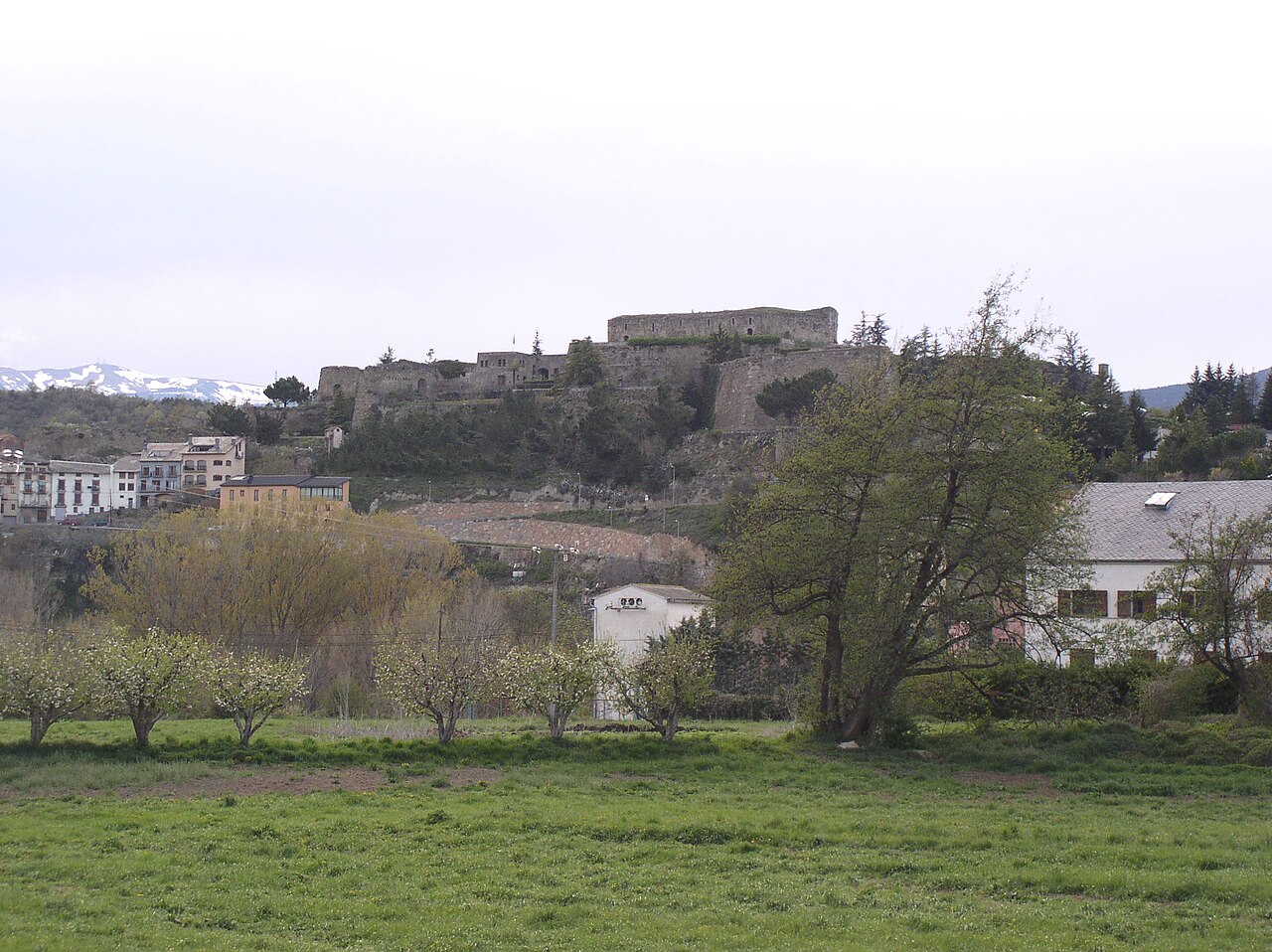
Castell de Rialb
Castell de Rialb is a medieval fortress strategically perched on a rocky hilltop overlooking the village of Rialp in Spain. This hill castle commands a commanding view of the confluence between the Noguera Pallaresa river valley and the Àssua valley, highlighting its historical role in controlling important regional routes and access points. Constructed during the Middle Ages, the castle's origins trace back to at least the mid-11th century, as evidenced by documentary records from 1065 mentioning a fortified enclosure known as "in castro Rialb."
Early history and feudal significance
The castle initially served as a defensive outpost linked to the nearby Castell de Surp, forming part of a network of fortifications protecting the region. By the late 13th century, Ramon de Bellera held Castell de Rialb under the allegiance of King Pere II of Aragon, reflecting its integration into the feudal structures of the time. The Bellera family played a significant role in local governance but faced financial difficulties, leading to the pawn of the Vall d’Àssua territory, including the castle's jurisdiction, to the Viscount of Castellbò in 1352.
Ownership disputes and conflicts
Despite its location within the county of Pallars, Castell de Rialb was not under the control of the Counts of Pallars, which sparked ongoing disputes. These tensions led to conflicts among noble families vying for authority over the valley. In 1435, Jaume de Bellera sold the Vall d’Àssua and the Barony of Rialb to Count Arnau Roger de Pallars. Subsequently, Arnau Roger transferred judicial rights to Joan I, Count of Foix, who asserted control without approval from the Aragonese monarch. This provoked retaliation from Pallars officials and mercenaries who occupied and plundered both the castle and the adjacent village.
Later history and decline
By 1460, ownership of Castell de Rialb was definitively in the hands of the Counts of Foix. In 1493, the Count of Foix appointed Joan Xiberri, known as "Matxicot", as castellan, who undertook repairs and reconstruction of the fortress and its defensive walls. The early 16th century brought political upheaval when King Ferdinand the Catholic confiscated the Viscountcy of Castellbò, including Rialb and Vall d’Àssua, during his conflict with Foix. These possessions were granted to his wife, Germana de Foix, who mortgaged the domains until their redemption by the Crown in 1548.
By the 17th century, Castell de Rialb had fallen into ruin and remained part of the Viscountcy of Castellbò holdings until the abolition of feudal privileges in the 19th century. Today, the site is managed by the Diputació de Lleida, preserving its historical legacy.
Architectural features and remains
Castell de Rialb occupies a rocky outcrop and follows a roughly rectangular ground plan. Among the surviving structures are two intersecting stone walls at the northeast corner, standing about eight meters tall. These walls measure approximately 9.5 meters and 5 meters in length, enclosing an area near 50 square meters across multiple floors. The walls are constructed from small, irregular slate stones locally called llicorella, bonded with a lime and gravel mortar. Finely cut rectangular stone blocks, or ashlar, frame the windows, which feature distinctive semicircular arches.
The base of the walls is about 1.3 meters thick, tapering by around 30 centimeters towards the top, with the walls currently rising to approximately seven meters above ground level. Defensive openings include a narrow loophole-shaped window on the north face, designed to provide surveillance while offering protection. The east-facing wall contains two additional arched windows, with three more apertures on the upper floor. These window openings vary, measuring around 125 centimeters wide and 150 centimeters tall internally, with exterior widths tapering from 10 to 70 centimeters, reflecting their strategic defensive design.
Approximately six meters south of the main structure lies a separate wall section about four meters long and over a meter thick, likely part of the castle’s original fortifications. Opposite this fragment once lay a defensive ditch or vall, a typical medieval feature enhancing the fortress's protection. These architectural remnants illustrate the castle’s role as a fortified stronghold controlling key access routes in the surrounding landscape.
Cultural and historical importance
Castell de Rialb stands as an important example of medieval military architecture in the Pallars region of Spain. Its history reflects the complex feudal dynamics and territorial disputes characteristic of the Middle Ages in this part of the Iberian Peninsula. The castle's strategic location and architectural features provide insight into defensive strategies employed during the high and late medieval periods.
Preservation efforts by local authorities aim to maintain the site as a cultural heritage landmark, offering visitors a glimpse into the region’s medieval past. The castle’s ruins, though partially preserved, continue to evoke the historical significance of feudal power struggles and regional defense mechanisms.
Frequently asked questions (FAQ)
- How do I get to Castell de Rialb?
- Castell de Rialb is located above the village of Rialp in Catalonia, Spain. Visitors can reach the site by car or on foot from the village, following marked trails leading to the castle ruins.
- What is the historical significance of Castell de Rialb?
- The castle dates back to at least the 11th century and played a key role in regional defense and feudal disputes in the Pallars region during the Middle Ages.
- Can I visit the interior of the castle?
- The castle is in ruins with limited structural remains. Visitors can explore the exterior walls and surrounding area but should exercise caution as the site is partially preserved.
- When is the best time to visit Castell de Rialb?
- The best time to visit is during late spring to early autumn when weather conditions are favorable for hiking and exploring the ruins.
- Are there guided tours available?
- Guided tours may be available through local tourist offices or the Diputació de Lleida. It is recommended to check in advance for tour availability and schedules.
Information
Sources & official resources
Verify the information above using these authoritative references.
Loading map...
Visitor reviews
No reviews yet. Been here? Write the first review and help other travelers!
Write the first reviewVisited this castle? Share your experience
Your review helps other travelers and adds first-hand knowledge to our encyclopedia.