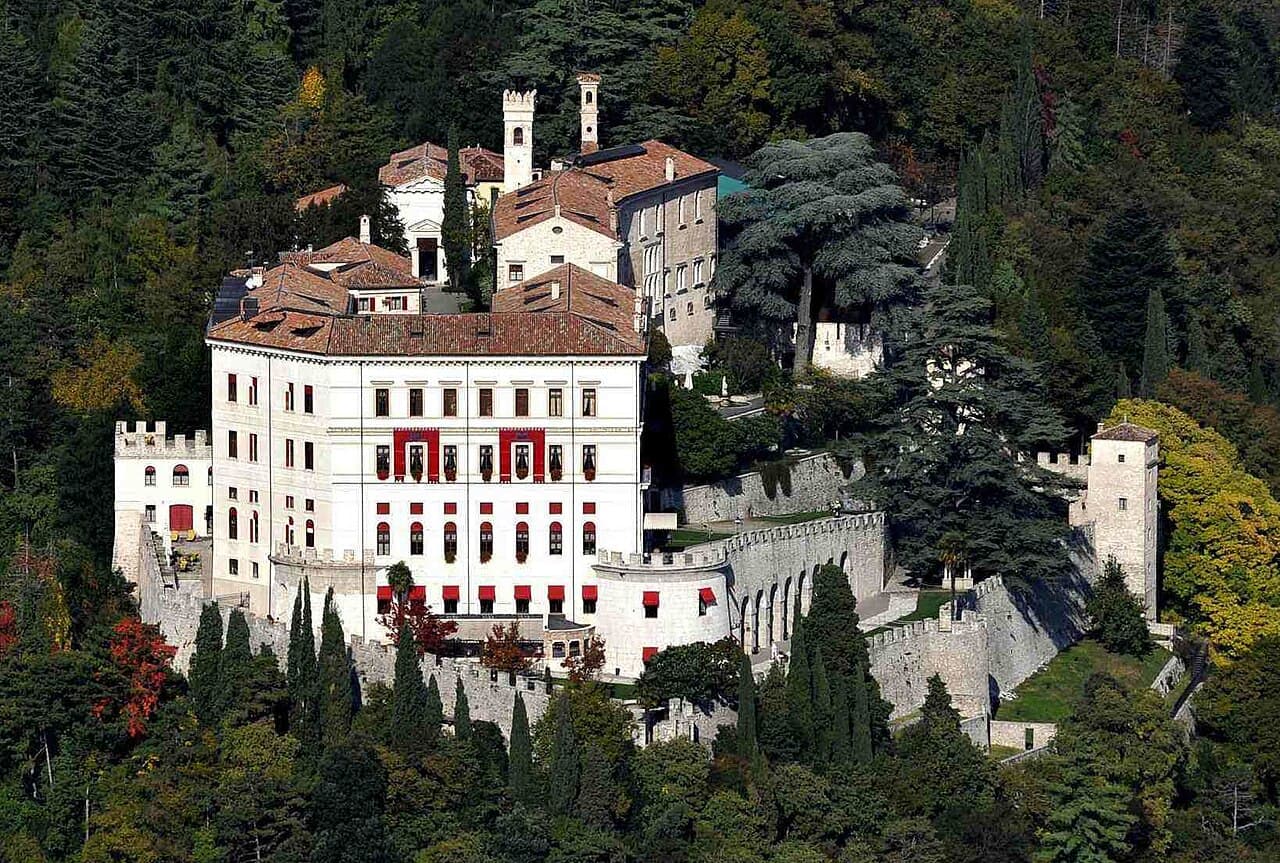
CastelBrando
CastelBrando, formerly known as Castrum Costae, is a remarkable medieval castle perched on a dolomite limestone rock at approximately 370 meters (1,210 feet) above sea level. It overlooks the picturesque villages of Cison di Valmarino and Valmareno in Northern Italy. The castle's name derives from the Brandolini family of Forlì, who were the historic lords of this fortress.
The origins of CastelBrando date back to the Roman era, around 46 AD, when it was initially constructed as a defensive fortress to protect vital communication routes connecting Northern Italy with territories beyond the Alps. The remains of the original Roman castrum are still visible today, including the foundations and the excavated Roman baths. Remarkably, the castle's water supply system, featuring original aqueduct pipes channeling water from three nearby natural springs, continues to function, providing water to the castle even now.
Roman foundations and early medieval significance
During the European Migration Period, CastelBrando held strategic importance as a defensive stronghold against barbarian invasions. The fortress's elevated position on a rocky outcrop offered natural protection and control over the surrounding valleys and trade routes.
Medieval expansions and architectural evolution
In the 13th century, the castle underwent significant enlargement under the ownership of the Da Camino family. This period saw the addition of imposing Guelph-Ghibelline style battlements that encircle the fortress, a typical feature of medieval Italian military architecture symbolizing the political factions of the time. The Da Camino also constructed a central tower, enhancing the castle's defensive capabilities and serving as a lookout.
Venetian period and Renaissance enhancements
Following its medieval phase, the castle came under the control of the Republic of Venice. After the fall of Venice in 1797, ownership transferred to the Brandolini Counts, an ancient noble family from Forlì. In the early 16th century, Antonio Maria Brandolini (1476–1522) commissioned skilled engineers to enlarge the central part of the castle, incorporating the Sansovino style and adding distinctive Venetian Gothic double and triple mullioned windows. These architectural features blend Renaissance elegance with Gothic verticality, reflecting Venice's artistic influence.
18th-century additions and religious architecture
In the 1700s, the Brandolini family engaged Ottavio Scotti, the architect and Count of Treviso, to design and build an extension on the southern side of the castle. This expansion included the construction of the castle chapel, the Church of San Martino. The chapel's interior was richly decorated with 18th-century frescoes by Egidio Dall'Oglio, adding a layer of Baroque artistic heritage to the castle complex.
Modern history and restoration
During World War I, the castle was occupied by Imperial Austrian forces and repurposed as a military hospital. This period marked a temporary shift from its noble residential use to a strategic military facility.
After the war, extensive restoration efforts were undertaken over a decade, financed by Count Girolamo IV Brandolini (1870–1935). By 1929, CastelBrando was reopened as a residence, preserving its historical fabric while adapting it for modern use.
Current use and visitor experience
Today, CastelBrando is a well-preserved hill castle that serves multiple functions. It houses a 4-star hotel, a museum, and a theatre, making it a cultural and tourist destination. Visitors can access the castle conveniently via a funicular railway from the village of Cison di Valmarino, which adds to the visitor experience by providing scenic views of the surrounding landscape.
The castle's architecture is a palimpsest of styles and periods, from its Roman foundations and medieval battlements to its Venetian Gothic windows and Baroque chapel frescoes. This blend illustrates the castle's continuous adaptation to changing political, military, and cultural contexts over nearly two millennia.
CastelBrando remains a significant heritage site in the Veneto region, reflecting the region's complex history from Roman times through the Middle Ages and Renaissance to the modern era.
Frequently asked questions (FAQ)
- How do I get to CastelBrando?
- CastelBrando is accessible by a funicular railway from the village of Cison di Valmarino, providing a scenic and convenient route to the castle perched on the hill.
- What is the historical significance of CastelBrando?
- CastelBrando has origins dating back to Roman times as a defensive fortress and has evolved through the medieval and Renaissance periods, reflecting the region's military and noble history.
- Can I visit the castle chapel?
- Yes, the Church of San Martino within CastelBrando is open to visitors and features 18th-century frescoes by Egidio Dall'Oglio, showcasing Baroque religious art.
- When was the castle last restored?
- The castle underwent major restoration after World War I, completed in 1929, funded by Count Girolamo IV Brandolini to preserve its historical and architectural integrity.
- Is there accommodation available at CastelBrando?
- Yes, CastelBrando currently operates as a 4-star hotel, offering visitors the chance to stay within the historic castle walls with modern amenities.
Photo gallery

Information
Opening hours
10:00-18:00, daily
Ticket prices
€10 adult, €5 child
Current owner
Brandolini family
Website
Visit websiteSources & official resources
Verify the information above using these authoritative references.
Loading map...
Visitor reviews
No reviews yet. Been here? Write the first review and help other travelers!
Write the first reviewVisited this castle? Share your experience
Your review helps other travelers and adds first-hand knowledge to our encyclopedia.



