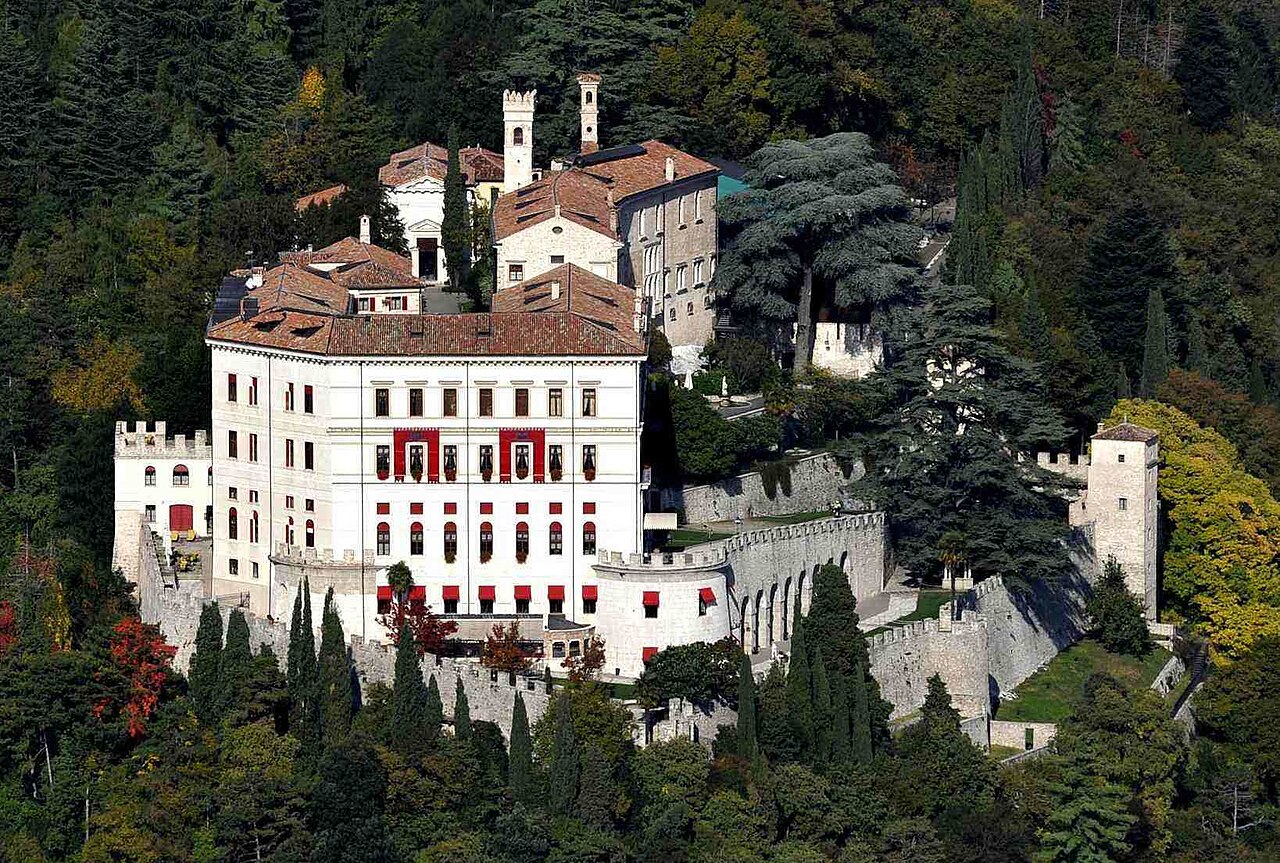
Zumelle Castle
Zumelle Castle stands as a remarkable example of medieval military architecture in the Veneto region of Italy, specifically in the village of Tiago within the municipality of Mel. The castle's origins trace back to the Roman era, around 46–47 AD, when the Romans established a fortification to consolidate control over the Valbelluna area, conquered in the 1st century BCE. This strategic position commanded a vital route through the Praderadego pass, likely a branch of the Via Claudia Augusta Altinate, facilitating military and commercial movement between the plains and the mountainous regions.
The early history and strategic importance
Following the fall of the Western Roman Empire, Zumelle Castle emerged as a key stronghold guarding the connections between the towns of Feltre and Ceneda. According to local legend, the castle was refounded by Genseric (or Gaiseric), a loyal follower of Queen Amalasuntha of the Ostrogoths. After the queen's assassination, Genseric settled at the site and fathered twins ("gemelle" in Italian), which is believed to have inspired the castle's name.
During the early Middle Ages, the castle became the focus of feudal conflicts. In 737, Lombard king Liutprand appointed Valentino, bishop of Ceneda, as lord of Zumelle, sparking a dispute with Giovanni, count-bishop of Belluno, who already governed these lands. This conflict was resolved in 750 by the intervention of King Aistulf. Later, in 963, Emperor Otto I granted the county of Zumelle to the bishops of Belluno, marking a shift in ecclesiastical authority over the region.
Ownership transitions and medieval reconstruction
In 1037, Emperor Conrad II assigned the castle to his baron Abelfredo. Upon Abelfredo's death without male heirs, the property passed to his daughter Adelheit, who married William of Colfosco. Their daughter Sofia married Guecellone II da Camino, bringing the castle into the hands of the powerful da Camino family.
The castle underwent significant rebuilding in 1311 under Rizzardo IV da Camino, lord of Treviso, Belluno, and Feltre. This reconstruction enhanced the castle's defensive features, adapting it to the military needs of the late medieval period.
After its conquest by the Republic of Venice, Zumelle Castle's military importance diminished. In 1358, it was granted to the Venetian patrician Zorzi family as compensation for territories lost in Dalmatia. The Zorzi were responsible for maintaining the castle, administering justice, and overseeing nineteen nearby villages.
The castle in the Renaissance and modern era
In 1501, during the War of the League of Cambrai, the castle was sacked by imperial troops, marking a turning point in its military relevance. The rise of firearms and a period of relative peace under Venetian rule reduced the need for such fortifications.
Ownership later passed to the Gritti family in 1720, after which the castle gradually fell into neglect. Following the fall of the Venetian Republic, the castle became part of the Austrian Empire. In 1872, the municipality of Mel acquired Zumelle Castle, preserving it as a historic monument.
Restoration efforts between the 1960s and 1980s helped conserve the structure, making Zumelle Castle one of the best-preserved medieval fortresses in the Valbelluna area. Unlike other local castles, it avoided extensive Venetian-era modifications, retaining much of its original medieval character.
Architectural features and layout
Zumelle Castle occupies a commanding position atop a steep rock overlooking the Terche stream. Its defensive system includes a ditch carved into the bedrock, encircling the complex to protect it from attackers. The castle's core is the 11th-century keep (mastio), which served as the primary defensive stronghold and residence.
Nearby stands the chapel of San Lorenzo, built over an earlier Byzantine sacellum. The chapel contains burials and a sarcophagus, underscoring the site's long-standing religious significance.
The castle also features fortified towers, surrounding walls, and a moat, all representative of medieval military architecture designed to repel sieges.
Medieval village reconstruction
Within the castle grounds, a reconstructed medieval village offers visitors insight into daily life during the Middle Ages. This includes a tower house displaying period interiors such as an apothecary's workshop, a bedroom, a banquet hall, a kitchen, and a scriptorium for manuscript copying. There is also an armory and a museum space, illustrating various aspects of medieval domestic and military life.
Nearby historical sites
Adjacent to Zumelle Castle is the early medieval Church of San Donato, dating back to Lombard times. The church features a single nave with three apses and contains an 18th-century altar alongside remnants of Gothic frescoes. Although currently closed due to structural damage caused by water infiltration, the church remains a significant example of Lombard ecclesiastical architecture and art.
Historical significance and cultural heritage
Zumelle Castle's long history, spanning from Roman times through the medieval period and into the modern era, reflects the strategic importance of the Valbelluna region. Its preservation offers valuable insights into military architecture, feudal power struggles, and the transition of authority from Roman to Lombard, and later Venetian and Austrian rule.
Today, the castle serves as a cultural venue managed by the organization "Sestiere Castellare," hosting historical reenactments and educational activities that bring medieval history to life for visitors.
Frequently asked questions (FAQ)
- How do I get to Zumelle Castle in Mel, Italy?
- Zumelle Castle is located in the village of Tiago, Mel, in the Veneto region. It can be reached by car or local bus services from nearby towns such as Belluno. Parking is available near the castle.
- What are the opening hours for Zumelle Castle?
- The castle is generally open to visitors during the warmer months, with specific opening hours varying seasonally. It is recommended to check the official website or local tourist information for current visiting times.
- Is there an entrance fee to visit Zumelle Castle?
- There is usually a modest entrance fee to visit Zumelle Castle, which helps support its maintenance and the cultural events hosted there. Discounts may be available for children, seniors, and groups.
- What architectural styles are represented at Zumelle Castle?
- Zumelle Castle primarily exhibits medieval military architecture from the late medieval period, with elements dating back to Roman and Lombard times. Its preservation offers a rare glimpse into early medieval fortification techniques.
- Can I visit the Church of San Donato near Zumelle Castle?
- The Church of San Donato is adjacent to Zumelle Castle but is currently closed to the public due to structural issues caused by water damage. Visitors can view the exterior and learn about its historical significance.
- What events or activities are held at Zumelle Castle?
- Zumelle Castle hosts historical reenactments, medieval fairs, and educational programs organized by the local cultural association "Sestiere Castellare," providing immersive experiences of medieval life.
Information
Sources & official resources
Verify the information above using these authoritative references.
Loading map...
Visitor reviews
No reviews yet. Been here? Write the first review and help other travelers!
Write the first reviewVisited this castle? Share your experience
Your review helps other travelers and adds first-hand knowledge to our encyclopedia.