Castel Sant'Elmo
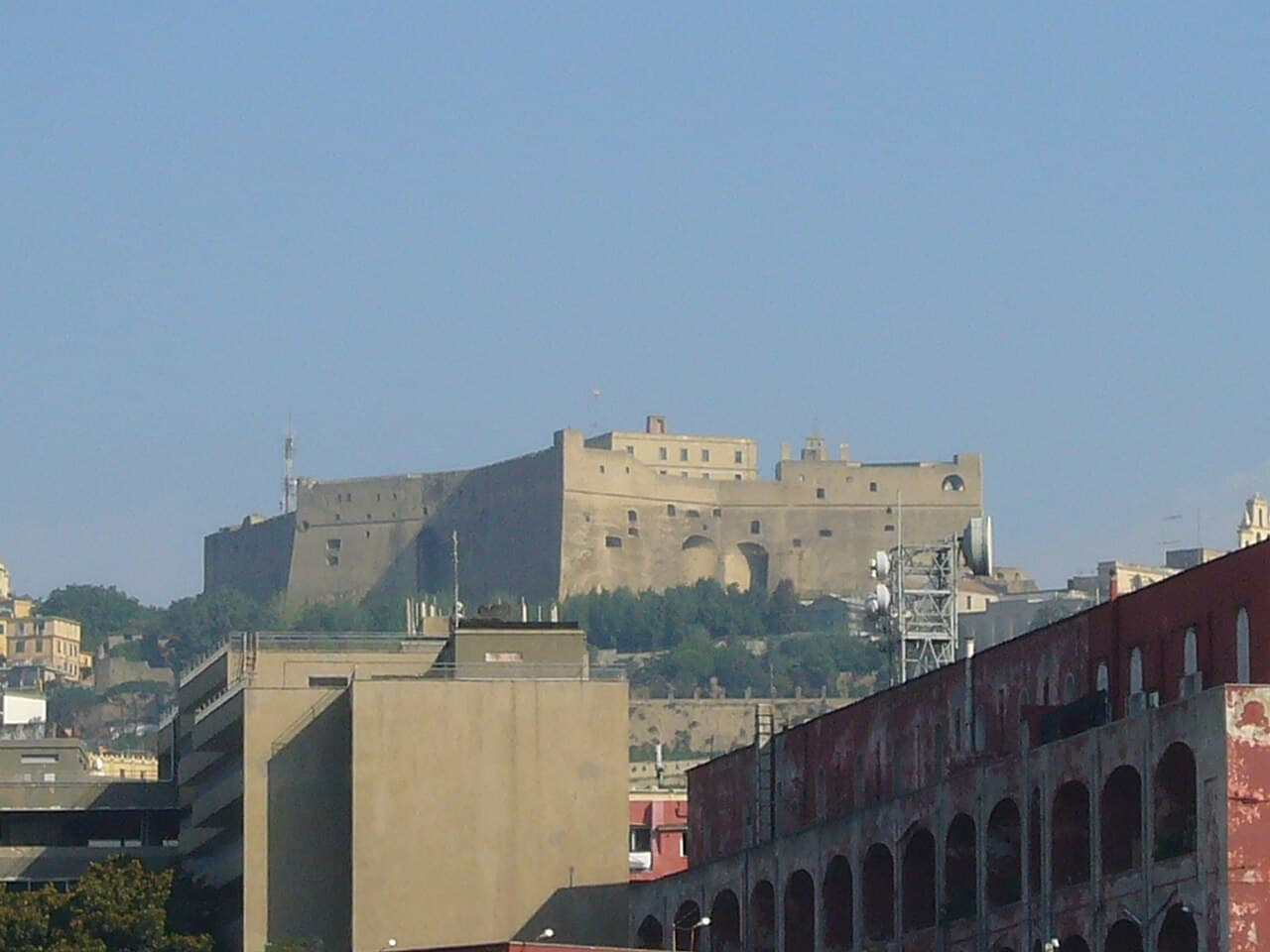
Castel Sant'Elmo is a prominent medieval fortress strategically positioned on Vomero Hill, offering commanding views over the city of Naples and its historic center. Its name originates from a former 10th-century church dedicated to Sant'Erasmo, which evolved linguistically over centuries to "Sant'Elmo." The fortress stands adjacent to the Certosa di San Martino and near the upper terminus of the Petraio, one of Naples' oldest pedestrian routes connecting the upper and lower city. Today, Castel Sant'Elmo serves as a museum, exhibition hall, and administrative offices, reflecting its cultural and historical significance.
Early origins and angevin construction
The earliest documented structure on the site dates to 1275, during the reign of Charles of Anjou. Originally known as Belforte, it likely functioned as a fortified residence surrounded by defensive walls, with its entrance gate flanked by two turrets. In 1329, King Robert of Naples commissioned the enlargement of the fortress based on designs by the Sienese architect Tino da Camaino. Camaino, who also oversaw construction of the adjacent Carthusian monastery of San Martino, directed the building works until his death in 1343. By 1336, the fortress was referred to as a castrum or castle, marking its evolution from a fortified residence to a military stronghold.
Architectural features of the angevin fortress
The Angevin fortress featured robust walls and towers, constructed primarily from volcanic tufa, a local stone providing strength and durability. A chapel dedicated to Saint Erasmus was established within the complex, lending the fortress its early religious significance. The fortress's elevated position allowed it to serve as a key defensive and surveillance point over Naples and the surrounding region.
Aragonese transformation and star-shaped design
The fortress suffered severe damage in the 1456 earthquake, which demolished its external walls and towers. In the 16th century, under the rule of the Aragonese dynasty, the castle was incorporated into a comprehensive defensive system designed to protect Naples' land perimeter. Don Pedro de Toledo, the first Spanish governor and cousin of the Viceroy, played a pivotal role in this fortification plan.
Between 1537 and 1547, the fortress underwent a radical transformation under the direction of the military architect Pedro Luis Escriva from Valencia. He redesigned Castel Sant'Elmo into a distinctive hexagonal star-shaped fortress, a cutting-edge style of 16th-century military architecture that improved resistance to artillery attacks. This innovative design featured six pointed bastions extending approximately twenty meters from the core, with large open embrasures replacing traditional towers and buttresses. Escriva's design initially faced fierce criticism, prompting him to publish an Apologia in 1538 defending the fortress's functional and strategic merits.
Defensive elements and structural details
The fortress is surrounded by a moat and incorporates a double tenaille system, enhancing its defensive capabilities. The entrance is accessed via a steep inclined ramp leading to a small bridge, flanked by walls pierced with twelve defensive loopholes on each side and seven additional loopholes guarding the drawbridge. The main gate is adorned with the imperial coat of arms of Emperor Charles V, featuring the double-headed eagle, alongside a commemorative marble inscription honoring Charles V and Viceroy Pedro de Toledo.
Catastrophic explosion and restoration
In 1587, lightning struck the fortress's munitions depot, causing a massive explosion that destroyed the church of Saint Erasmus, the chaplain's house, and officers' quarters, and resulted in the deaths of approximately 150 people. Restoration efforts commenced between 1599 and 1601, led by the architect Domenico Fontana, who rebuilt the damaged structures while preserving the fortress's original layout.
Religious and commemorative features
The restored church contains notable artworks, including paintings by Luca Giordano, Antonio De Bellis, and Francesco De Maria, and a richly decorated maiolica and terracotta floor. Don Pedro de Toledo's funerary monument, dating to 1588, is housed in the church's sacristy. The church's vault features an 18th-century fresco of the Assumption of Mary, and the main altar holds a sculpture of Saint Erasmus, the fortress's patron saint.
Military and prison use
From the early 17th century, Castel Sant'Elmo functioned primarily as a military prison. It housed notable prisoners such as the philosopher Tommaso Campanella (1604–1608), who was branded a heretic, and the princess Giovanna di Capua. The fortress also played a role during the 1647 Neapolitan revolution, providing refuge for the viceroy Rodrigo Ponce de León and resisting siege by popular forces.
Throughout the 18th century, the fortress faced sieges by Austrian and Bourbon troops, reflecting its continued strategic importance amid European conflicts. During the turbulent period of the French Revolution and the 1799 Neapolitan uprising, Castel Sant'Elmo was used to imprison Jacobin supporters and republicans, including Mario Pagano, Gennaro Serra di Cassano, and Luigia Sanfelice. The castle was briefly seized by republicans who raised the Neapolitan Republic's flag and planted a tree of liberty, symbolizing revolutionary ideals.
The fortress remained a military prison until 1952, after which the prison functions were transferred to Gaeta. It subsequently housed naval personnel and their families until 1976.
Modern restoration and cultural use
Beginning in 1976, a comprehensive restoration project was undertaken by the provincial authority of Campania, led by the Provveditorato alle Opere Pubbliche. The restoration removed centuries of accretions, stabilized the structure, and recreated original architectural features such as galleries, parapet walkways, and underground chambers. An auditorium seating 700 was installed within the fortress's underground spaces, blending modern functionality with historical preservation.
In 1982, the castle was transferred to the Soprintendenza per i Beni Artistici e Storici of Naples. The Bruno Molajoli Art History Library was established in an upper story of the former prison block, enhancing the site's cultural offerings. The former Marine headquarters now houses administrative offices, including the Catalogue Office, Photographic Archives, and the Thefts Office for Naples.
Permanent art exhibits enrich the visitor experience, including a unique more than 30-foot-long railing inscribed with braille, installed in 2015 above the drill grounds on the northernmost wall near the west corner. Additional modern sculptures, such as a large metal helmet and a conical metal structure with cutouts, complement the historical environment.
Architectural significance and features
Castel Sant'Elmo's most distinctive feature is its six-pointed star-shaped layout, a hallmark of Renaissance military architecture designed to counter artillery assaults. Unlike traditional castles with towers and buttresses, it employs large open embrasures at its bastions, allowing defenders to mount artillery effectively. The fortress is built predominantly from volcanic tufa, which provides both strength and a characteristic appearance.
The fortress's defensive perimeter includes a moat, and its water needs during sieges were met by a sophisticated cistern system beneath the parade ground, comprising two large tanks. Today, a modern water tank with a capacity of 400 cubic meters is integrated into the walls, supplying the surrounding Vomero district.
The main entrance features a steep ramp and a small bridge flanked by walls with numerous loopholes for defense. The interior contains a Napoleonic-era guillotine gate near the entrance, prison cells, and halls with large windows offering panoramic views of Naples and the Bay of Naples.
Outside the main fortification ring are two significant churches: the small church of Our Lady of the Pillar (1682) and the church of Saint Erasmus (1547), the latter rebuilt after the 1587 explosion. These religious structures underscore the fortress's dual military and spiritual roles throughout history.
The fortress also features a piperno stone sentry box from the Bourbon period, offering vistas over the Posillipo cape, Nisida island, Miseno cape, and the volcanic Phlegraean fields, highlighting its strategic visual command of the region.
Frequently asked questions (FAQ)
- How do I get to Castel Sant'Elmo?
- You can reach Castel Sant'Elmo by taking the funicular from the city center of Naples to the top of the hill. It is also accessible by car or public transportation, with several bus lines serving the area. The castle is located in the Vomero district, offering stunning views of the city.
- What is the historical significance of Castel Sant'Elmo?
- Castel Sant'Elmo was built in the 14th century and served as a fortress to protect Naples from invasions. Its strategic position on the hill of Sant'Elmo made it a crucial military outpost throughout history. Today, it stands as a symbol of Neapolitan resilience and artistic heritage.
- When was Castel Sant'Elmo constructed?
- Construction of Castel Sant'Elmo began in 1329, and it was completed in the mid-15th century. The castle has undergone various renovations and restorations over the centuries, reflecting different architectural styles. Its unique star shape is a testament to the military engineering of the time.
- Can I visit Castel Sant'Elmo year-round?
- Yes, Castel Sant'Elmo is open to visitors throughout the year, although specific opening hours may vary by season. It is advisable to check the official website for current visiting times and any possible closures due to events or maintenance. Visiting during weekdays can offer a quieter experience.
- Why is Castel Sant'Elmo a popular tourist attraction?
- Castel Sant'Elmo is popular for its breathtaking panoramic views of Naples and the Bay of Naples. Visitors are also drawn to its rich history and impressive architecture, which showcase the evolution of military fortifications. Additionally, the castle often hosts cultural events and exhibitions, enhancing its appeal.
- Is it possible to buy tickets online for Castel Sant'Elmo?
- Yes, you can purchase tickets online through the official Castel Sant'Elmo website or various tourism platforms. Buying tickets in advance is recommended, especially during peak tourist seasons, to avoid long queues. Discounts may be available for students and groups.
- What are the opening hours for Castel Sant'Elmo?
- Castel Sant'Elmo typically opens at 9:30 AM and closes at 7:30 PM, with the last entry one hour before closing. During holidays or special events, hours may vary, so it’s best to check in advance. The castle is usually closed on certain holidays, so plan your visit accordingly.
- What nearby attractions can I visit while at Castel Sant'Elmo?
- While visiting Castel Sant'Elmo, you can also explore the nearby Certosa di San Martino, a stunning monastery with beautiful gardens and museums. Additionally, the Vomero district offers charming streets filled with shops, cafes, and panoramic viewpoints. Combining these sites will enrich your experience in Naples.

Information
Website
Visit websiteSources & official resources
Verify the information above using these authoritative references.
Loading map...
Visitor reviews
No reviews yet. Been here? Write the first review and help other travelers!
Write the first reviewVisited this castle? Share your experience
Your review helps other travelers and adds first-hand knowledge to our encyclopedia.