Castel Nuovo
Castel Nuovo, also known as Maschio Angioino, stands as one of the most iconic and historically significant fortresses in Naples, Italy. Constructed beginning in 1279 under the reign of Charles I of Anjou, this castle was designed by the French architect Pierre de Chaule to serve as a royal residence and a formidable fortress. Its strategic position near the sea and the city center made it a vital military and political hub throughout the centuries.
The castle was originally built to replace older fortifications like Castel Capuano and Castel dell'Ovo, marking the shift of the Sicilian capital to Naples after Charles I's conquest. From its inception, Castel Nuovo was not only a stronghold but also a cultural center. Under the rule of Robert of Anjou, it became a vibrant hub for artists, poets, and scholars including Giotto, Petrarch, and Boccaccio, who contributed to the castle's artistic and intellectual prestige.
Architectural evolution and aragonese transformation
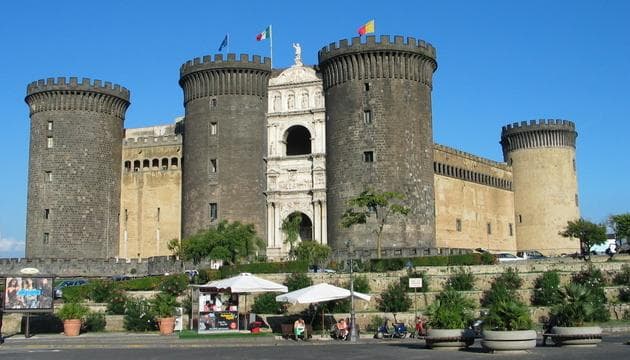
The castle's original design reflected high medieval military architecture, featuring a square layout with robust towers and defensive walls. However, a significant transformation occurred during the reign of Alfonso V of Aragon after he captured Naples in 1443. Between 1453 and 1479, the fortress was extensively remodeled by the Catalan architect Guillem Sagrera in the Gothic-Catalan style. This renovation replaced the original square towers with five massive round towers, enhancing the castle's defensive capabilities and giving it the imposing silhouette it retains today.
One of the castle's most striking features is the triumphal arch at the main entrance, constructed between 1452 and 1471 to celebrate Alfonso V's victorious entry into Naples. This Renaissance-style marble arch is richly decorated with reliefs depicting Alfonso's procession, statues of the four cardinal virtues, and a statue of Saint Michael crowning the top. The arch was crafted by renowned sculptors including Guillem Sagrera, Domenico Gagini, Isaia da Pisa, and Francesco Laurana, making it a masterpiece of Renaissance sculpture and a symbol of Aragonese power.
Structural layout and defensive features
Castel Nuovo has an irregular trapezoidal plan surrounded by a moat, with five main towers: San Giorgio, Mezzo, and Guardia on the landward side, and Oro and Beverello facing the sea. Four towers are faced with piperno, a volcanic stone typical of the Naples region, while one tower is clad in tuff. Each tower is topped with battlements supported by corbels and contains a cylindrical spiral staircase known as the Catalan staircase, which provided access to rooftop watch posts and defensive positions.
Historical significance and cultural heritage
Throughout its history, Castel Nuovo served as a royal residence for successive dynasties including the Angevins, Aragonese, French, Spanish viceroys, and Bourbons. It was the site of important historical events, such as the abdication of Pope Celestine V and the election of Pope Boniface VIII in 1294. The castle also hosted a failed conspiracy against King Ferdinand I of Aragon in 1487, after which the conspirators were executed within its walls.
Under the Spanish viceroyalty (1503-1734), the castle's military functions were emphasized, leading to modifications that sometimes compromised its artistic elements. The Bourbon period saw further changes, including the addition of barracks and warehouses, which altered the castle's appearance and function. Despite these changes, the castle retained its importance as a symbol of royal authority and military strength.
Artistic treasures and interior spaces
The castle's interiors include the Palatine Chapel, the only surviving part of the original Angevin structure, featuring a Renaissance portal decorated by Andrea dell’Aquila and Francesco Laurana. The chapel's rose window was redesigned during the Aragonese period by Matteo Forcimanya. Although much of the original Giotto frescoes have been lost, the chapel remains a significant example of Neapolitan Renaissance art.
The Hall of the Barons, once the throne room, is a large space measuring approximately 26 by 28 meters. It is covered by an eight-sided umbrella vault with pointed lunettes and a central oculus. The hall features a large fireplace, galleries for musicians, and decorative elements such as a double-sided marble portal by Domenico Gagini. The floor is tiled with white and blue majolica from Valencia, reflecting the cultural exchanges of the period.
The Armory Hall reveals important archaeological remains from the Roman period beneath a glass floor, showcasing the site's long history. The Chapel of the Souls in Purgatory, added in the late 16th century, exhibits Baroque decoration and was used to administer sacraments to prisoners condemned to death. The Chapel of Saint Francis of Paola, consecrated in 1688, underwent Baroque restoration but suffered damage during World War II.
Restoration and modern use
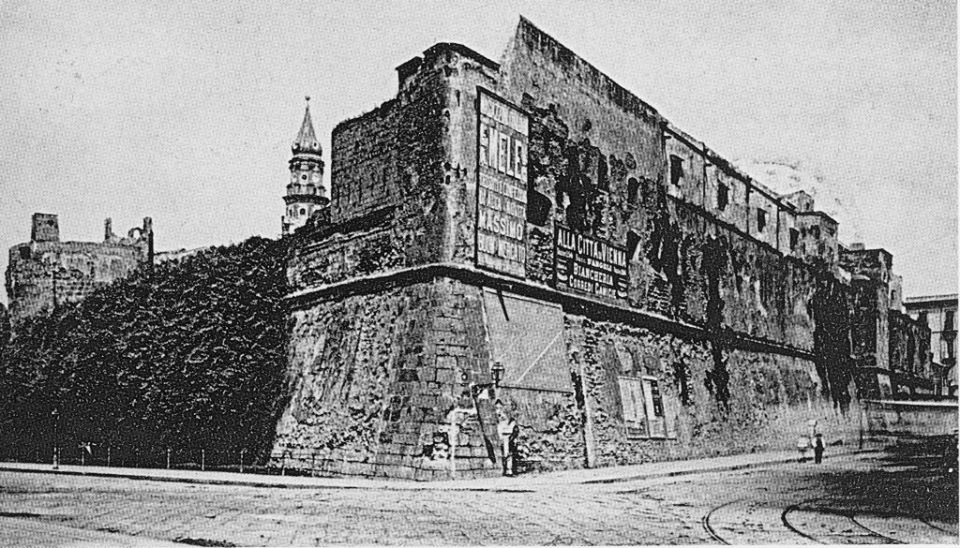
In the 20th century, restoration efforts focused on isolating the castle from surrounding buildings and recovering its 15th-century appearance. These campaigns removed many later additions, revealing medieval windows, battlements, walls, and the moat. Some roofs were replaced with modern coverings to ensure structural safety.
Today, Castel Nuovo is a well-preserved monument and a cultural venue hosting exhibitions, concerts, and events. It houses the Civic Museum, which contains collections from the 15th to 20th centuries, including works by followers of Caravaggio and Neapolitan Baroque artists. The castle also holds the library of the Neapolitan Society of Homeland History, featuring rare early printed books.
Visitors can explore key areas such as the Armoury Hall, Palatine Chapel, Hall of Charles V, and the Sala della Loggia. Some parts remain closed due to ongoing preservation challenges, but the castle continues to be a vital link to Naples' medieval and Renaissance past.
Frequently asked questions (FAQ)
- What is the historical significance of Castel Nuovo?
- Castel Nuovo, also known as the Maschio Angioino, is a prominent medieval castle in Naples, Italy, built in the 13th century. It served as a royal palace for several kings and has witnessed significant historical events, making it a symbol of the city’s rich heritage.
- When was Castel Nuovo built?
- Construction of Castel Nuovo began in 1279 under King Charles I of Anjou and was completed in 1282. The castle has undergone numerous renovations over the centuries, reflecting various architectural styles and historical periods.
- What are the opening hours of Castel Nuovo?
- Castel Nuovo is typically open from 9:00 AM to 7:30 PM, with the last entry at 6:30 PM. It is advisable to check the official website for any seasonal changes or special closures before your visit.
- Can I purchase tickets online for Castel Nuovo?
- Yes, visitors can purchase tickets online to avoid long queues and ensure entry at their desired time. Online ticket sales often offer discounts or special packages, so it's worth checking the official website for details.
- Is it possible to access Castel Nuovo with a wheelchair?
- Castel Nuovo is partially accessible for visitors with mobility challenges, with ramps and elevators available in certain areas. It’s recommended to contact the castle staff in advance for detailed information on accessibility options.
- When is the best time to visit Castel Nuovo?
- The best time to visit Castel Nuovo is during the spring (April to June) and fall (September to October) when the weather is mild and the tourist crowds are smaller. These seasons provide a more enjoyable experience for exploring the castle and its surroundings.
- What nearby attractions can I visit after Castel Nuovo?
- After visiting Castel Nuovo, you can explore nearby attractions such as the Royal Palace of Naples, the Teatro di San Carlo, and the picturesque Piazza del Plebiscito. These sites offer a glimpse into the rich cultural history of Naples.
- What are the ticket prices for Castel Nuovo?
- Ticket prices for Castel Nuovo typically range from €10 for adults, with reduced prices for students and seniors. Children under a certain age may enter for free, so it's best to check the official site for the most current pricing and any available discounts.

Information
Website
Visit websiteSources & official resources
Verify the information above using these authoritative references.
Loading map...
Visitor reviews
No reviews yet. Been here? Write the first review and help other travelers!
Write the first reviewVisited this castle? Share your experience
Your review helps other travelers and adds first-hand knowledge to our encyclopedia.