Castel National Park
Castel National Park is a historically significant site located in the municipality of Mevaseret Zion, Israel. Positioned on a fortified hill in the Judean Mountains, it commands a strategic vantage point overseeing the vital road connecting Tel Aviv and Jerusalem. The site's origins trace back to the Roman period, when a fortress known as Castellum was constructed to secure this crucial passage during the 2nd century CE.
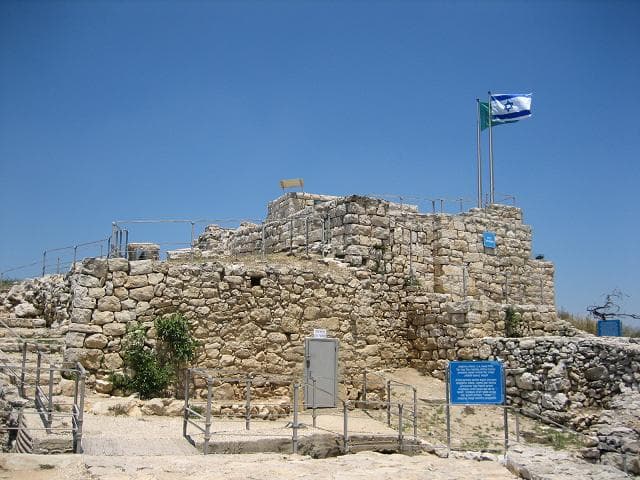
The Roman fortress served both military and administrative roles, featuring foundational fortifications designed to control movement along the main route to Jerusalem. These remains represent some of the earliest known structures at the site, embodying Roman military architecture adapted to the local topography.
Medieval and later historical significance
During the Crusader period, the hill regained military importance. Historical accounts mention a fortress called Castellum Belveer built atop the Roman ruins. However, no archaeological evidence has yet confirmed the physical remains of this Crusader castle. Despite this, the site's strategic value was clearly recognized by successive powers controlling the region.
In subsequent centuries, the hill became home to the Arab village Al-Qastal. The village's mukhtar constructed his residence on the hilltop, reportedly directly over the Crusader fortress's location, thereby integrating later habitation with earlier fortifications. Under the British Mandate in the early 20th century, the site continued to be known locally as "The Castle," reflecting its enduring association with fortification and defense.
The 1947–1948 arab-israeli conflict and military importance
Castel National Park's most dramatic chapter unfolded during the 1947–1948 Arab-Israeli conflict. The site was a critical battleground during the Arab siege of Jerusalem, particularly in Operation Nachshon, a Jewish military campaign aimed at breaking the blockade on the city. Control of Al-Qastal shifted multiple times amid intense fighting.
A pivotal moment occurred on April 8, 1948, when the prominent Arab commander Abd al-Qadir al-Husayni was killed during combat at the site. His death caused a temporary withdrawal of Arab forces for his funeral, allowing Israeli troops to capture the hill with minimal resistance on April 9, 1948. Securing Castel Hill was vital in reopening the main highway to Jerusalem, significantly alleviating the siege's pressure.
Post-war developments and memorialization
Following the conflict, the area saw the establishment of the Jewish community Mevaseret Zion at the base of Castel Hill in the early 1950s. The site was subsequently developed into a national park and memorial to commemorate the battles fought there and honor those who died attempting to break Jerusalem's blockade.
Today, Castel National Park preserves a layered historical landscape. The Roman fortress ruins remain visible, showcasing the ancient military architecture that once controlled the region. Above these, the mukhtar's house from the Arab village period stands, reportedly built atop the Crusader fortress site, blending historical epochs.
The terrain also retains physical traces from the 1948 battles, including preserved fortress ruins and trenches carved during the fighting. These features are intentionally maintained as part of the site's role as a memorial, providing visitors with tangible connections to the past conflict.
Memorials and interpretive features
Throughout the park, several bronze plaques offer detailed accounts of the April 1948 battle, guiding visitors through the military events and emphasizing the site's strategic importance. Memorials dedicated to Israeli soldiers who fell during the fighting are prominent, including a monument created in 1980 by artist Yitzhak Yamin.
Additionally, a memorial honors the convoys that endeavored to break Jerusalem's blockade during the siege, symbolizing the courage and sacrifice of those involved in this critical chapter of Israeli history. These commemorative installations reinforce Castel National Park's dual role as both a historic site and a place of remembrance.
Architectural and historical significance
Castel National Park exemplifies a site where multiple historical layers converge, from Roman military architecture to modern 20th-century warfare. Its position on a hilltop in the Judean Mountains has continuously made it a strategic military asset, reflected in its repeated fortification and use across centuries.
The preservation of Roman fortifications alongside 20th-century trenches and memorials offers a unique opportunity to study the evolution of defensive architecture and military strategy in this region. The site's integration into modern Israel as a national park ensures ongoing public engagement with this rich historical heritage.
Visitors to Castel National Park can explore the ancient ruins, walk the preserved battle trenches, and reflect at the memorials, gaining insight into the complex history of Jerusalem's defense and the broader regional conflicts that have shaped its destiny.
Frequently asked questions (FAQ)
- How do I get to Castel National Park?
- Castel National Park is located near Mevaseret Zion in the Jerusalem District of Israel. It is accessible by car and public transportation from Jerusalem and Tel Aviv. Visitors should check local transit schedules for the most convenient routes.
- What historical periods are represented at Castel National Park?
- The park features remains from the Roman period, the Crusader era, and the 1947–1948 Arab-Israeli conflict. It showcases layers of military history spanning over two millennia.
- Is it possible to see the 1948 battle trenches at Castel National Park?
- Yes, the park preserves trenches and fortress ruins from the 1948 battles, allowing visitors to explore and understand the site's role in the Arab siege of Jerusalem.
- What memorials are present at Castel National Park?
- There are several memorials, including a monument by artist Yitzhak Yamin dedicated to Israeli soldiers and a memorial honoring the convoys that broke Jerusalem's blockade during the 1948 siege.
- When was Castel National Park established as a memorial site?
- The park was developed in the decades following the 1948 conflict, with significant memorial installations added by the 1980s to commemorate the battles and fallen soldiers.
Photo gallery

Photo by אסף.צ at Hebrew Wikipedia•Public domain
Information
Sources & official resources
Verify the information above using these authoritative references.
Loading map...
Visitor reviews
No reviews yet. Been here? Write the first review and help other travelers!
Write the first reviewVisited this castle? Share your experience
Your review helps other travelers and adds first-hand knowledge to our encyclopedia.