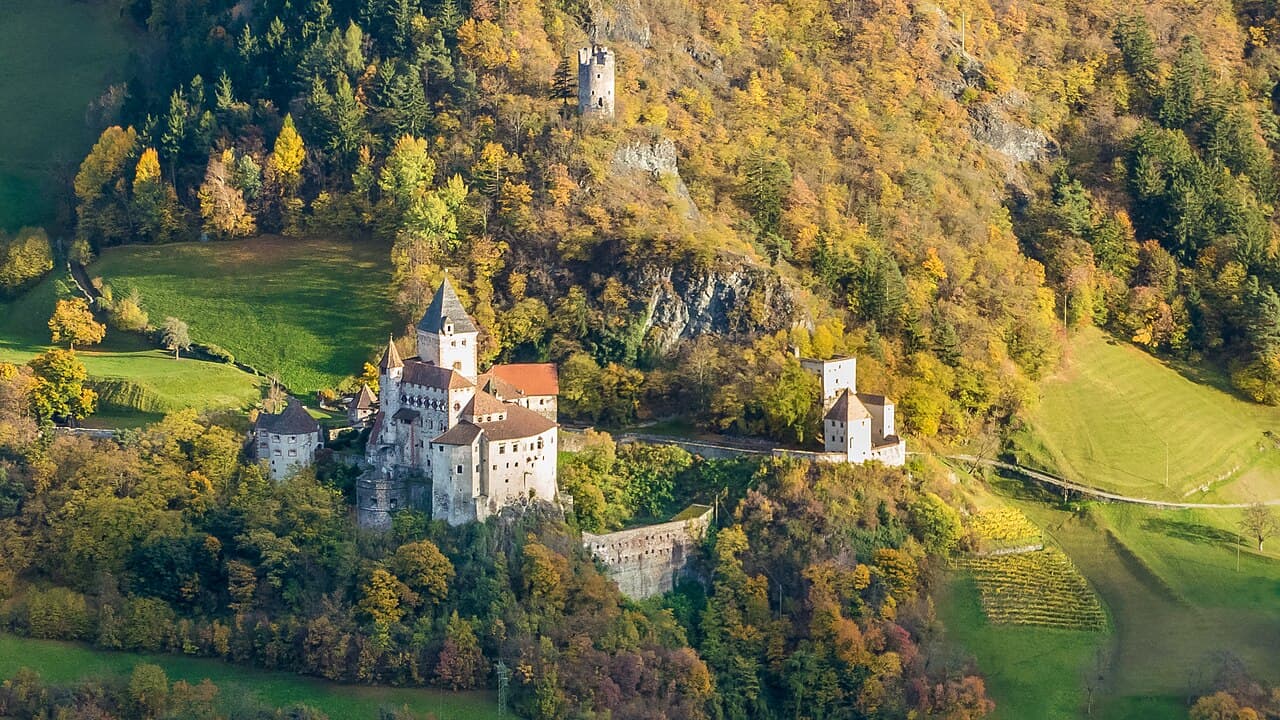
Castel Gardena
Trostburg Castle, perched on a natural rocky promontory overlooking the Eisack Valley near Ponte Gardena in South Tyrol, Italy, stands as a remarkable example of a medieval hilltop fortress with a rich history spanning over eight centuries. Its strategic location and architectural evolution reflect its significance as both a defensive stronghold and noble residence, making it a key heritage site in the region.
The earliest known mention of Trostburg Castle dates back to 1173, when it was recorded as the residence of Cunrat de Trosperch, a nobleman from the Castelrotto family. Over the centuries, the castle passed through several noble hands, including the Velturns family and later the Wolkenstein-Trostburg family, who held it for nearly six centuries. This enduring lineage contributed to the castle's architectural and historical richness.
Architectural evolution and fortifications
Medieval origins and early structures
The castle's core includes a Romanesque palas dating from the early 13th century, originally three stories high and later raised by an additional floor in the 17th century. The central courtyard is dominated by a tall bergfried (keep) constructed around 1230, serving as a formidable defensive tower and symbol of feudal authority. Adjacent to this is a Gothic residential wing built atop 15th-century medieval walls, illustrating the castle's continuous adaptation to changing architectural styles and defensive needs.
Renaissance and early modern additions
Between the 16th and 17th centuries, the castle underwent significant expansions, including the addition of a Renaissance wing where earlier fortifications once stood. The Renaissance hall within features elaborate stucco figures portraying the castle-owning family and richly carved coffered ceilings with heraldic motifs dating from 1607 to 1618. An adjoining loggia displays painted coats of arms, reflecting the artistic tastes and noble prestige of the era.
Fortifications against artillery
From the late 15th century through the early 17th century, Trostburg's defenses were enhanced to withstand artillery warfare. These improvements included the construction of bastions and outer barriers, some of which were later converted into living spaces during the 18th century as the castle's military role diminished. Defensive features such as iron-bound gates, a massive wooden portcullis, firearm-adapted window openings, and iron stakes to deter attackers remain notable elements of the castle's fortifications.
The castle complex and grounds
Outer bailey and gatehouse
The castle complex comprises three interconnected sections: the main castle, the outer bailey, and the Kreideturm watchtower. The outer bailey forms a large enclosed courtyard surrounded by a ring wall and a wide moat, accessed through the fortified Michaelstor gate featuring a drawbridge. This area historically housed essential service buildings such as stables, a smithy, and storage facilities, supporting the castle's daily operations.
Kreideturm watchtower
Perched on a rocky outcrop above the main castle, the Kreideturm served as a signal tower where beacon fires could be lit to warn neighboring castles of impending threats. This tall watchtower underscores the castle's strategic importance in regional defense and communication networks.
Interior spaces and notable features
Inside, visitors can find a rare Gothic chamber distinguished by a triple-arched wooden vault predating 1407, one of the few surviving examples of such medieval craftsmanship. The castle chapel remains a key religious space, reflecting the spiritual life of its inhabitants. The interior also includes richly decorated rooms with Renaissance and Gothic elements, such as the elaborately adorned Ahnensaal (Hall of Ancestors), completed in 1632 under Count Engelhardt Dietrich zu Wolkenstein.
Historical significance and ownership
Throughout its history, Trostburg Castle was a center of noble power and jurisdiction. The Wolkenstein-Trostburg family exercised authority over the nearby municipality of Ponte Gardena and, at times, the court of Villanders. The castle's role evolved from a fortified residence to a summer retreat by the 17th century, reflecting broader changes in aristocratic lifestyles and military technology.
Despite periods of neglect and damage, including structural collapses and World War II bombings, extensive restoration efforts since the late 20th century have preserved Trostburg's architectural integrity. The castle was acquired by the South Tyrolean Castle Institute in 1981, which has overseen ongoing conservation and public access initiatives.
Cultural heritage and museum
Since 2005, Trostburg Castle has housed the South Tyrolean Castles Museum, which showcases the rich history of regional fortifications and noble residences. The museum features a notable collection of 86 scale models of South Tyrolean castles created by Ludwig Mitterdorfer in the early 20th century, providing visitors with a comprehensive overview of the area's medieval and early modern heritage.
The castle grounds also include historical artifacts such as three Roman votive stones dating to approximately 180 AD and one of Italy's largest historic wine presses, notable for its exceptionally long 11-meter press beam. The presence of a Tetraclinis articulata (sandarak tree) planted during the early modern era adds botanical interest to the site.
Visiting trostburg castle
Trostburg Castle is accessible to visitors via a steep medieval pathway traditionally used by knights or a gentler road from the nearby village of Ponte Gardena. The castle's well-preserved state, combined with its historical ambiance and museum exhibits, offers a compelling experience for enthusiasts of medieval architecture and South Tyrolean history.
While the castle interiors contain delicate historical features, public access is managed to preserve these elements. Visitors can explore the museum's exhibitions and enjoy views of the Eisack Valley from the castle's elevated position.
Frequently asked questions (FAQ)
- How do I get to Castel Gardena?
- Castel Gardena is located in Waidbruck, Italy, easily accessible by car or public transportation. If you are traveling by train, the nearest station is in Bolzano, from where you can take a bus or taxi to reach the castle.
- What is the historical significance of Castel Gardena?
- Castel Gardena dates back to the 13th century and played a crucial role in the region's defense and trade routes. It is an excellent example of medieval architecture and provides insights into the feudal system of the time.
- When was Castel Gardena built?
- Construction of Castel Gardena began in the early 13th century, around 1230, and it was completed in subsequent decades. The castle has seen various renovations and restorations throughout its history, reflecting different architectural styles.
- Can I take guided tours of Castel Gardena?
- Yes, guided tours are available for visitors who want to learn more about the history and architecture of Castel Gardena. These tours typically include access to the castle's main areas and detailed explanations of its historical significance.
- Why is Castel Gardena a popular tourist attraction?
- Castel Gardena attracts visitors due to its stunning views of the surrounding Dolomites, rich history, and well-preserved architecture. The blend of natural beauty and cultural heritage makes it a must-see destination in the region.
- Is it possible to host events at Castel Gardena?
- Yes, Castel Gardena offers facilities for hosting special events such as weddings, corporate events, and private gatherings. The picturesque setting and unique ambiance make it an ideal location for memorable celebrations.
- What are the opening hours for Castel Gardena?
- Castel Gardena is typically open to visitors from March to October, with varying hours depending on the season. It is recommended to check the official website for the most current opening hours before planning your visit.
- What are the ticket prices for visiting Castel Gardena?
- Ticket prices for Castel Gardena are generally affordable, with discounts available for students, seniors, and families. Special rates may apply during certain events or exhibitions, so it's advisable to check the official site for the latest pricing information.
- What is the best time to visit Castel Gardena?
- The best time to visit Castel Gardena is during the spring and early autumn months when the weather is mild and the landscape is particularly scenic. Additionally, visiting during these times allows you to enjoy fewer crowds and a more relaxed experience.
- Are there nearby attractions to visit after Castel Gardena?
- Yes, visitors can explore several nearby attractions, such as the beautiful town of Bolzano, the stunning Dolomites, and various hiking trails. Each of these locations offers unique experiences that complement your visit to Castel Gardena.
Photo gallery

Information
Website
Visit websiteSources & official resources
Verify the information above using these authoritative references.
Loading map...
Visitor reviews
No reviews yet. Been here? Write the first review and help other travelers!
Write the first reviewVisited this castle? Share your experience
Your review helps other travelers and adds first-hand knowledge to our encyclopedia.



