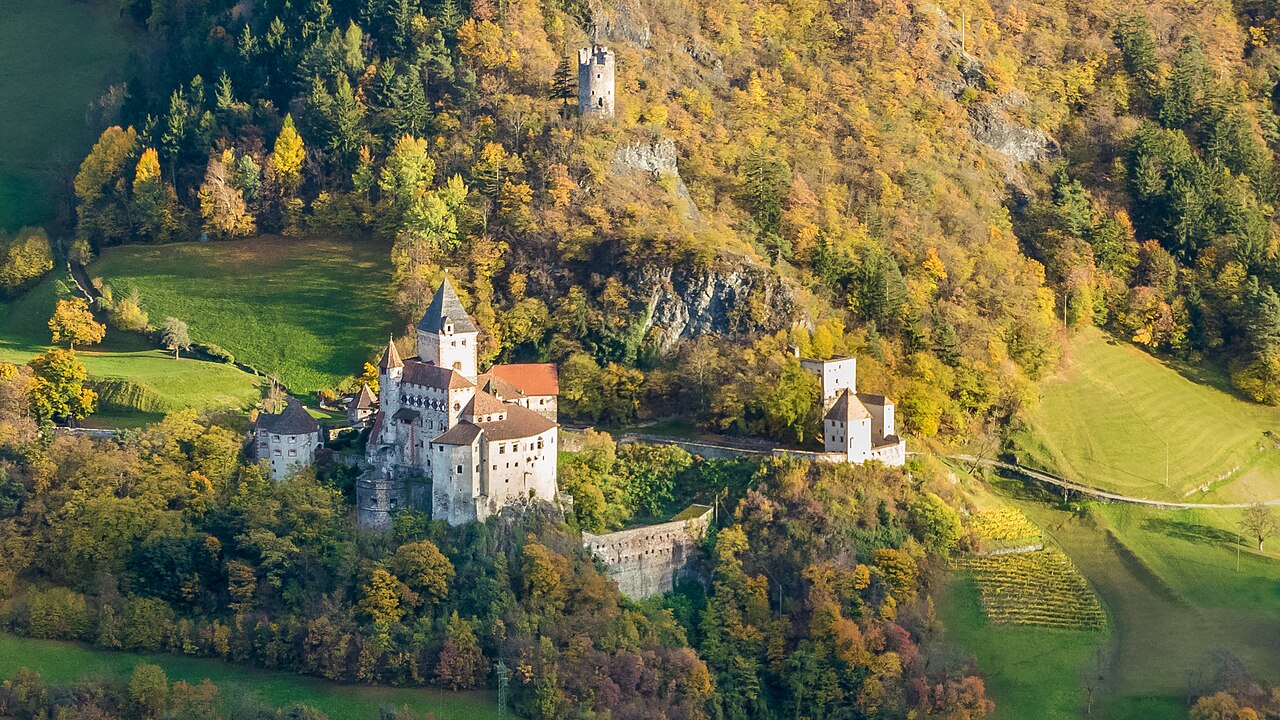
Branzoll Castle
Branzoll Castle is a striking example of a high medieval hill castle located above the town of Chiusa (Klausen), Italy. Constructed around 1250 by the Lords of Säben, members of the influential Volser family, it served as a strategic stronghold guarding the entrance to the bishopric’s fortress on Mount Säben. The castle's position atop a hill provided commanding views of the surrounding valley, making it a vital defensive and administrative center through the centuries.
The castle’s initial purpose was closely tied to the turbulent power struggles of the era, particularly between local nobility and the ecclesiastical authorities represented by Bishop Bruno von Kirchberg and his ministeriales, officials who managed the bishop’s estates. By the early 14th century, specifically in 1304, the Lords of Säben formally transferred control of Branzoll Castle to the bishops of Brixen, marking a significant shift in regional power and integrating the castle fully into the bishopric’s domain by the mid-15th century.
Architectural features and layout
The castle complex is a classic example of a hill castle, designed for both defense and residence. The core of the fortress is the bergfried, a tall, robust tower over 20 meters high that remains the most prominent surviving medieval feature. This tower, known as the burghauptmannsturm (castle captain's tower), was named after the castle captains (burghauptmann) who administered the site during its centuries of episcopal use.
The bergfried was constructed to be a final refuge during attacks and a symbol of lordly power. Its thick stone walls and height allowed defenders to monitor the surrounding landscape and signal to allied forces. The tower survived a devastating fire in 1671 that destroyed most of the castle, preserving a tangible link to the original medieval fortress.
Surrounding the bergfried is the inner bailey, a compact enclosure that housed essential living quarters and administrative spaces. This inner courtyard was protected by a zwinger, an outer defensive courtyard designed to trap and expose attackers between the outer and inner walls. The zwinger’s partial reconstruction during the late 19th and early 20th centuries restoration efforts helps visitors appreciate the castle’s defensive complexity.
Beyond the zwinger lies the outer bailey, now maintained as a garden, which historically would have contained auxiliary buildings and stables. The curtain walls enclosing these areas were rebuilt and topped with battlements (crenellations), allowing defenders to shield themselves while observing or firing upon attackers.
Historical significance and events
Throughout its history, Branzoll Castle played a key role as an administrative and judicial center for the Prince-Bishopric of Brixen. Between 1465 and 1671, it housed the court judge of the prince-bishop, underscoring its importance in regional governance. The castle’s function as a seat of power was closely linked to the bishops’ efforts to consolidate control over their territories amid local noble resistance.
The catastrophic fire of 1671 marked a turning point, destroying much of the residential buildings and administrative quarters. Only the bergfried and foundational walls of the palas (main residential building) survived. Following the fire, the castle fell into ruin and was largely abandoned for over two centuries. Stones from the ruins were quarried for other construction projects, accelerating its decline.
Ownership remained with the bishopric until 1874, when the property was gifted to the town of Klausen. Attempts to sell the dilapidated ruins initially failed, but in 1895, the castle was acquired by Otto Piper, who initiated extensive restoration efforts. Over the following decades, private owners continued reconstruction, blending medieval remains with new residential structures. By 1913, the castle had been largely rebuilt and restored as a residence.
Restoration and current condition
The restoration of Branzoll Castle in the late 19th and early 20th centuries was a significant architectural undertaking. While the bergfried retained much of its original medieval fabric, the residential tract was entirely rebuilt, reflecting contemporary architectural styles and living standards of the period. A notable addition was the semicircular tower housing a stone staircase, which connects the bergfried to the new residential buildings, integrating medieval and modern elements.
The castle’s defensive walls were reconstructed with attention to historical accuracy, including the restoration of battlements and partial rebuilding of the zwinger. The outer bailey was landscaped as a garden, preserving the castle’s footprint and providing a serene setting that contrasts with its martial origins.
Today, Branzoll Castle remains privately owned by the Leitner family since 1982 and is not open to the public. Despite this, its imposing silhouette dominates the skyline above Klausen, continuing to be one of the most architecturally impressive and historically rich landmarks in the region.
Cultural and architectural legacy
Branzoll Castle exemplifies the evolution of medieval fortifications in the Alpine region, showcasing the transition from purely military structures to combined defensive and residential complexes. Its survival through centuries of conflict, natural disaster, and neglect highlights the resilience of medieval stone architecture.
The castle’s connection to the Prince-Bishopric of Brixen provides valuable insights into the ecclesiastical power structures and territorial administration of the Holy Roman Empire’s southern Alpine territories. The architectural features such as the bergfried, zwinger, and battlements serve as tangible reminders of the martial and political history that shaped the region.
Branzoll Castle’s restoration in the modern era reflects broader trends in historic preservation and the romantic fascination with medieval heritage that characterized the late 19th and early 20th centuries. Although not accessible to visitors, the castle remains a potent symbol of Klausen’s medieval past and an important subject for architectural and historical study.
Frequently asked questions (FAQ)
- What is the historical significance of Branzoll Castle?
- Branzoll Castle, located in Chiusa, Italy, dates back to the 13th century and is a prime example of medieval architecture in the region. It played a key role in the defense against invasions and served as a residence for noble families, reflecting the power dynamics of its time.
- When was Branzoll Castle built?
- Branzoll Castle was constructed in the early 13th century, around 1200 AD. Its strategic location and robust architecture made it an important fortress during its early years.
- What are the opening hours for Branzoll Castle?
- Branzoll Castle is open to visitors from April to October, typically from 10 AM to 5 PM. It is advisable to check the castle's official website for any seasonal changes or special events that may affect opening hours.
- Can I visit Branzoll Castle year-round?
- While Branzoll Castle is primarily open from April to October, it may also host special events or tours during the off-season. It's best to consult the castle's official website or contact them directly for information on winter visits.
- Is Branzoll Castle accessible for visitors with disabilities?
- Branzoll Castle features some accessibility options, but due to its historical nature and the terrain surrounding it, full accessibility may be limited. Visitors are encouraged to reach out in advance to inquire about specific accommodations available.
- What are the ticket prices for Branzoll Castle?
- The ticket prices for Branzoll Castle are generally affordable, with discounts available for children, seniors, and groups. It's best to check the castle's official website for the most current pricing and any special deals.
- When is the best time to visit Branzoll Castle?
- The best time to visit Branzoll Castle is during the spring and early autumn months when the weather is mild and the surrounding landscape is beautiful. This allows visitors to enjoy the outdoor areas and stunning views without the peak summer crowds.
- What nearby attractions should I visit while in Chiusa?
- While visiting Branzoll Castle, be sure to explore the charming town of Chiusa, including its historic streets and the nearby Monastery of Sabiona. The area is also known for its scenic hiking trails and local wineries, making it a perfect spot for a day of exploration.
Information
Website
Visit websiteSources & official resources
Verify the information above using these authoritative references.
Loading map...
Visitor reviews
No reviews yet. Been here? Write the first review and help other travelers!
Write the first reviewVisited this castle? Share your experience
Your review helps other travelers and adds first-hand knowledge to our encyclopedia.