Castel del Monte
Castel del Monte stands as a remarkable 13th-century citadel in the Apulia region of southeast Italy, near the town of Andria. Commissioned by Emperor Frederick II in 1240, it reflects his extraordinary intellect and cultural vision. The castle's distinctive octagonal design and precise geometry mark it as one of the most unique medieval fortifications, blending influences from northern Europe, the Muslim world, and classical antiquity. This synthesis of styles and the castle's mathematical rigor have earned it recognition as a UNESCO World Heritage Site and a symbol of medieval architectural innovation.
Historical context and construction
The construction of Castel del Monte began officially in 1240 under the orders of Frederick II, who was then King of Sicily and Holy Roman Emperor. The castle was built on a rocky hill in the Murgia region, a fertile area rich in natural resources at the time. While some sources attribute the design to the architect Riccardo Montefuscolo, others argue that Frederick II himself played a significant role in its conception, reflecting his deep interest in architecture, science, and philosophy.
The castle was likely built on the site of an earlier Lombard and Norman fortress, though no structural remains of the previous fortification survive. Construction probably continued until Frederick's death in 1250, and the castle may not have been fully completed. Despite its imposing appearance, Castel del Monte was rarely used as a residence or military fortress. It hosted notable events such as the 1246 wedding of Frederick's illegitimate daughter Violante, but otherwise remained largely unoccupied.
Architectural features and symbolism
Octagonal plan and towers
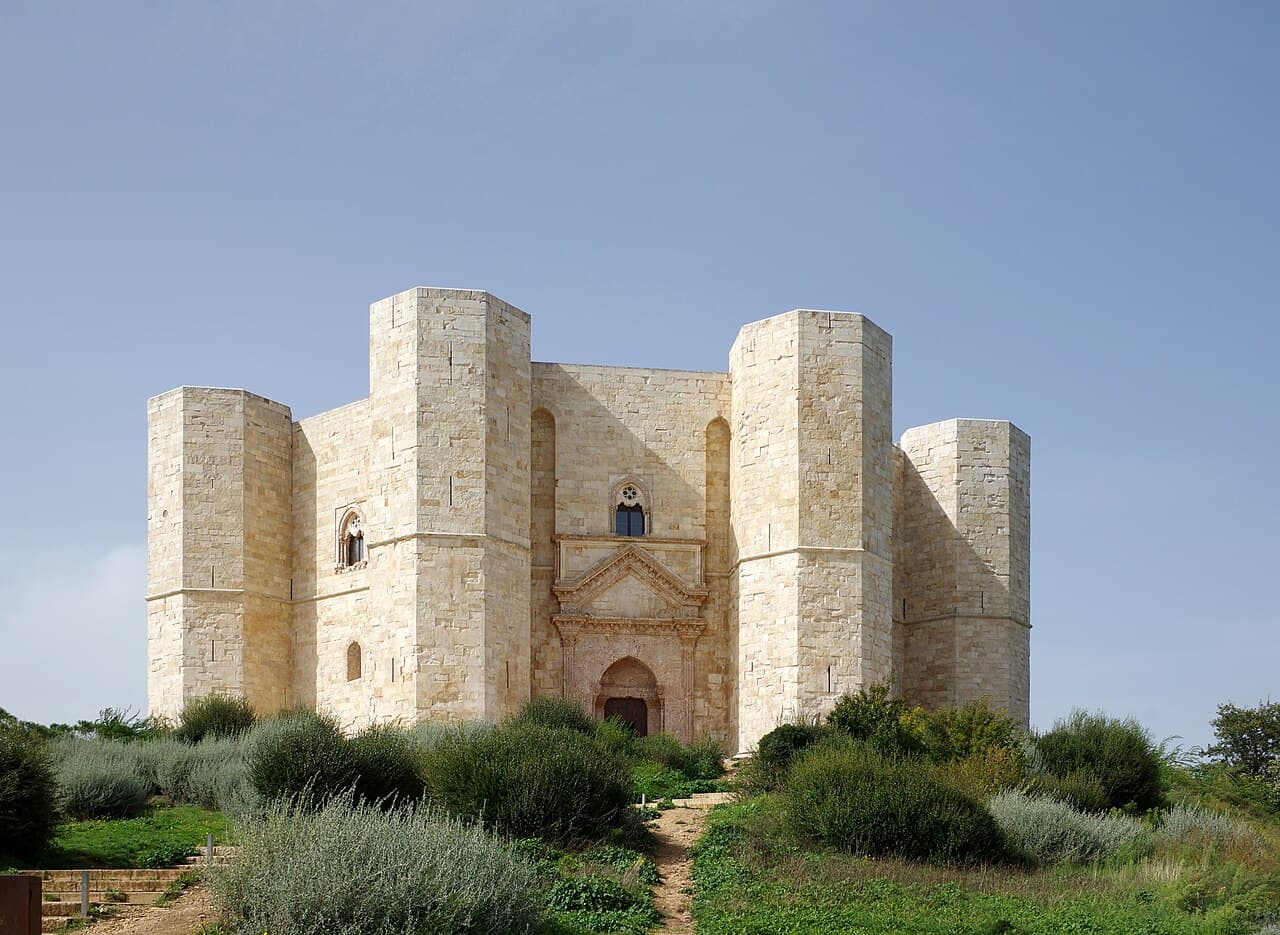
The castle's most striking feature is its perfect octagonal plan, a rare design in medieval fortifications. The main building forms an octagonal prism approximately 56 meters in diameter, with eight octagonal towers at each corner. Each tower rises approximately 26 meters high, originally standing about 5 meters taller than today, possibly including a third floor now lost.
The octagonal shape is rich in symbolic meaning, often interpreted as an intermediate form between the square (representing earth) and the circle (representing heaven). This symbolism may have been inspired by the Dome of the Rock in Jerusalem, which Frederick II visited during the Sixth Crusade, or the Palatine Chapel of Aachen Cathedral, reflecting a fusion of religious and cultural motifs.
Interior layout and innovations
Inside, the castle contains eight trapezoidal rooms arranged around an octagonal courtyard, each with vaulted ceilings. The design includes two main entrances: a modest service entrance and a grand main entrance featuring classical architectural elements, highlighting Frederick's admiration for Greco-Roman styles.
Innovative features include a sophisticated hydraulic system that collected rainwater in underground cisterns and pools, an uncommon luxury in medieval castles. This system supported bathing facilities aligned with Arabic customs, demonstrating the cultural blend Frederick II embraced at his court.
Function and use through history
Despite its fortress-like appearance, Castel del Monte's defensive capabilities are debated. It lacks a moat and drawbridge, and archaeological evidence suggests it originally had a curtain wall, indicating some military purpose. However, it may have served more as a hunting lodge, a symbol of imperial power, or a place for contemplation and scholarly pursuits rather than a fortress designed for prolonged siege.
After Frederick II's death, the castle saw limited use. Under Manfred of Sicily, it was occasionally used as a hunting lodge. Later, under Charles I of Anjou, it became a state prison holding Manfred's sons and other political prisoners. From the 17th century onward, the castle fell into neglect, stripped of its marble decorations and furnishings, and used as a refuge for shepherds, bandits, and political exiles.
Restoration and modern significance
The Italian State purchased Castel del Monte in 1876 when it was in poor condition. Restoration efforts began in 1879 and continued through the 20th century, including significant work in 1928 under architect Quagliati and further restoration from 1975 to 1981. The castle was declared a national monument in 1936 and has since been preserved as a cultural treasure.
During World War II, the castle served as a secret navigational aid station for the US 15th Army Air Force. In the 1950s, soil samples near the castle led to the discovery of compounds used in chemotherapy drugs, linking the site to medical advances.
Today, Castel del Monte is celebrated as a masterpiece of medieval architecture and a symbol of Frederick II's enlightened rule. It appears on the Italian one-cent Euro coin and attracts scholars and tourists fascinated by its unique design and historical significance.
Architectural style and cultural influences
The castle exemplifies the High Medieval period's architectural innovation, combining elements of Romanesque and Gothic styles with influences from Islamic and classical traditions. Its geometric precision and harmonious proportions reflect the humanist ideals and scientific curiosity of Frederick II's court.
Unlike typical defensive castles, Castel del Monte's design emphasizes symmetry, symbolism, and aesthetics. The octagonal shape and the use of classical motifs in the main entrance demonstrate a deliberate departure from purely military architecture toward a more intellectual and cultural statement.
Location and surroundings
Situated on a rocky hill at an altitude of approximately 540 meters, Castel del Monte commands views over the surrounding Murgia landscape. The site was chosen for its strategic visibility and symbolic prominence rather than for defensive advantages alone. The fertile region once provided ample resources, and the castle's location near the former monastery of Santa Maria del Monte links it to earlier religious and cultural traditions.
Castel del Monte in popular culture and heritage
The castle has inspired numerous cultural works, including Umberto Eco's novel The Name of the Rose, where a similar fortress called the 'Aedificium' features prominently. It also served as a filming location for the movie Tale of Tales. Despite popular myths, there is no historical evidence linking Castel del Monte to the Knights Templar.
The surrounding region is known for the Castel del Monte DOC wine, producing red, white, and rosé wines that reflect the area's rich agricultural heritage.
Frequently asked questions (FAQ)
- What is Castel del Monte known for?
- Castel del Monte is renowned for its unique octagonal shape and remarkable architecture that blends elements of Romanesque, Gothic, and Islamic styles. Built in the 13th century by Emperor Frederick II, it is a UNESCO World Heritage site and symbolizes the cultural and historical richness of the region.
- When was Castel del Monte built?
- Construction of Castel del Monte began in 1240 and was completed around 1250. The castle reflects the visionary ideas of Emperor Frederick II, who was known for his interest in science, philosophy, and architecture.
- Can I visit Castel del Monte year-round?
- Yes, Castel del Monte is open to visitors throughout the year, although specific opening hours may vary by season. It is advisable to check the official website for current visiting hours and any potential closures due to events or maintenance.
- What are the ticket prices for Castel del Monte?
- As of 2023, the standard ticket price for adults is approximately €10, while reduced rates are available for children and seniors. It is recommended to purchase tickets online in advance to avoid long queues, especially during peak tourist season.
- Is it possible to access Castel del Monte by public transport?
- Yes, Castel del Monte is accessible by public transport. Visitors can take a train to Andria and then use local buses or taxis to reach the castle, making it a convenient option for those without a car.
- When is the best time to visit Castel del Monte?
- The best time to visit Castel del Monte is during the spring (April to June) and fall (September to October) when the weather is mild and crowds are smaller. Visiting during these months allows you to fully enjoy the stunning landscapes surrounding the castle.
- What nearby attractions can I visit while at Castel del Monte?
- In addition to exploring Castel del Monte, visitors can enjoy nearby attractions such as the city of Andria, famous for its historic sites and local cuisine. Other nearby highlights include the Trani Cathedral and the beautiful coastal town of Trani along the Adriatic Sea.
- Is there parking available at Castel del Monte?
- Yes, there is parking available near Castel del Monte for visitors arriving by car. However, it is advisable to arrive early during busy seasons to secure a spot, as the parking lot can fill up quickly.
Photo gallery

Information
Website
Visit websiteSources & official resources
Verify the information above using these authoritative references.
Loading map...
Visitor reviews
No reviews yet. Been here? Write the first review and help other travelers!
Write the first reviewVisited this castle? Share your experience
Your review helps other travelers and adds first-hand knowledge to our encyclopedia.