Barletta Castle
Barletta Castle stands as a monumental fortress in the city of Barletta, located in the Puglia region of southern Italy. Originally established during the Norman period in the mid-11th century, the castle has undergone extensive transformations throughout its history, reflecting the varied influences of Swabian, Angevin, Aragonese, and Spanish rule. Its strategic position near the Adriatic Sea made it a crucial military and administrative center, especially during the Middle Ages and Renaissance. Today, the castle is a well-preserved example of a high medieval hill castle that has been adapted for cultural use while retaining its formidable defensive features.
Construction of Barletta Castle began between 1225 and 1228 under the reign of Frederick II, Holy Roman Emperor and King of Sicily, who was born in Barletta in 1194. While the site hosted an earlier Norman fortification dating back to the 10th century, Frederick II significantly rebuilt and expanded the fortress, replacing parts of the original structure with his own architectural vision. The castle served as a royal residence and a military stronghold, notably hosting the Diet before Frederick II's departure for the Sixth Crusade in 1228. His emblem, the eagle clutching its prey, is carved into window lunettes, symbolizing imperial authority and intellectual prowess.
Norman origins and early medieval development
The castle's earliest incarnation was as a motte and bailey structure erected by the Normans in the 10th century, a common type of fortification during their expansion along the Adriatic coast. This initial fortress provided a defensive base and support for Norman campaigns in the region, including the nearby city of Trani. Count Peter the Norman initiated the first major construction phase between 1046 and 1050, establishing town walls that divided Barletta into two districts, Santa Maria and San Giacomo.
During the 12th century, under the reigns of William I and William II of Sicily, the castle was enlarged with additional towers and connecting walls, forming a roughly trapezoidal layout. William II briefly resided in the castle in 1172 and contributed to the local religious community. The Norman era concluded with the death of Tancred in 1194, but the southeast tower from this period was preserved and integrated into later reconstructions.
Swabian enhancements and imperial significance
Following the Norman period, the castle gained prominence under the Swabian dynasty (1194–1266). Frederick II, raised under papal guardianship and born in Barletta, frequently resided in the castle. He ordered the demolition of the eastern Norman section and initiated construction of the Frederician domus, transforming the fortress into a royal palace with refined architectural elements. The castle's role expanded beyond military functions to include administrative and ceremonial uses.
Frederick II's reign marked a high point in the castle's history. In 1240, an imperial decree listed Barletta among the castles of the Giustizierato of Bari, underscoring its strategic importance. The castle hosted the Diet before the emperor's departure for the Sixth Crusade, a significant historical event linking Barletta to broader European and Crusader history. The Swabian influence is evident in the castle's iconography, such as the carved eagle motifs symbolizing imperial strength and intelligence.
Angevin renovations and fortifications
After the Swabian dynasty's fall, the Angevin family assumed control of Barletta in 1269. Under the direction of Emperor Charles I of Anjou and architect Pierre d'Angicourt, the castle underwent extensive renovations to enhance its defensive capabilities and representational functions. The Angevin palatium was constructed on the northern side, though it no longer survives.
Key defensive upgrades included replacing the collapsed Norman tower with a circular tower, excavation of a protective moat, and the addition of an outer defensive wall called a talutum. The curtain walls were reinforced, and the main gateway, known as Porta Trani, was built. These improvements reflected contemporary military architectural trends and the need to fortify the castle against evolving siege technologies.
The Angevin period also saw the castle used as a prison for the Knights Templar between 1308 and 1312 during the reign of Robert of Anjou. The dynasty's rule ended after a series of succession disputes involving rulers such as Joanna I and Charles III.
Aragonese and Spanish expansions
From 1442 to 1501, the castle was under Aragonese control, during which time the fortress and city defenses were strengthened in several campaigns. Notably, in 1459, Ferdinand I of Naples was crowned in the castle and resided there. The castle successfully withstood a siege supported by the Albanian leader Scanderbeg, whose coat of arms and a commemorative plaque remain on the fortress walls.
The moat was deepened, and the nearby port expanded, enhancing the castle's strategic maritime defense. After the Treaty of Lyon in 1504, the Spanish Habsburg dynasty took control, initiating further fortification projects. In 1528, French troops briefly occupied the castle during a military campaign but did not cause damage.
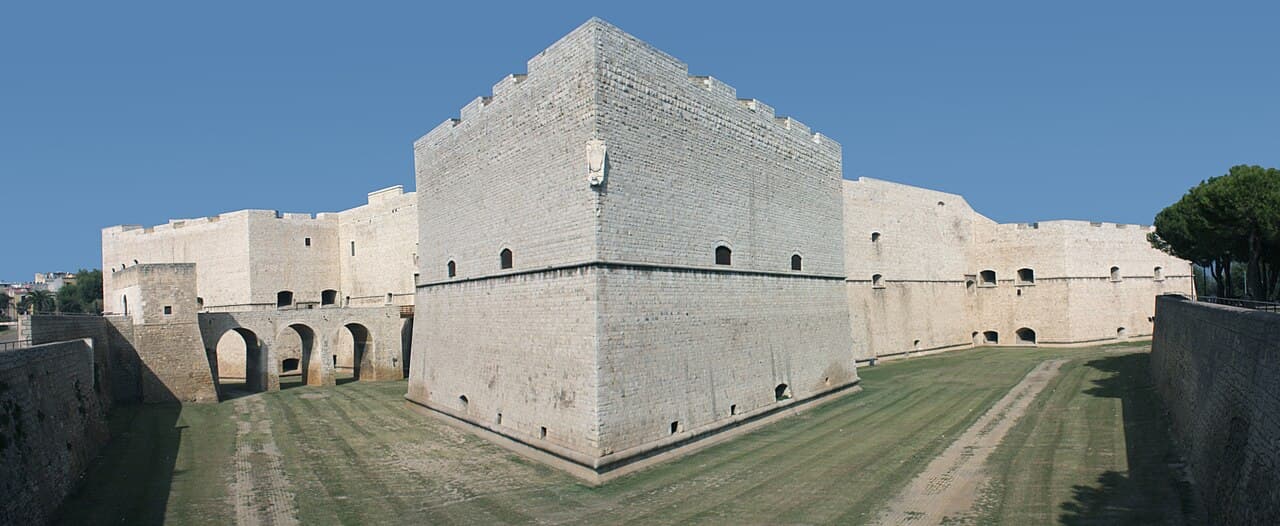
Between 1532 and 1598, under Emperor Charles V, the castle was extensively remodeled by military engineer Evangelista Menga. The walls were thickened up to 12 meters, and four large pentagonal bastions—Santa Maria, San Vincenzo, Sant’Antonio, and Dell’Annunziata—were constructed at the corners, giving the castle its current quadrangular shape. A wide moat surrounded the fortress on three sides, isolating it from the city and sea. These enhancements reflected the evolution of military architecture to resist artillery fire.
Architectural features and layout
The castle is a quadrangular fortress with sides measuring approximately 120 to 127 meters and diagonal distances of about 125 meters between bastions. The walls, built mainly of carefully squared limestone blocks, range from 5 to 12 meters thick. The moat, originally filled with seawater, extends up to 24 meters wide near bastions and over 110 meters along the northern seafront, separated by a retaining wall about 7 meters high.
Access is gained via a masonry bridge with three stone arches and a wooden drawbridge dating to the 16th century, preserved and restored in recent years. The main gateway features a richly carved architrave with Latin inscriptions commemorating Diego Feliz, castellan in 1584, and decorative coats of arms.
The façade is divided vertically into three zones: a sloping base with cannon embrasures, a central band with cannon openings and ventilation holes, and an upper battlemented level. Decorative elements include Aragonese coats of arms, sculpted male masks, lion faces, and shields adorning bastions and curtain walls.
The nearly square courtyard, about 35 meters per side, contains two wells connected to underground cisterns. The western façade has large arches leading to former prison cells now part of the civic museum. The eastern façade combines Swabian-Angevin medieval sections with later Spanish additions and houses the municipal library in the Frederician wing.
The southern façade reveals the Norman tower interior and features a portico with arches and a relocated Roman milestone from the Via Traiana. Upper floors include soldiers’ quarters, museum spaces, and a grand circular chamber known as the Red Room with a domed ceiling and oculus, located in the Sant’Antonio bastion.
Later history and cultural significance
Throughout the 17th and 18th centuries, the castle underwent maintenance and minor modifications, including the construction of a bomb disposal laboratory on the roof in 1621 under Philip IV of Spain. The fortress survived earthquakes and plagues with limited damage but fell into neglect during Austrian Habsburg rule in the 18th century.
In the 19th century, the castle served various military functions, including as a prison and barracks. During World War I, it was bombarded by Austro-Hungarian forces with minimal damage. In World War II, the castle was the site of Italian resistance against German forces in 1943, culminating in a tragic massacre.
Restoration efforts began in the 1970s and continued through the 1980s, transforming the castle into a cultural center with museum exhibits, a library, and event spaces. The castle gardens were reopened in 2002, and the site now hosts festivals, art exhibitions, and serves as a prominent heritage landmark in Barletta.
Barletta Castle remains a testament to the layered history of southern Italy, showcasing architectural evolution from Norman motte and bailey to a Renaissance bastioned fortress. Its preservation and adaptive reuse highlight its enduring cultural and historical significance.
Frequently asked questions (FAQ)
- How do I get to Barletta Castle?
- Barletta Castle is conveniently located in the heart of Barletta, Italy. You can reach it by public transportation, including buses and trains, which connect to the city's main transport hubs. If you prefer driving, there are parking facilities nearby, making it accessible for visitors traveling by car.
- What is the historical significance of Barletta Castle?
- Barletta Castle, known as Castello di Barletta, dates back to the 15th century and was built by the Aragonese. It serves as a symbol of the city's rich history and has witnessed numerous historical events, including battles and sieges. The castle is also famous for the Challenge of Barletta, a legendary duel between knights that took place in 1503.
- When was Barletta Castle built?
- Construction of Barletta Castle began in 1453 and was completed in the late 15th century. It was commissioned by King Ferdinand I of Aragon as a defensive fortress. The castle's architectural style reflects the military needs of the time, showcasing robust walls and impressive towers.
- Can I take guided tours of Barletta Castle?
- Yes, guided tours of Barletta Castle are available and highly recommended for a deeper understanding of its history and architecture. Tours are conducted in various languages and provide insights into the castle's significance and the stories behind its structures. Visitors can check the castle’s official website for tour schedules and booking options.
- Why is Barletta Castle considered an architectural gem?
- Barletta Castle is considered an architectural gem due to its blend of Gothic and Renaissance styles, characterized by its imposing walls and majestic towers. The castle's well-preserved structure includes a moat and a large courtyard, offering visitors a glimpse into medieval military architecture. Its unique design and historical context make it a fascinating site for architecture enthusiasts.
- Is it possible to host events at Barletta Castle?
- Yes, Barletta Castle offers facilities for hosting various events, including weddings, exhibitions, and cultural events. The castle's stunning surroundings and historical ambiance provide a unique backdrop for any occasion. Interested parties should contact the castle’s administration for details on availability and rental options.
- What are the opening hours for Barletta Castle?
- Barletta Castle is generally open to visitors from 9 AM to 7 PM, but hours may vary depending on the season and special events. It is advisable to check the official website or contact the castle directly for the most current information on opening hours. During holidays, the castle may have modified hours, so planning ahead is recommended.
- What are the ticket prices for Barletta Castle?
- The ticket prices for Barletta Castle are very affordable, with discounts available for students and seniors. As of the latest information, general admission is around €5, while reduced tickets are about €3. Children under a certain age may enter for free, making it a great family-friendly destination.
- When is the best time to visit Barletta Castle?
- The best time to visit Barletta Castle is during the spring and early fall when the weather is mild, and tourist crowds are smaller. These seasons allow for a more enjoyable exploration of the castle and its surroundings. Additionally, visiting during local festivals can enhance your experience with cultural events and activities.
- Are there any nearby attractions to visit after Barletta Castle?
- Yes, there are several nearby attractions to explore after your visit to Barletta Castle. The beautiful Barletta Cathedral and the historic city center are just a short walk away. You can also visit the nearby beaches or enjoy local dining options to fully experience the charm of Barletta.
Photo gallery

Information
Website
Visit websiteSources & official resources
Verify the information above using these authoritative references.
Loading map...
Visitor reviews
No reviews yet. Been here? Write the first review and help other travelers!
Write the first reviewVisited this castle? Share your experience
Your review helps other travelers and adds first-hand knowledge to our encyclopedia.