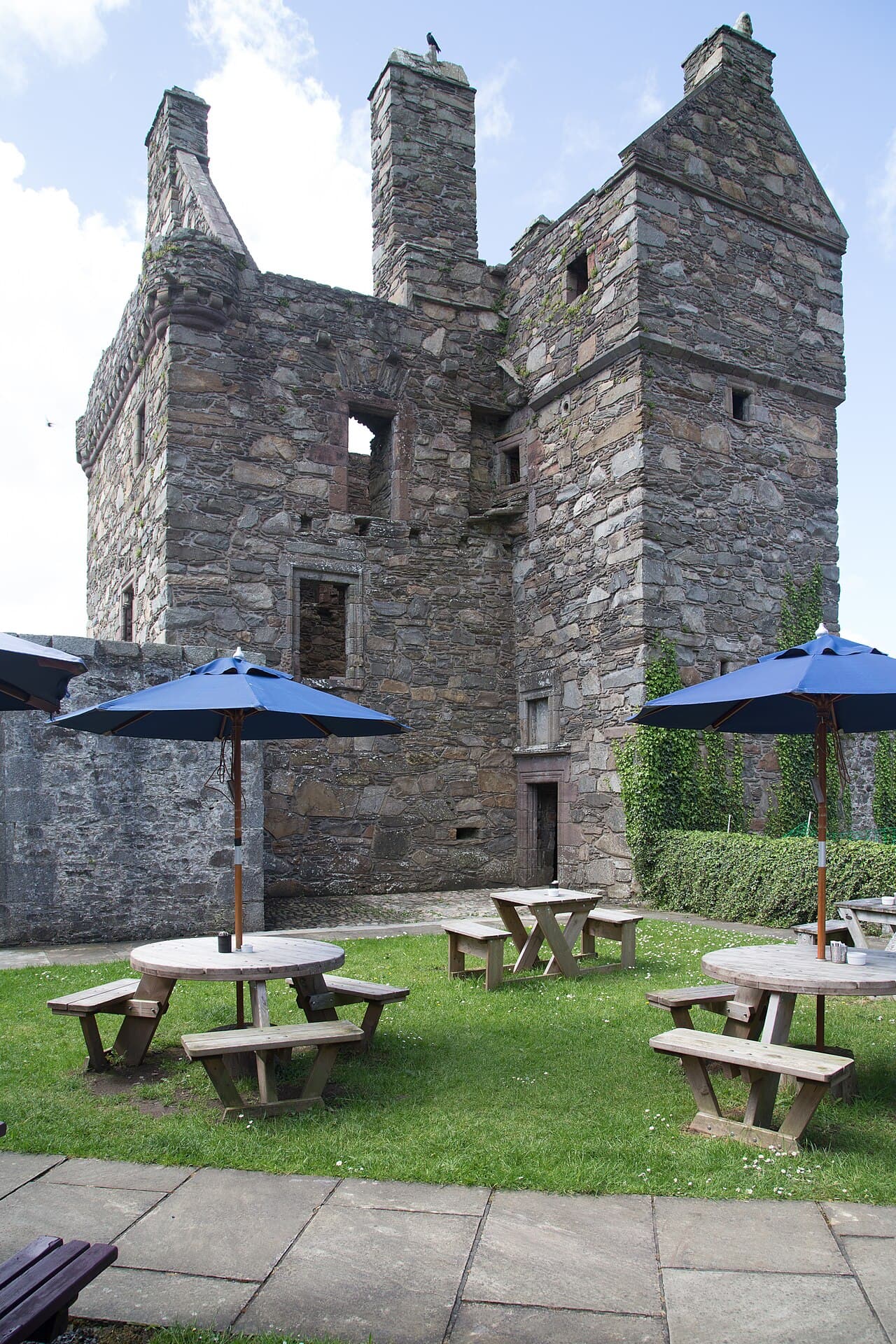
Carsluith Castle
Carsluith Castle stands as a remarkable example of a 16th-century Scottish tower house, located near Wigtown Bay in Kirkcudbrightshire, Scotland. This ruined tower house reflects the architectural and historical evolution of fortified residences during the Renaissance period in Scotland. The castle's origins trace back to lands held by the Cairns family until the mid-15th century, after which the property passed to James Lindsay of Fairgirth, the Chamberlain of Galloway. It was likely under his ownership, in the late 15th or early 16th century, that the core main tower was constructed, marking the beginning of the castle's enduring presence.
The castle's strategic location near the shoreline and its commanding views of the surrounding landscape underscore its defensive and residential significance. Although now in ruins, Carsluith Castle retains key architectural elements that illustrate its original design and subsequent modifications. The castle has not been inhabited since the 18th century but remains a vital cultural heritage site managed by Historic Environment Scotland, open to the public for exploration and education.
Historical context and ownership
The lands of Carsluith were initially under the Cairns family until approximately 1460, when ownership transferred to James Lindsay of Fairgirth. Lindsay, who served as the Chamberlain of Galloway, is credited with erecting the main tower during the late medieval to early Renaissance transition. This period was marked by the construction of many tower houses in Scotland, designed to combine residential comfort with defensive capabilities.
In the mid-16th century, the castle passed by marriage to the Brown (or Broun) family. John Brown took possession in 1546, following his mother Elisabeth Lindsay’s tenure as Lady of Carsluith. The Browns, known for their Roman Catholic faith, were influential in the region and involved in the religious and political turbulences of the time. Their stewardship saw the addition of a stair tower in the 1560s, enhancing the castle's defensive and functional architecture.
A notable figure from the Brown family was Gilbert Brown, the last Catholic abbot of Sweetheart Abbey. His arrest in 1605 for harboring Jesuit priests and subsequent exile to France highlight the religious conflicts impacting the castle's owners. Gilbert Brown died in Paris in 1612, symbolizing the broader struggles of Catholic families in post-Reformation Scotland.
Following the Browns’ emigration to India in 1748, Carsluith Castle was abandoned. Throughout the 19th century, the estate changed hands several times, with owners such as Alistair Johnston and Miss Hannay of Kirkdale. The addition of farm buildings during this era reflects the property's shift from a noble residence to an agricultural estate.
Architectural features and layout
Main tower and stair tower
The castle's surviving structure centers on a rectangular main tower house measuring approximately 9.8 by 7.6 meters. This tower rises about 10 meters to the eaves and is crowned with distinctive crow-step gables, a hallmark of Scottish Renaissance architecture. These stepped gables are complemented by corbelled wall walks along the gable ends, which provided defenders with protected patrol routes.
Three of the main tower’s corners feature round turrets, enhancing both its defensive capabilities and aesthetic appeal. The later-added stair tower projects from the northeast corner, forming an L-shaped footprint. This stair tower is topped by a gabled cap-house, a small structure that shelters the stairwell's uppermost section.
Interior spaces and defensive elements
Entry to the castle is through the stair tower, where the Brown family coat of arms is prominently carved above the door, accompanied by initials and a date inscription from the 1560s. The ground floor of the main tower contains a vaulted basement divided into two cellars. These cellars feature gunloops, narrow openings designed for firearms, reflecting the castle’s defensive role during a turbulent historical period.
Above the basement lies the great hall, which was the principal living and social space. It includes windows for natural light and a fireplace for heating, emphasizing the dual residential and defensive functions of the castle. The upper floors, now largely lost, originally contained bedrooms and an attic at the wall walk level. Architectural evidence such as holes in the north exterior wall suggests the presence of a wooden gallery, which would have connected the stair tower to the second-floor rooms, facilitating internal movement.
One of the castle’s distinctive external features is a carved gargoyle on the west side, which served as a drain for a sink located on the first floor. This detail highlights the integration of practical domestic features within the fortified structure.
Site setting and later developments
Carsluith Castle is situated close to the shoreline and a nearby road, with evidence suggesting the former presence of a moat or pond that would have separated the castle from the roadway, adding an extra layer of defense. The surrounding landscape would have provided natural protection as well as access to maritime routes.
Adjacent to the castle are 19th-century farm buildings arranged in a U-shaped layout. These agricultural structures, now recognized as Category C listed buildings, reflect the estate’s transition from a fortified noble residence to a working farm. The farm buildings contribute to the historical narrative of the site, illustrating changes in land use and ownership over several centuries.
Preservation and public access
Since falling out of residential use in the 18th century, Carsluith Castle has remained a ruin but has been subject to preservation efforts. The castle entered state care in 1913 and has been designated a scheduled monument and a Category A listed building, reflecting its national importance as a heritage asset.
Today, the castle is maintained by Historic Environment Scotland and is accessible to visitors interested in Scotland’s rich medieval and Renaissance history. The site offers insight into the architectural styles, defensive features, and domestic arrangements of Scottish tower houses. Visitors can explore the remains of the main tower, stair tower, and surrounding farm buildings, gaining an appreciation for the castle’s historical and cultural significance.
Historical significance and cultural legacy
Carsluith Castle embodies the complex interplay of architecture, religion, and politics in Scotland from the late medieval period through the Renaissance. Its association with prominent families such as the Lindsays and Browns, and figures like Gilbert Brown, links the castle to broader narratives of religious conflict and social change.
The castle’s architectural features, including its crow-step gables, corbelled wall walks, and gunloops, exemplify the defensive innovations of Scottish tower houses during the Renaissance. The preservation of these elements provides valuable insights into the construction techniques and living conditions of the period.
As a heritage site, Carsluith Castle continues to attract historians, architects, and tourists, contributing to the understanding and appreciation of Scotland’s fortified residences and their role in shaping regional identity.
Frequently asked questions (FAQ)
- How do I get to Carsluith Castle?
- Carsluith Castle is located in Newton Stewart, Scotland, easily accessible by car or public transport. There is parking available nearby, and local bus services connect Newton Stewart to larger cities in the region.
- What is the historical significance of Carsluith Castle?
- Carsluith Castle dates back to the late 15th century and is an excellent example of a Scottish tower house. It served as a stronghold for the McCulloch family and played a crucial role in local history during the tumultuous times of clan warfare.
- When was Carsluith Castle built?
- Carsluith Castle was constructed in the late 15th century, around 1470. Its architecture reflects the defensive needs of the time, showcasing typical features of Scottish castle design.
- Can I enter Carsluith Castle?
- Yes, visitors are welcome to explore Carsluith Castle during the open season. Access to certain areas may be restricted for safety reasons, but the castle grounds and key features are typically open for guests to enjoy.
- Why is Carsluith Castle an important architectural site?
- Carsluith Castle is notable for its well-preserved structure and unique defensive architecture, characteristic of the late medieval period in Scotland. It offers insights into the living conditions and defensive strategies of Scottish nobility during its time.
- Is it possible to visit Carsluith Castle year-round?
- While Carsluith Castle has specific opening hours during the tourist season, it is generally closed during the winter months. It’s best to check the official website or local tourist information for the exact dates of operation each year.
- What are the ticket prices for visiting Carsluith Castle?
- Admission prices for Carsluith Castle are usually modest, with discounts available for children, students, and seniors. For the latest information on ticket prices, it is advisable to visit the official site or contact local tourist information.
- What is the best time to visit Carsluith Castle?
- The best time to visit Carsluith Castle is during the spring and summer months when the weather is pleasant, and the gardens are in full bloom. Additionally, the extended daylight hours provide more time to explore the castle and its surroundings.
- Are there any nearby attractions to Carsluith Castle?
- Yes, there are several attractions near Carsluith Castle, including the Galloway Forest Park and the charming town of Newton Stewart. Visitors can also explore beautiful coastal areas and hiking trails in the surrounding region.
Photo gallery

Information
Loading map...
Visitor reviews
No reviews yet. Been here? Write the first review and help other travelers!
Write the first reviewVisited this castle? Share your experience
Your review helps other travelers and adds first-hand knowledge to our encyclopedia.


