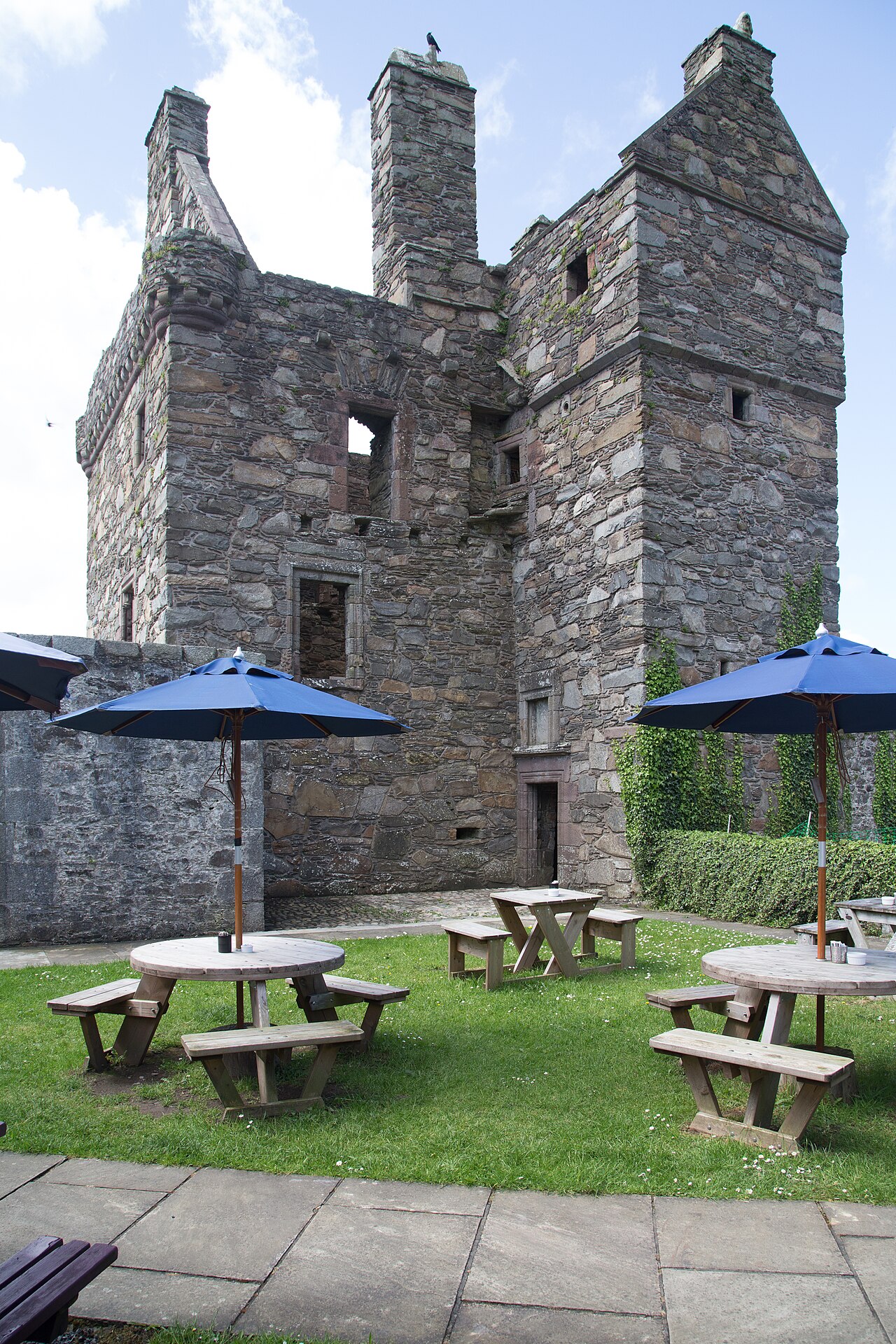
Sorbie Tower
Sorbie Tower stands as a remarkable example of a late 16th-century Scottish tower house, located near Newton Stewart in the historic region of Galloway, Scotland. Constructed by the prominent Hannay family in the late 1500s, the tower embodies the architectural and social complexities of the Scottish Borders during the turbulent Early Modern period. Its history, architecture, and enduring clan connections offer a vivid window into the defensive residences of the Scottish gentry amid regional conflicts and shifting allegiances.
The Hannays acquired the land from Whithorn Abbey by the early 16th century, establishing their local influence. Sorbie Tower was built as a fortified residence reflecting the need for defense and status during an era marked by clan rivalries and feuds. The Hannays were notably involved in power struggles with the Murray family of Broughton and maintained alliances with influential families such as the Stewarts of Garlies, the Kennedys, and the Dunbars. These relationships illustrate the intricate network of support and enmity characterizing the Scottish Borders in the 16th and 17th centuries.
Historical context and clan significance
The 17th century was a period of upheaval for Sorbie Tower and its owners. In 1640, John Hannay was killed during local conflicts, which precipitated financial difficulties for the family. The economic strain eventually led to their bankruptcy, and by the 1670s, ownership of Sorbie Tower passed to the Stewart family, Earls of Galloway. The tower remained inhabited until around 1740, after which it fell into disrepair and partial ruin.
Despite its decline, the tower retained symbolic importance for the Hannay clan. In the 20th century, clan members undertook efforts to preserve and consolidate the structure. The clan formally regained stewardship of Sorbie Tower in 1965, and since 1963, the Clan Hannay Society has managed the site. Recognized for its cultural and historical value, Sorbie Tower was designated a scheduled monument and was listed as a Category A building in 1972, though the latter status was removed in 2018. These designations underscore the tower's significance as a heritage site.
Architectural features and layout
Sorbie Tower exhibits an L-shaped plan typical of Scottish tower houses of the period. The main structure is a four-storey stone tower measuring approximately 12.3 by 7.3 meters, attached to a wing about 6 by 7.8 meters in size. The entrance is strategically located at the inner angle of the two wings, providing controlled access to the fortified residence.
The ground floor is vaulted in stone, divided into storage areas on the southern side and a kitchen on the northern side, which retains a restored fireplace. This vaulted cellar not only provided structural strength but also served practical functions such as food storage and defense. The first floor contains the main hall, which features a large east-facing fireplace, serving as the primary living and social space.
The adjoining wing rises one storey above the main block and includes a distinctive stair tower at its southeast corner. This stair tower projects outward as a round turret from the first floor upwards, with the main entrance doorway located beneath it. The turret would have provided defensive advantages as well as architectural interest.
The masonry is primarily rubble stone with natural stone detailing and finely cut corner stones, demonstrating skilled craftsmanship. Some original window rod moldings survive, and narrow slit windows illuminate the vaulted ground floor, balancing light with defensive needs. A stairway runs the length of the shorter wing, providing access to upper floors.
Though the upper floors and roof above the first story no longer survive, historical evidence suggests the tower once had projecting corner turrets known as tourelles. Notably, Sorbie Tower lacks a wall-walk or parapet, distinguishing it from many contemporaneous Scottish tower houses that featured these defensive elements.
The medieval roots: sorbie motte
Adjacent to Sorbie Tower lie the remains of Sorbie Motte, a medieval earthwork dating back to the 12th century. This artificial mound, approximately five square meters in area, was originally constructed as an early defensive structure. Archaeological excavations in 1996 revealed traces of wooden buildings atop the motte and evidence of a wooden hanging bridge on its northeast side. These features highlight the site's strategic importance long before the stone tower was erected, indicating continuous occupation and defense through the medieval period.
The motte and its associated wooden structures represent a typical early medieval fortification style in Scotland, predating the stone castles that later dominated the landscape. Its proximity to Sorbie Tower underscores the layered defensive history of the site and the evolution of fortification techniques over several centuries.
Preservation and cultural heritage
Today, Sorbie Tower remains a partially preserved ruin, maintained through the dedicated efforts of the Clan Hannay Society. The tower's status as a scheduled monument protects it under UK heritage laws, ensuring its conservation for future generations. Visitors to the site can appreciate the tower's robust stone construction, vaulted interiors, and surviving architectural details that convey the lifestyle and defensive needs of Scottish gentry families in the late medieval and early modern eras.
The tower's connection to the Hannay clan continues to inspire cultural events and clan gatherings, reinforcing its role as a symbol of local identity and heritage. Sorbie Tower stands not only as an architectural relic but also as a testament to the enduring legacy of Scottish clans and their ancestral homes.
Frequently asked questions (FAQ)
- How do I visit Sorbie Tower?
- Sorbie Tower is accessible to the public, managed by the Clan Hannay Society. Visitors should check local tourism websites or contact the society for current visiting hours and any access restrictions.
- What is the historical significance of Sorbie Tower?
- Sorbie Tower is a late 16th-century Scottish tower house built by the Hannay family, reflecting the turbulent clan history and regional conflicts of Galloway in the Early Modern period.
- When was Sorbie Tower built?
- Sorbie Tower was constructed in the late 1500s, during the late medieval period, by the Hannay family who owned the surrounding lands.
- Can I explore the remains of Sorbie Motte near the tower?
- Yes, the remains of Sorbie Motte, a 12th-century earthwork, are located near Sorbie Tower and can be viewed by visitors interested in early medieval fortifications.
- Is Sorbie Tower fully preserved?
- Sorbie Tower is partially preserved; while some upper floors and roof structures no longer survive, significant architectural features remain visible.
- Why does Sorbie Tower lack a wall-walk or parapet?
- Unlike many Scottish tower houses, Sorbie Tower does not have a wall-walk or parapet, which may reflect specific architectural choices or defensive strategies of its builders.
Information
Sources & official resources
Verify the information above using these authoritative references.
Loading map...
Visitor reviews
No reviews yet. Been here? Write the first review and help other travelers!
Write the first reviewVisited this castle? Share your experience
Your review helps other travelers and adds first-hand knowledge to our encyclopedia.