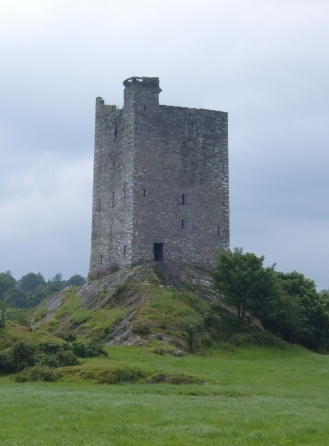
Carrignacurra Castle
Carrignacurra Castle is a historic tower house prominently located on a rocky outcrop overlooking the south bank of the River Lee, east of the village of Inchigeelagh in County Cork, Ireland. This castle exemplifies the defensive residences built in the late 16th century to control strategic river crossings and assert local power.
Historical background and ownership
The castle was likely constructed around 1575 by the O'Leary family as a fortified seat to defend a ford across the River Lee. Its position on a rocky promontory provided a natural defensive advantage. In 1602, the castle was captured by Donal Cam O'Sullivan Beare, a notable Gaelic leader during the turbulent period of Irish resistance against English expansion.
Following the 1641 Irish Rebellion, Carrignacurra Castle was forfeited but later restored in the 1660s to the MacCarthy family. Despite this change in ownership, the O'Learys continued to occupy the castle as tenants, reflecting the complex landholding patterns in post-rebellion Ireland.
In the 18th century, the castle passed into the hands of the Masters family. By the 19th century, it was abandoned and fell into ruin, a fate common to many Irish tower houses as military and residential needs evolved.
Architectural features and style
Carrignacurra Castle is a classic example of an Irish tower house, a type of fortified residence popular from the late medieval period into the post-medieval era. The castle's stone construction and vertical emphasis are typical of these structures, designed to provide both defense and habitation within a compact footprint.
The castle's location on a rocky outcrop enhanced its defensive capabilities, with steep approaches limiting access. Architectural details likely include narrow windows or arrow slits, battlements, and possibly a bawn wall enclosing a courtyard, although specific surviving features require further archaeological study.
While the existing metadata suggests a post-Renaissance period and an 18th-century build date, the evidence of its construction around 1575 places it at the end of the late medieval period transitioning into the early modern. Its style aligns more closely with traditional Irish tower houses rather than later Renaissance or Baroque influences.
Modern history and conservation status
By the 19th century, Carrignacurra Castle was abandoned and fell into disrepair. In recent years, it attracted interest for restoration and adaptive reuse. Around 2017-2018, the castle was offered for sale with planning permission to convert it into a private residence, including the addition of a modern wing. This plan reflects a growing trend of restoring historic Irish castles for contemporary living while preserving their heritage value.
Currently, the castle appears situated within farmland and remains freely accessible to visitors. There are no visible ongoing building works, but the structure remains an evocative example of a well-preserved tower house ruin with strong potential for restoration.
Significance and tourism potential
Carrignacurra Castle holds cultural and historical significance as a representative of 16th-century Irish defensive architecture and the turbulent history of Gaelic Ireland during the Elizabethan and Cromwellian eras. Its connection to prominent families such as the O'Learys and MacCarthys adds to its heritage value.
For visitors, the castle offers an accessible glimpse into Ireland's medieval past amidst scenic surroundings along the River Lee. Its potential restoration may enhance its appeal as a private residence or heritage site, contributing to the local cultural landscape.
Frequently asked questions (FAQ)
- How do I visit Carrignacurra Castle?
- Carrignacurra Castle is located near Inchigeelagh in County Cork and is freely accessible on foot. Visitors should be prepared for rural terrain and check local conditions before visiting.
- What is the historical significance of Carrignacurra Castle?
- The castle was built around 1575 by the O'Leary family to defend a ford on the River Lee and was involved in key historical events including its capture by Donal Cam O'Sullivan Beare in 1602.
- Can I explore the interior of Carrignacurra Castle?
- As the castle is currently a ruin, interior exploration should be done with caution. There are no formal visitor facilities, and parts of the structure may be unstable.
- When was Carrignacurra Castle built?
- Carrignacurra Castle was likely constructed around 1575, during the late medieval period transitioning into the early modern era.
- Is there any ongoing restoration work at Carrignacurra Castle?
- As of the latest information, there are no visible restoration activities, but the castle was previously offered for sale with planning permission for conversion into a private home.
Information
Current owner
Private owner
Loading map...
Visitor reviews
No reviews yet. Been here? Write the first review and help other travelers!
Write the first reviewVisited this castle? Share your experience
Your review helps other travelers and adds first-hand knowledge to our encyclopedia.