Carrigaphooca Castle
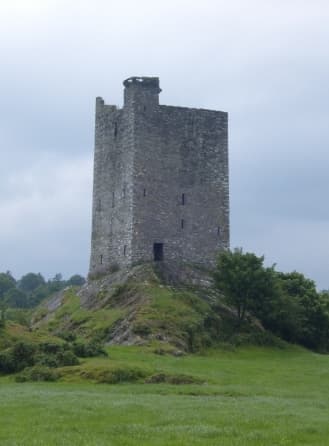
Carrigaphooca Castle (Irish: Caisleán Charraig a' Phúca, meaning "castle on the rock of the fairy") is a ruined five-storey rectangular tower house located on a steep-sided rock overlooking the River Sullane in County Cork, Ireland. This late medieval fortress stands approximately 6 km west of Macroom, within an area historically known as Gleann na n-Dearg ("valley of the reds"). The tower dominates the landscape of Lissacresig (Fairyland) in Clondrohid and Lower Shanballyshane in Kilnamartyra, reflecting its strategic and symbolic significance in the region.
Architectural features and construction
Carrigaphooca Castle is constructed primarily from sandstone and limestone, materials typical of the region and period. The castle is a classic example of a late medieval Irish tower house, characterized by its tall, narrow rectangular plan rising over five storeys. The tower's elevated position on a rocky outcrop provided natural defense advantages, with steep sides making direct assault difficult.
The tower house features defensive architectural elements including narrow slit windows designed for archery defense, thick stone walls for protection against siege weapons, and battlements that would have allowed defenders to monitor and repel attackers. The interior originally contained multiple floors with living quarters, storage rooms, and a great hall, accessible by a narrow spiral staircase embedded within the thick walls.
Historical context and ownership
Built in the early 15th century, Carrigaphooca Castle was constructed by the MacCarthys of Muskerry, a powerful Gaelic Irish dynasty that controlled large parts of southwest Ireland during the late medieval period. The MacCarthys used the castle as a defensive stronghold to oversee and protect their lands, as well as to assert their dominance in the region.
The castle's name, which incorporates the word púca, meaning ghost or fairy, reflects the deep-rooted Irish folklore and cultural significance attached to the site and its surroundings. The tower's location near other prehistoric monuments suggests the area held long-standing importance before the castle's construction.
Surrounding landscape and archaeological significance
Carrigaphooca Castle is situated in a landscape rich with ancient monuments, highlighting the area's continuous human occupation over millennia. Just two fields east lies the Carrigaphooca Stone Circle, a Neolithic ceremonial site consisting of standing stones arranged in a circle. To the west stands a large solitary standing stone, or gallán, further emphasizing the prehistoric significance of the locale.
The castle's siting on a rocky promontory overlooking the River Sullane not only provided defensive advantages but also connected it visually and culturally to these earlier monuments. This layering of historical periods makes Carrigaphooca a site of both medieval and prehistoric interest.
Current status and accessibility
Today, Carrigaphooca Castle remains a ruined tower house, with partial walls and structural elements surviving to convey its original form. The castle is located on private property and is not generally accessible to the public. However, it is owned by the Irish state and maintained by the Office of Public Works, which ensures its preservation as an important cultural and historical monument.
Visitors interested in the castle and its surroundings can explore the nearby landscape and view the castle from a distance, appreciating its dramatic position on the rock and its connection to the rich heritage of County Cork.
Frequently asked questions (FAQ)
- What is the historical significance of Carrigaphooca Castle?
- Carrigaphooca Castle is a 15th-century fortified tower house located in County Cork, Ireland. It is a prime example of medieval Irish architecture and played a role in the region's tumultuous history, serving as a defensive structure during various conflicts.
- When was Carrigaphooca Castle built?
- Carrigaphooca Castle was constructed in the late 1400s, reflecting the architectural style and defensive needs of that period. Its construction marks an important era in Irish history, showcasing the feudal system and the influence of local chieftains.
- Is it possible to visit Carrigaphooca Castle?
- Yes, Carrigaphooca Castle is accessible to visitors, although it is primarily a ruin. Visitors can explore the grounds and appreciate the scenic views of the surrounding landscape, but guided tours are not available due to its condition.
- What are the opening hours for Carrigaphooca Castle?
- Carrigaphooca Castle is open year-round for visitors, and there are no specific opening hours as it is an outdoor site. However, it is recommended to visit during daylight hours to fully enjoy the scenery and historical context.
- Can I take photographs at Carrigaphooca Castle?
- Absolutely! Photography is encouraged at Carrigaphooca Castle, as the ruins and surrounding landscape offer beautiful backdrops. Just be mindful of your surroundings and respect the historical site while capturing your memories.
- When is the best time to visit Carrigaphooca Castle?
- The best time to visit Carrigaphooca Castle is during the spring and summer months when the weather is generally milder and the surrounding countryside is lush and green. Additionally, the longer daylight hours provide ample time for exploration.
- Are there nearby attractions to visit while at Carrigaphooca Castle?
- Yes, there are several nearby attractions, including the scenic Blarney Castle and the charming village of Blarney, known for its famous Blarney Stone. The region is rich in history and natural beauty, making it an ideal location for a day of exploration.
- What are the ticket prices for Carrigaphooca Castle?
- There is no admission fee to visit Carrigaphooca Castle, as it is a public historical site. Visitors can enjoy the castle and its grounds free of charge, making it an accessible destination for all.
- How do I get to Carrigaphooca Castle?
- Carrigaphooca Castle is located just outside of Blarney, County Cork, and can be reached by car or bus from Cork city. There are also walking trails that lead to the castle, offering a scenic approach for those who enjoy hiking.
Photo gallery

Photo by Ceoil (talk) (Uploads)•Public domain
Information
Loading map...
Visitor reviews
No reviews yet. Been here? Write the first review and help other travelers!
Write the first reviewVisited this castle? Share your experience
Your review helps other travelers and adds first-hand knowledge to our encyclopedia.