Carmarthen Castle
Carmarthen Castle stands as a prominent high medieval hill castle located in the town of Carmarthen in West Wales, United Kingdom. Originally established in the early 12th century by Walter, Sheriff of Gloucester, it has witnessed centuries of military conflict, political intrigue, and architectural evolution. The castle's strategic position overlooking the tidal River Towy enabled control over a vital crossing point, marking it as a key defensive and administrative site in southwest Wales.
The castle's origins trace back to a timber motte-and-bailey design constructed between 1104 and 1109, with earlier Norman fortification efforts near the site around 1094. Throughout the 12th and 13th centuries, Carmarthen Castle was repeatedly contested by Welsh princes and Norman-English forces, reflecting the turbulent power struggles of the era. Notable Welsh leaders such as Gruffydd ap Rhys, Owain Gwynedd, Cadell ap Gruffydd, Rhys ap Gruffydd, and Llywelyn the Great captured the castle at various times, underscoring its military importance.
Medieval construction and architectural features
In the late 12th century, the castle was rebuilt in stone, transitioning from its original timber form to a more durable fortification. The surviving shell keep atop the motte is the oldest extant stone structure and exemplifies the defensive architectural advances of the period. The castle's layout included a quadrangular outer bailey enclosed by curtain walls, with multiple towers enhancing its defenses.
The gatehouse and defensive innovations
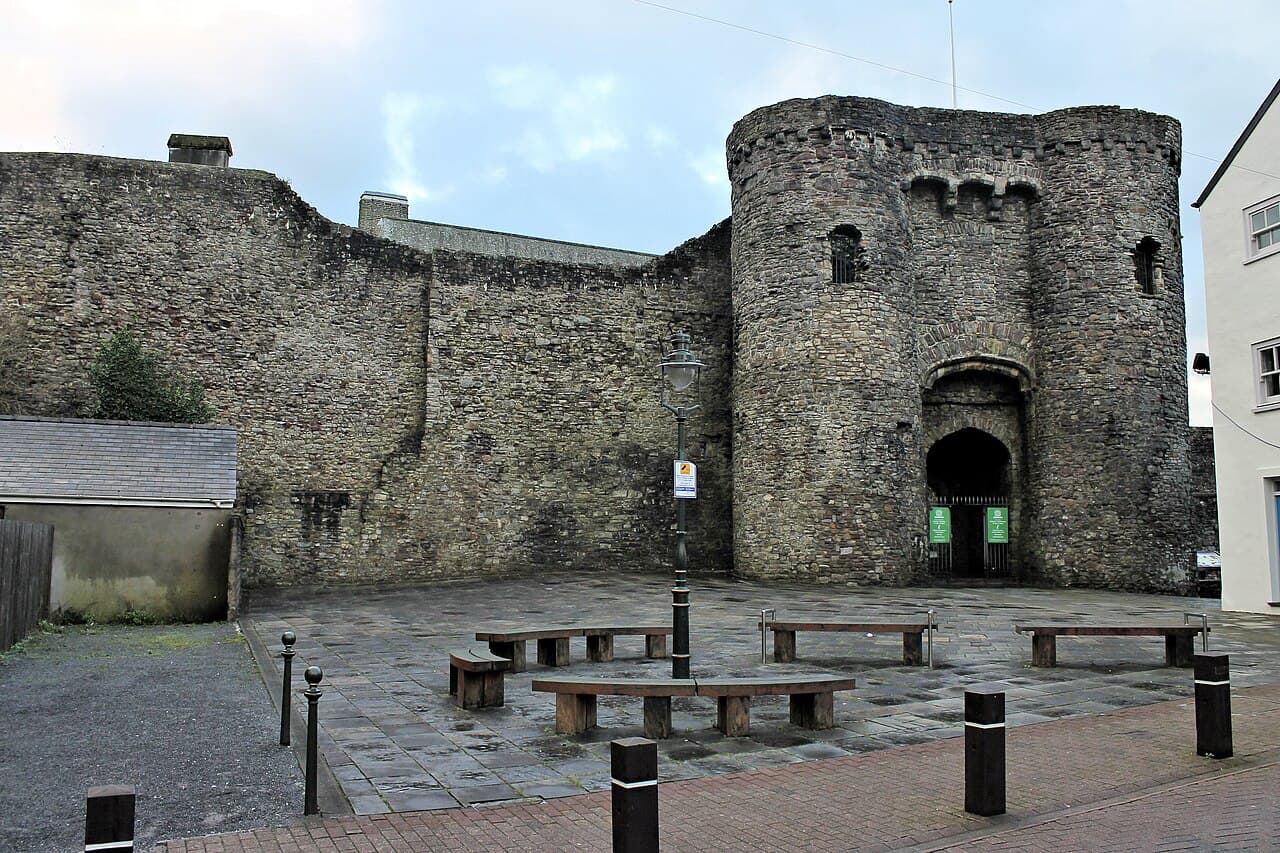
The most notable surviving structure is the late 13th-century gatehouse, which rises approximately 13 meters and features machicolations and narrow arrow slits for archers. Flanked by two round towers, the gatehouse provided a formidable entrance and included a restored spiral staircase accessing upper floors that served as lodgings for the castle's constable. This gatehouse remains a key highlight for visitors and a testament to medieval military architecture.
Additional surviving elements include a southwest tower with a distinctive transition from a square base to a round upper section, and a square mural tower embedded within the curtain wall. These features illustrate the castle's evolving defensive strategies and architectural styles.
Historical significance and political role
Carmarthen Castle played a central role in the military and political history of Wales and England. It was captured by the Welsh rebel Owain Glyndŵr during his uprising in 1405, reflecting its ongoing strategic importance. The castle was also notable during the Wars of the Roses, when it fell to William Herbert, a Yorkist supporter. It was here that Edmund Tudor, father of Henry VII, died in captivity in 1456, linking the castle to Tudor dynasty history.
During the English Civil War, the castle was held by Royalist forces before being captured by Parliamentary troops in 1645. Following the war, the castle was ordered to be dismantled ('slighted') by Oliver Cromwell around 1660, ending its role as a military fortress.
Post-medieval use and preservation
After its military significance waned, Carmarthen Castle was repurposed as a prison from the late 18th century until the 1920s. The prison was rebuilt between 1789 and 1792 based on designs by the renowned architect John Nash. Originally containing eight cells, the prison was expanded in the 19th century to include additional facilities such as a women's wing. The prison complex was mostly demolished in the 1930s to make way for the Carmarthenshire County Hall, constructed in a chateau style and completed in 1955.
The castle grounds now include the County Hall, a large four-winged building made of grey Forest of Dean stone with Portland stone detailing. The north entrance features eleven relief panels by sculptor David Evans, depicting county administrative functions and civic symbolism.
Modern restoration and public access
From 2002 to 2005, restoration efforts focused on preserving the gatehouse and shell keep, allowing improved public access and interpretation. Today, the castle ruins serve as a tourist attraction and house the town's Tourist Information Centre within Castle House, a mid-19th-century building originally constructed as a police station. The site is protected as a Grade I listed heritage site since 1954, reflecting its cultural and historical importance.
Architectural layout and landscape setting
Carmarthen Castle occupies a raised terrace approximately 20 meters above sea level, commanding views over the River Towy. The castle's original motte-and-bailey design exploited the natural topography for defense. The stone shell keep atop the motte and the surrounding curtain walls formed a compact, fortified complex.
The castle's inner bailey once contained the prison and other ancillary buildings, while the outer bailey extended into what is now the town center, partially overlain by modern civic structures. The surviving curtain walls and towers provide insight into medieval defensive architecture and the castle's adaptation over centuries.
The restored gatehouse remains the most striking architectural feature, symbolizing the castle's medieval heritage and serving as the main entrance for visitors today. The castle’s grassy motte summit offers panoramic views and a tangible connection to its medieval past.
Frequently asked questions (FAQ)
- What is the historical significance of Carmarthen Castle?
- Carmarthen Castle is a notable example of medieval architecture and has played a crucial role in the history of Wales. Originally built in the 11th century, it served as a royal stronghold and a center for local governance, reflecting the turbulent history of the region.
- When was Carmarthen Castle built?
- Carmarthen Castle was established in the late 11th century, around 1070, by the Normans. It has undergone various modifications and restorations over the centuries, showcasing different architectural styles and historical periods.
- Can I visit Carmarthen Castle?
- Yes, Carmarthen Castle is open to the public, allowing visitors to explore its rich history and stunning architecture. Guided tours and informational displays are available to enhance your experience.
- What are the opening hours of Carmarthen Castle?
- Carmarthen Castle typically opens from 10 AM to 5 PM daily, but it is advisable to check the official website for any seasonal changes or special events. Last entry is usually one hour before closing.
- Is there an admission fee to enter Carmarthen Castle?
- Yes, there is an admission fee for visitors to enter Carmarthen Castle. Ticket prices may vary based on age, group sizes, and special discounts, so it's best to consult the official website for the most accurate and current pricing.
- What is the best time to visit Carmarthen Castle?
- The best time to visit Carmarthen Castle is during the spring and summer months when the weather is pleasant, and the grounds are in full bloom. Additionally, this period often features special events and activities that enhance the visitor experience.
- Is Carmarthen Castle accessible for individuals with disabilities?
- Carmarthen Castle strives to be accessible to all visitors, with efforts made to accommodate those with mobility issues. However, as a historic site, some areas may have limitations, so it's recommended to contact the castle staff in advance to discuss specific accessibility needs.
- What nearby attractions can I visit while in Carmarthen?
- While visiting Carmarthen Castle, you can also explore nearby attractions such as the Carmarthen Museum and the picturesque River Towy. The town itself offers a variety of shops, restaurants, and cultural sites worth checking out.
Photo gallery

Information
Website
Visit websiteSources & official resources
Verify the information above using these authoritative references.
Loading map...
Visitor reviews
No reviews yet. Been here? Write the first review and help other travelers!
Write the first reviewVisited this castle? Share your experience
Your review helps other travelers and adds first-hand knowledge to our encyclopedia.