Canterbury Castle
Canterbury Castle stands as a significant medieval fortress located within the historic city of Canterbury in Kent, England. This castle, originally constructed in the late 11th to early 12th century, reflects the Norman strategy of fortifying key urban centers to control important transportation routes, notably the ancient Roman road known as Watling Street connecting Dover to London. The castle's evolution from a wooden motte-and-bailey to a formidable stone stronghold exemplifies the architectural and military developments of the High Medieval period.
The earliest fortification at Canterbury was a timber motte-and-bailey castle erected shortly after the Norman Conquest around 1066. This initial structure was situated on a raised earthwork mound within what is now Dane John Gardens, a site believed to incorporate a Roman burial mound. The name "Dane John" is derived from the Old French word "donjon," referring to the castle's keep or main tower, highlighting the site's longstanding military significance. This early wooden castle was strategically placed adjacent to the Roman city walls to maximize defensive advantages.
Transition to stone construction and architectural features
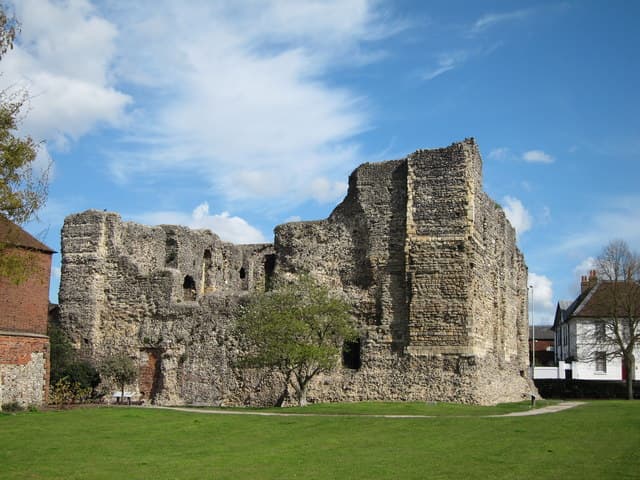
Between 1085 and 1125, under the reign of King Henry I, the wooden fortifications were replaced with a massive stone keep, marking a pivotal transformation in the castle's defensive capabilities. This stone keep is notable for being the third largest in England, surpassed only by the keeps at Dover and Rochester Castles. Constructed primarily from flint rubble and sandstone blocks, the keep measures approximately 29.4 meters by 25.5 meters at its base and originally rose to an estimated height of 24 meters. Its rectangular design and robust construction illustrate the Norman emphasis on imposing and durable fortifications.
Surrounding the keep was a curtain wall that incorporated sections of the existing Roman city wall, supplemented by a defensive ditch. The castle's layout included an eastern bailey added in the 12th century, which served as a protected courtyard. This bailey was enclosed by walls and featured two main gates: a northern gate providing access to the city and a southern gate opening onto agricultural lands, reflecting the castle's role in controlling both urban and rural areas.
Historical significance and military use
Canterbury Castle was one of three royal castles in Kent, playing a key role in the region's defense and administration. During the First Barons' War in 1216, the castle was captured by Baronial-French forces, underscoring its strategic importance. Following this period, the castle's function shifted from a military fortress to primarily serving as the county's main prison. This penal role persisted for approximately 300 years, illustrating the adaptive reuse of medieval castles in the later Middle Ages.
Throughout the 13th and 14th centuries, the castle underwent various modifications, including the construction of a new gate in 1380. Despite these updates, by the early 17th century, the castle had fallen into disuse and was described as a ruin by 1609. The decline continued into the 18th century when the curtain walls were dismantled, and the keep further deteriorated.
Industrial repurposing and preservation
In the 19th century, Canterbury Castle experienced a significant change in function when it was acquired by a gas company in 1825. The site was repurposed as a coal and gas storage facility, leading to the demolition of the upper floor of the stone keep to accommodate industrial needs. This adaptation caused considerable damage to the historic structure but also inadvertently preserved parts of the castle by maintaining its use.
Today, the castle remains a protected Grade I listed historic ruin, with its stone keep and earthworks still visible within the city. The motte, now part of Dane John Gardens, remains a prominent earthwork feature. While the castle is currently closed to the public due to safety concerns regarding falling masonry, it is a site of considerable heritage value. The surrounding city center, including the famous Canterbury Cathedral, complements the castle's historical significance and offers visitors a rich cultural experience.
Architectural legacy and archaeological importance
The surviving ruins of Canterbury Castle provide valuable insights into Norman military architecture and urban fortification strategies. The integration of the castle within the Roman city walls demonstrates a continuity of defensive use of the site from antiquity through the medieval period. The massive stone keep stands as a testament to Norman engineering prowess and the political importance of Canterbury as a regional center.
Although detailed interior features and artefacts have not been extensively documented, the castle's structural remains contribute to understanding medieval construction techniques and the evolution of castle functions over several centuries. The site remains a focus for archaeological interest and heritage conservation efforts, highlighting the ongoing significance of Canterbury Castle in England's medieval history.
Visiting information and current status
Access to Canterbury Castle has varied in recent years, with the site being freely accessible during daytime prior to 2018. Due to safety concerns, it has been closed since then, with potential plans for reopening. Visitors to Canterbury are encouraged to explore the castle's exterior ruins and the adjacent Dane John Gardens, while also experiencing the broader historical context of the city through its well-preserved medieval streets and landmarks.
Frequently asked questions (FAQ)
- How do I get to Canterbury Castle?
- Canterbury Castle is easily accessible by public transportation, with trains and buses connecting it to the city center. If you're driving, there are several parking options nearby, including public car parks within walking distance of the castle.
- What is the historical significance of Canterbury Castle?
- Canterbury Castle, built in the 11th century, is one of the oldest surviving structures in England. It played a crucial role in the defense of the city during the medieval period and has witnessed significant historical events, including the Norman Conquest.
- When was Canterbury Castle built?
- Construction of Canterbury Castle began around 1070 under the orders of Bishop Odo of Bayeux, following the Norman Conquest. The castle's design reflects the architectural styles of the time, with its impressive stone keep and fortified walls.
- Can I take guided tours of the castle?
- Yes, guided tours are available at Canterbury Castle, providing visitors with insights into its rich history and architecture. These tours are led by knowledgeable guides who can answer your questions and share fascinating stories about the castle.
- Why is Canterbury Castle a popular tourist attraction?
- Canterbury Castle attracts visitors due to its historical significance, impressive architecture, and picturesque setting. It offers a glimpse into medieval life and provides beautiful views of the surrounding area, making it a must-see for history enthusiasts.
- Is it possible to host events at Canterbury Castle?
- Yes, Canterbury Castle can be rented for private events, including weddings and corporate functions. The unique historical setting provides a memorable backdrop for any special occasion.
- What are the opening hours of Canterbury Castle?
- Canterbury Castle is typically open to visitors from 10 AM to 5 PM, but hours may vary seasonally. It's recommended to check the official website for the most up-to-date information before your visit.
- What are the ticket prices for Canterbury Castle?
- Ticket prices for Canterbury Castle are generally affordable, with discounts available for children, students, and seniors. Family tickets and group discounts may also be offered, so it's advisable to check the official site for current pricing.
- What is the best time to visit Canterbury Castle?
- The best time to visit Canterbury Castle is during the spring and summer months when the weather is pleasant, and the gardens are in full bloom. Visiting during weekdays or early mornings can also help you avoid crowds and enjoy a more peaceful experience.
- Are there nearby attractions to visit after Canterbury Castle?
- Yes, Canterbury is rich in attractions, including the stunning Canterbury Cathedral, the Canterbury Roman Museum, and the picturesque Westgate Gardens. After exploring the castle, you can easily spend the day discovering the city's other historical sites and beautiful parks.
Photo gallery

Information
Sources & official resources
Verify the information above using these authoritative references.
Loading map...
Visitor reviews
No reviews yet. Been here? Write the first review and help other travelers!
Write the first reviewVisited this castle? Share your experience
Your review helps other travelers and adds first-hand knowledge to our encyclopedia.