Cadbury Castle
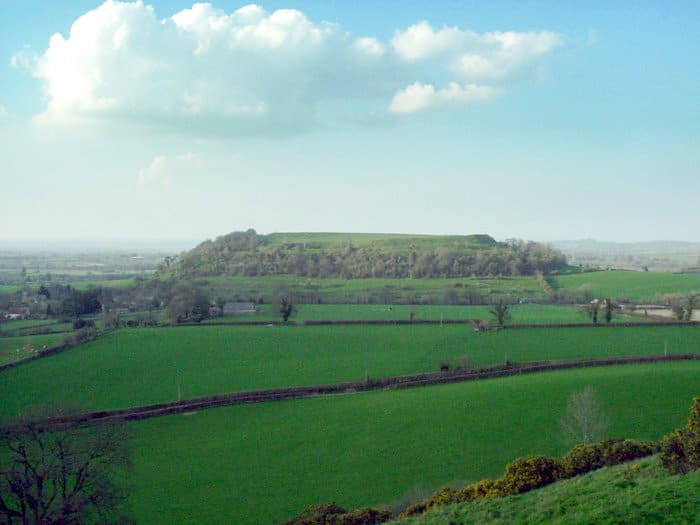
Cadbury Castle is a significant Bronze and Iron Age hillfort located in the parish of South Cadbury in Somerset, England. This ancient site occupies a commanding position atop Cadbury Hill, a limestone prominence overlooking the surrounding landscape. Encompassing approximately 7.28 hectares (18 acres), the hillfort is defined by impressive ramparts and defensive ditches that encircle the plateau, making it one of the most important prehistoric fortifications in southwestern England.
The site has long attracted archaeological interest due to its extensive history of occupation and its association with King Arthur's legendary court at Camelot. While the Arthurian connection remains a matter of legend rather than confirmed history, Cadbury Castle's strategic location and substantial fortifications have fueled scholarly and popular imagination alike.
Archaeological excavations and findings
Systematic excavations at Cadbury Castle began in the late 19th and early 20th centuries, led by archaeologists James Bennett and Harold St George Gray. These early investigations uncovered the site's complex stratigraphy and evidence of multiple phases of occupation. However, it was the extensive work carried out in the 1960s by Leslie Alcock that transformed understanding of the site. Alcock's excavations revealed a wealth of artifacts and structural remains spanning from the Neolithic period through the Bronze Age and into the Iron Age.
More recent research, including studies by the South Cadbury Environs Project beginning in 1992, has continued to refine the chronology and interpretation of the site. Archaeologists have identified evidence of Roman reuse of the fort, as well as significant activity during the post-Roman period around c. 470 to after 580 AD. This later phase is particularly notable for the construction of substantial buildings within the hillfort, including a large "Great Hall", which may have served as a high-status residence or administrative center.
Architectural features and site layout
The fortification consists of multiple concentric ramparts and ditches that take advantage of the natural topography of Cadbury Hill. The defensive earthworks were constructed primarily from local limestone and earth, creating formidable barriers against potential attackers. The plateau itself is relatively flat, providing ample space for settlement and activity within the protected enclosure.
Within the interior, excavations have revealed foundations of various buildings, including round and rectangular houses, which indicate a long-term settlement with evolving architectural styles. The discovery of metalworking debris points to on-site craft production, while the identification of a probable sequence of small rectangular temples or shrines suggests religious or ceremonial functions.
The great hall and post-roman occupation
The Great Hall uncovered at Cadbury Castle is a particularly significant structure. Measuring approximately 20 by 10 meters, it is one of the largest buildings from the early medieval period found in Britain. Its size and construction quality imply it was a seat of power, possibly occupied by a local ruler or elite group during the turbulent years following the Roman withdrawal from Britain.
This phase of occupation, dated roughly from the late 5th to late 6th century AD, aligns with the period traditionally associated with the historical basis for the Arthurian legends. The presence of high-status buildings and fortifications from this era supports the idea that Cadbury Castle was an important regional center during the early medieval period.
Historical significance and cultural legacy
Cadbury Castle's long history of occupation, spanning from the Neolithic through the Iron Age, Roman, and early medieval periods, makes it a key site for understanding the prehistoric and early historic landscape of southwestern England. Its formidable defenses and evidence of elite residence highlight its role as a major power center.
The association with King Arthur and Camelot has made Cadbury Castle a focus of cultural tourism and scholarly debate. While definitive proof linking the site to Arthurian legend remains elusive, the castle's archaeological record provides valuable insights into the social and political dynamics of post-Roman Britain.
Later use and preservation
In the 11th century, Cadbury Castle briefly functioned as a Saxon mint, demonstrating its continued strategic and economic importance into the medieval period. Today, the site is protected as a scheduled monument, ensuring the preservation of its extensive archaeological remains.
Visitors to Cadbury Castle can explore the earthworks and enjoy panoramic views of the Somerset countryside. Ongoing archaeological projects continue to shed light on the site's complex history and development.
Frequently asked questions (FAQ)
- What is the historical significance of Cadbury Castle?
- Cadbury Castle is a major prehistoric hillfort with occupation spanning from the Neolithic through the Iron Age, Roman, and early medieval periods, making it key to understanding the region's history.
- Can I visit Cadbury Castle and explore the site?
- Yes, Cadbury Castle is accessible to the public as a scheduled monument. Visitors can walk the ramparts and enjoy views of the surrounding Somerset countryside.
- When was Cadbury Castle most actively used?
- The site saw major activity during the Iron Age and experienced significant reuse in the post-Roman period, particularly between c. 470 and after 580 AD.
- Why is Cadbury Castle linked to King Arthur?
- The castle's post-Roman occupation and substantial early medieval buildings have led some to associate it with King Arthur's legendary court at Camelot, though this remains unproven.
- What archaeological work has been done at Cadbury Castle?
- Excavations by James Bennett, Harold St George Gray, Leslie Alcock, and the South Cadbury Environs Project have uncovered evidence of long-term occupation and complex structures.
Photo gallery

Information
Current owner
English Heritage
Loading map...
Visitor reviews
No reviews yet. Been here? Write the first review and help other travelers!
Write the first reviewVisited this castle? Share your experience
Your review helps other travelers and adds first-hand knowledge to our encyclopedia.