Nunney Castle
Nunney Castle, located near the village of Nunney in Somerset, England, is a remarkable example of a 14th-century quadrangular hill castle that blends defensive features with residential elegance. Built in 1373 by Sir John de la Mare, an experienced soldier who gained wealth during the early years of the Hundred Years' War, the castle was intended as a powerful symbol of status and influence rather than a purely military fortress. The design shows clear inspiration from contemporary French castle architecture, a reflection of John de la Mare's military service in France, though it shares similarities with other English castles such as Dudley and Stafford.
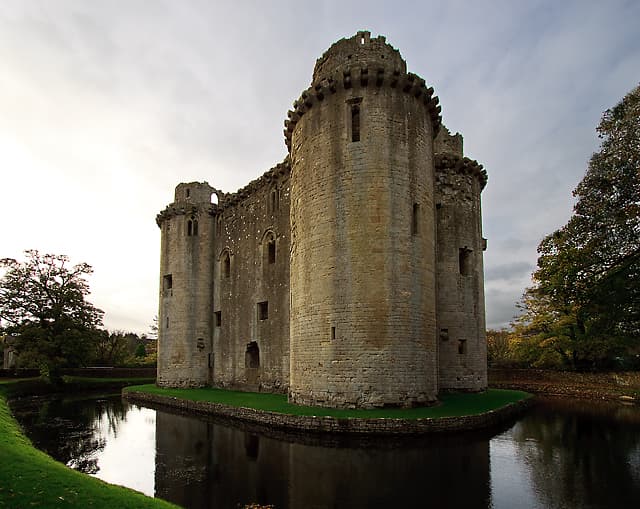
The castle's construction utilized finely cut oolite ashlar stone (Lias Oolite), forming a four-storey rectangular tower-keep approximately 60 feet long and 24 feet wide internally, with walls about 8 feet thick. Each of the four corners is anchored by a round tower capped with conical roofs and equipped with machicolations—openings that allowed defenders to repel attackers with defensive measures from above. This architectural style was uncommon in England at the time and underscores the castle's continental influences.
Architectural design and layout
The castle is surrounded by a moat fed by the nearby Nunney Brook, which also provided a fresh water source. The moat was originally about 10 feet deep and extended up to the base of the castle walls, enhancing its defensive posture. Beyond the moat, a courtyard would have contained stables and other ancillary buildings necessary for the castle's operation.
The ground floor of the tower housed the kitchen and storerooms, while the first floor was likely servants' quarters. The second floor was dominated by a great hall, serving as the social and administrative heart of the castle. The uppermost floor provided high-status accommodation for the lord and his family, featuring multiple windows and fireplaces, although the overall interior remained somewhat dim and the staircases narrow and awkward.
At parapet level, the castle featured projecting corbels that supported a wooden platform surrounding the top of the structure, allowing defenders to patrol and defend the castle effectively. The main entrance was modest and accessed via a drawbridge crossing the moat, emphasizing the castle's defensive intent despite its emphasis on status.
Historical ownership and modifications
Following Sir John de la Mare's death, Nunney Castle remained in the de la Mare family until the early 15th century, when the last male heir, Elias de la Mare, died in King Henry V's 1415 campaign in France. Ownership then passed through marriage to the Poulet family, who primarily resided at Basing Castle in Hampshire, leaving Nunney Castle to serve more as an estate asset than a principal residence.
In the late 16th century, the castle came into the hands of the Roman Catholic Prater family, who undertook extensive modifications to adapt the castle to contemporary domestic needs. These changes included enlarging windows to allow more natural light, installing a grand staircase to improve internal circulation, and adding a Catholic altar, reflecting the religious practices of the family. The moat was narrowed to approximately 25 feet, and a stone terrace was constructed within it, altering the castle's defensive features to favor comfort and aesthetics.
Nunney castle during the english civil war
During the English Civil War (1642–1651), Nunney Castle was a Royalist stronghold under the command of Colonel Richard Prater, a staunch Catholic supporter of King Charles I. The castle remained untouched during the early years of the war due to Royalist dominance in the South West. However, in September 1645, Parliamentary forces under Sir Thomas Fairfax and Oliver Cromwell laid siege to the castle following their victory at the Battle of Naseby. After two days of bombardment with heavy artillery, a breach was made in the north wall, forcing the garrison to surrender. Unlike many other Royalist fortifications, Nunney Castle was not deliberately slighted but was set alight as Parliamentary troops departed, leaving it a burnt-out ruin.
Post-war restoration and decline
After the Restoration of the monarchy in 1660, the castle was returned to the Prater family. Efforts were made to repair the damage from the siege, including rebuilding the breached north wall and replacing burnt floors, restoring the castle to a habitable condition. The castle remained occupied through much of the 18th century but gradually fell into disuse and decay thereafter.
By the 20th century, Nunney Castle had become overgrown and structurally unsound. A significant collapse of part of the north wall occurred on Christmas Day 1910. The castle's ownership transferred to the State in 1926 under Robert Bailey-Neale, initiating conservation efforts to stabilize and preserve the ruins. Today, Nunney Castle is a protected scheduled monument under English Heritage, recognized for its unique blend of medieval defensive architecture and residential design, as well as its rich historical associations.
Architectural significance and legacy
Nunney Castle stands out among English castles for its French-influenced quadrangular design with round corner towers and machicolations, features that were rare in England during the late 14th century. Its construction reflects the social ambitions of a rising knightly class during the Late Medieval period, combining the need for defense with the desire to display wealth and status.
The castle's moat and drawbridge illustrate typical medieval defensive measures, while the later modifications by the Prater family demonstrate the evolution of castles from military fortresses to comfortable noble residences. The siege and damage during the English Civil War further add to the site's historical depth, providing tangible evidence of the turbulent political and religious conflicts of 17th-century England.
Today, Nunney Castle remains a significant heritage site, attracting visitors interested in medieval architecture, English history, and the legacy of the Hundred Years' War and Civil War eras. Its well-preserved ruins offer insight into castle construction techniques and the lifestyle of medieval English nobility.
Frequently asked questions (FAQ)
- How do I get to Nunney Castle?
- Nunney Castle is located near the village of Nunney in Somerset, England. It is accessible by local roads and is best reached by car or taxi from nearby towns such as Frome or Bath.
- What is the historical significance of Nunney Castle?
- Nunney Castle is significant for its unique French-influenced quadrangular design and its role in the English Civil War. It reflects the status of its builder, Sir John de la Mare, and the turbulent history of 14th to 17th century England.
- Can I visit Nunney Castle year-round?
- Nunney Castle is managed as a historic ruin and is typically open to visitors year-round. However, opening times may vary seasonally, so it is advisable to check with English Heritage or local tourist information before planning your visit.
- What remains can I see at Nunney Castle?
- Visitors can see the impressive stone tower-keep with its four round corner towers, the moat, the breached north wall from the Civil War siege, and parts of the surrounding courtyard and moat structure.
- Is Nunney Castle wheelchair accessible?
- Due to its status as a historic ruin with uneven terrain and narrow passages, Nunney Castle has limited wheelchair accessibility. Visitors with mobility issues should contact English Heritage for advice and assistance before visiting.
Photo gallery

Information
Sources & official resources
Verify the information above using these authoritative references.
Loading map...
Visitor reviews
No reviews yet. Been here? Write the first review and help other travelers!
Write the first reviewVisited this castle? Share your experience
Your review helps other travelers and adds first-hand knowledge to our encyclopedia.