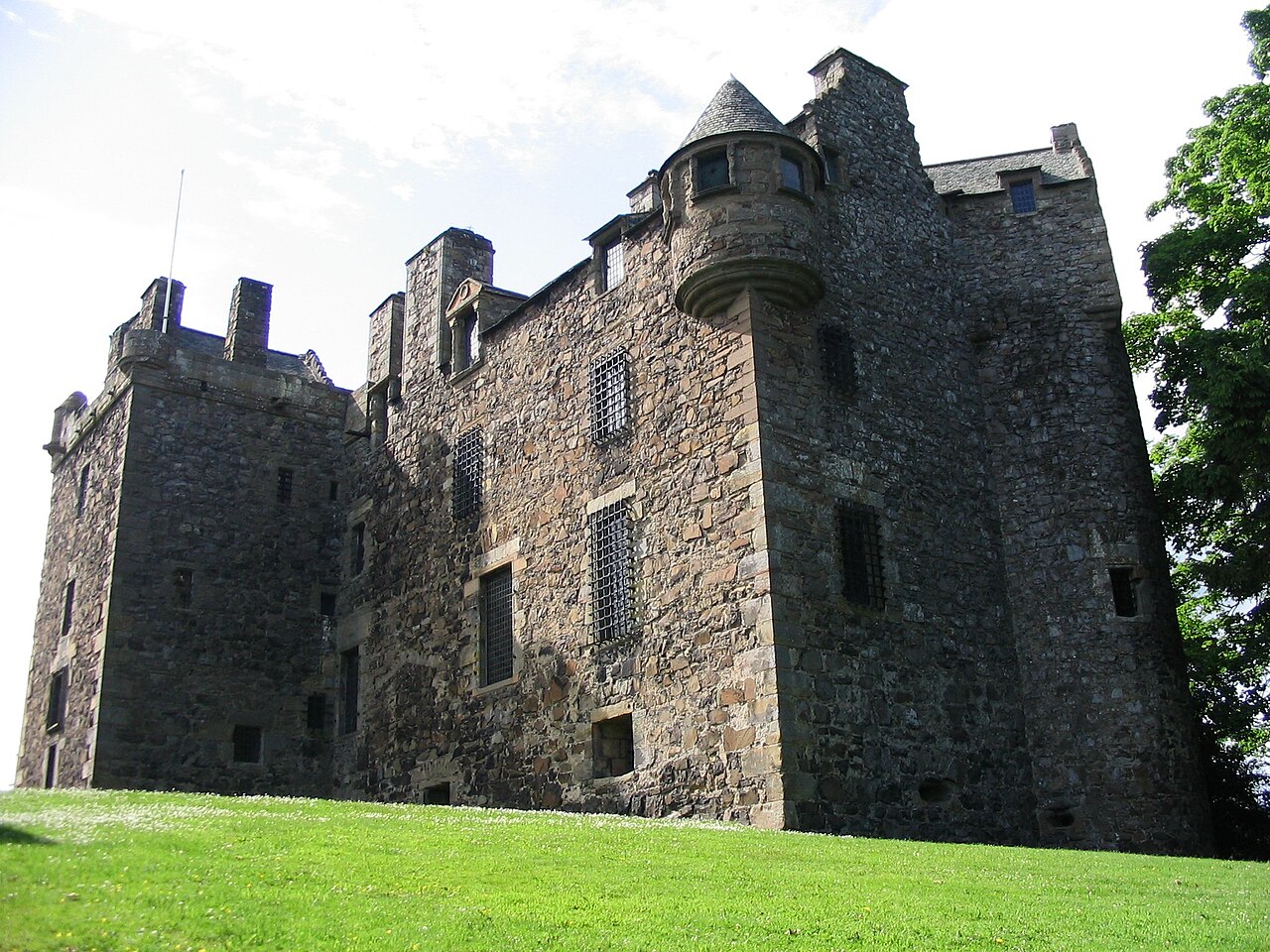
Balvaird Castle
Balvaird Castle stands as a remarkable and well-preserved example of a late medieval Scottish tower house, located near Abernethy in Scotland. Constructed around 1495 for Sir Andrew Murray, a younger son of the Murray family of Tullibardine, this castle exemplifies the architectural and social characteristics of Scottish noble residences during the late 15th century. The castle occupies a site likely chosen for its strategic advantages and may have been built atop earlier fortifications associated with the Barclay family, from whom the Murrays acquired the lands through Sir Andrew's marriage to Margaret Barclay, heiress of the Barclay estates.
The castle's design and construction reflect the defensive needs and domestic requirements of its era. It is built primarily of red sandstone and features a distinctive L-shaped plan integrating a main block, a wing, and a square stair tower. The main block rises over three stories and an attic, housing large chambers including a substantial hall with a fireplace and an unusually elaborate aumbry (a built-in wall cupboard). Attached to this is a wing that extends an additional floor higher to accommodate private chambers, while the stair tower contains a spiral staircase and serves as the principal entrance. Above the stair tower is a cap-house designed as a miniature tower house, providing access to the battlemented parapets that crown the castle walls.
Historical context and family heritage
The earliest records of Balvaird Castle date to 1498, when it was mentioned as "the place of Balward" in the Register of the Great Seal of Scotland. The castle served as the family seat of the Murrays for over 150 years, witnessing their rise in nobility. In 1641, Sir Andrew Murray was ennobled as Lord Balvaird, and his descendants later acquired titles such as Lord Scone and Earl of Mansfield. The family's main residence shifted in 1658 to Scone Palace near Perth following their elevation to the Viscountcy of Stormont, reflecting a transition to more comfortable and grand accommodations.
After the Murrays moved out, Balvaird Castle continued to be inhabited, likely serving as housing for farm workers and estate staff. The property remained in the Murray family until 2017, when it was sold to Brady Brim-DeForest, an American entrepreneur. Throughout the modern era, the castle has been managed and partially restored by Historic Environment Scotland, which has undertaken archaeological excavations and conservation efforts to preserve its architectural integrity. The castle is a scheduled monument and remains accessible to the public, although entry into the tower house itself is limited to certain days due to preservation concerns.
Architectural features and defensive design
Layout and construction materials
Balvaird Castle's L-shaped layout is typical of late medieval Scottish tower houses, combining residential comfort with defensive features. The use of red sandstone not only provides durability but also allows for intricate carving and detailing, which is evident throughout the structure. The castle's walls are pierced with inverted keyhole gun-holes, a defensive innovation of the late 15th century, allowing defenders to fire hand-held weapons while remaining protected.
Decorative stonework
One of the castle's most distinctive features is the finely carved stonework, including corbels carved as stylized heads that support the corner roundels of the wall-walk. These corbels add both structural support and ornamental interest to the parapets. The aumbry in the first-floor hall is unusually elaborate for a secular building, suggesting either the reuse of ecclesiastical stonework or the high status of the owners. The cap-house above the stair tower, resembling a miniature tower house, provides a covered exit onto the battlements, enhancing both the defensive capability and aesthetic appeal of the castle.
Internal arrangements and special features
The ground floor of the wing contains a compact kitchen, a relatively rare feature for a castle of this period, indicating a degree of domestic sophistication. Embedded within the thick walls is a prison pit, used historically to detain prisoners securely. The castle also includes a gatehouse built in 1567, which extends eastward with an additional wing. The gatehouse features two floors, with the upper chamber serving as a chapel, reflecting the religious practices of the residents.
Surrounding landscape and ancillary structures
Balvaird Castle is set within a rectangular courtyard originally enclosed by defensive walls, with the main tower positioned at the northwest corner to maximize strategic defense. Surrounding the courtyard are the ruins of various outbuildings that likely served as storage, workshops, or stabling. To the south of the castle lies the remains of a large walled garden or yard, while to the northeast an enclosed orchard or pleasance provided a leisure space for walking and relaxation.
Historical records from the late 19th century describe the discovery of a recumbent stone statue within the castle grounds, believed to represent Lady Margaret Barclay, linking the site to its original noble lineage. These features illustrate the castle's role not only as a fortified residence but also as a center of estate management and noble domestic life.
Conservation and public access
In recent decades, Historic Environment Scotland has undertaken significant restoration and archaeological work at Balvaird Castle to stabilize the structure and uncover its historical layers. While the castle is open to visitors year-round, access to the interior of the tower house is limited to specific days, ensuring preservation while allowing public engagement. The castle's status as a scheduled monument underscores its cultural and historical importance within Scotland's heritage landscape.
Balvaird Castle remains a compelling destination for those interested in Scottish medieval architecture, noble family history, and the evolution of fortified residences. Its combination of refined architectural detail, historical significance, and scenic setting near Abernethy offers a rich experience for visitors and scholars alike.
Frequently asked questions (FAQ)
- How do I visit Balvaird Castle and what are the opening hours?
- Balvaird Castle is open to visitors year-round, but access to the tower house interior is limited to certain days. It is advisable to check with Historic Environment Scotland for specific visiting times.
- What is the historical significance of Balvaird Castle?
- Balvaird Castle is a fine example of a late medieval Scottish tower house built around 1495 for Sir Andrew Murray. It reflects the architectural and social history of the Scottish nobility during that period.
- Can I explore the castle grounds and gardens?
- Visitors can freely explore the castle's exterior grounds, including the courtyard, garden remains, and orchard area. However, access inside the tower house is restricted to preserve the structure.
- What are some unique architectural features of Balvaird Castle?
- Balvaird Castle features finely carved corbels shaped as heads, an elaborate aumbry in the hall, a cap-house above the stair tower, and inverted keyhole gun-holes dating to the late 15th century.
- Is Balvaird Castle accessible for visitors with mobility issues?
- Due to the historic nature and partial restoration of Balvaird Castle, accessibility inside the tower house may be limited. Visitors with mobility concerns should inquire in advance about accommodations.
Information
Sources & official resources
Verify the information above using these authoritative references.
Loading map...
Visitor reviews
No reviews yet. Been here? Write the first review and help other travelers!
Write the first reviewVisited this castle? Share your experience
Your review helps other travelers and adds first-hand knowledge to our encyclopedia.