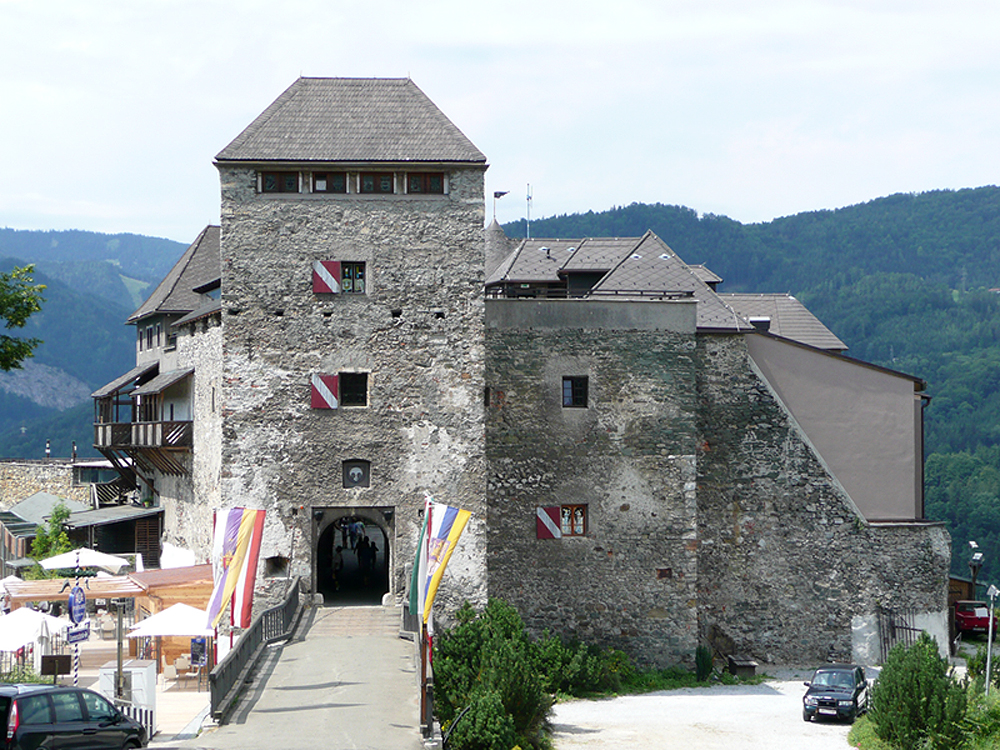
Burgruine Lichtenegg
Burgruine Lichtenegg stands as a significant medieval hill castle ruin located above the village of Wartberg within the municipality of St. Barbara, in the region of Styria, Austria. This fortress was strategically positioned to oversee and control important regional routes in the Styrian Mürztal area, particularly guarding the Scheibsgraben passage leading to the Aflenzer Basin. Its placement on a hilltop exemplifies the typical defensive advantage sought by medieval builders in the High to Late Medieval period.
Early history and construction
The earliest known occupation of the site dates back to around 1290, when it served as a small noble residence or farmhouse under the authority of the Kindberg lordship. This initial structure was modest but strategically important for local control. By the mid-14th century, ownership had passed to Hans Liechtenecker, whose family maintained the estate until the early 15th century. In 1395, Hans's grandson received official permission to fortify the residence, transforming it into a true castle. This fortification included the construction of defensive walls and a main tower, or bergfried, enhancing its military and administrative role as a bulwark securing the vital Scheibsgraben passage.
Fortification and strategic role
The castle's fortifications were typical of the era, with a ring wall encircling the core area to protect against assaults. The bergfried served as a lookout and last refuge during attacks, a common feature in hill castles of the period. The fortress's location allowed control over the surrounding valleys and routes, underscoring its importance in regional defense and administration.
Ownership changes and historical significance
Following the extinction of the Liechtenecker family line in 1425, the castle passed to Albrecht der Aflenzer, a relative by kinship. In 1443, King Friedrich III enfeoffed the castle to the sons of Ulrich Reisacher, demonstrating the feudal practice of land tenure in exchange for service. The estate later became embroiled in inheritance disputes in the early 16th century, resulting in its sale to the Stadler family.
Despite the turmoil of the 1529 Turkish War, the castle itself was never besieged or attacked, indicating either its defensive strength or strategic irrelevance to the invading forces. Over subsequent centuries, ownership shifted among several noble families, including Sebald Pögl, who was linked to the local mining industry and invested in strengthening the castle's defenses.
After 1600, the estate was acquired by Leopold Freiherr von Herberstein, who managed approximately 200 hectares and about 150 subjects, reflecting the castle's administrative importance. Religious reasons prompted Leopold to sell the property to Anna Catherina Eggsin, whose daughter transferred ownership in 1677 to Johann Ferdinand Zehentner von Zehentgrub. Subsequently, the castle was sold to Johann Rudolf Freiherr von Stadl in 1692, and later came into the possession of Maria Regina von Stubenberg.
Decline and partial dismantling
By the 18th century, the aristocratic owners had moved their primary residence to the valley below, leaving the castle mainly occupied by stewards rather than nobility. Among the owners during this period were Carl Josef Anton von Crollolanza and, from 1757, Anton Graf Inzaghi. Graf Inzaghi shifted the estate's administration to Oberkindberg, which led to the castle's abandonment and gradual decline.
A significant blow to the castle's structure came after a major fire in the nearby city of Bruck in 1792. The local population was permitted to dismantle parts of the castle to reuse the stones for rebuilding efforts, accelerating the ruinous state of the fortress. Further damage was inflicted by an earthquake in 1855, which compromised the remaining structures.
Modern preservation and current state
In 1857, the ruined castle passed into the hands of the Counts Attems. Since 1932, and especially after 1958, a dedicated castle association has owned and cared for the remains, emphasizing heritage preservation. An important event in the site's recent history was the demolition of the weakened ring wall in 1953 for safety reasons, which marked a transformation from a fortified complex to a historical ruin.
Between 1980 and 1990, the main tower or bergfried was adapted to house a local history museum, preserving part of the castle's heritage and making it accessible for educational purposes. Today, the bergfried remains the most prominent surviving feature, symbolizing the castle's medieval defensive and administrative functions.
Architectural features and layout
Burgruine Lichtenegg was originally designed as a hill castle with a defensive complex adapted to the natural contours of its elevated site. The castle's layout included a bergfried as the central stronghold and a surrounding ring wall that enclosed the main courtyard and living quarters. The use of stone masonry typical of the medieval period is evident in the surviving structures.
The bergfried, a tall, sturdy tower, served multiple purposes: as a lookout point, a last refuge during sieges, and a symbol of lordly power. Its preservation into the late 20th century allowed for its conversion into a museum, highlighting its architectural and cultural significance.
While much of the castle's original fabric has been lost due to dismantling for building materials and natural disasters, the remaining ruins still convey the fortress's role in regional defense and governance. The loss of the ring wall in the mid-20th century reduced the site's defensive completeness but did not erase its historical footprint.
Defensive adaptations
The castle's hilltop position afforded commanding views of the surrounding valleys and routes, crucial for early warning and control. The ring wall would have included battlements and possibly gatehouses to regulate access. Defensive features typical of such castles, like arrow slits and thick walls, would have been present to withstand assaults.
Economic and administrative role
Beyond its military function, Burgruine Lichtenegg served as an administrative center overseeing local landholdings and subjects. The estate's management under various noble families reflects its role in regional governance, land tenure, and economic activities, including mining interests under owners like Sebald Pögl.
Frequently asked questions (FAQ)
- What is the historical significance of Burgruine Lichtenegg?
- Burgruine Lichtenegg is a significant medieval castle located in Austria, known for its strategic position and architectural features. It dates back to the 13th century and served as a defensive stronghold, witnessing many historical events that shaped the region.
- When was Burgruine Lichtenegg built?
- Construction of Burgruine Lichtenegg began in the early 13th century, around 1200. Over the centuries, it underwent several modifications and expansions, reflecting the architectural styles of different periods.
- What are the opening hours for Burgruine Lichtenegg?
- Burgruine Lichtenegg is generally open to visitors from May to October, with varying hours depending on the day of the week. It is advisable to check the official website for the most up-to-date information regarding opening hours before your visit.
- Can I access Burgruine Lichtenegg with a wheelchair?
- Access to Burgruine Lichtenegg may be challenging due to the castle's historical structure and terrain. While efforts have been made to improve accessibility, it is recommended to contact the site in advance to inquire about specific accommodations for visitors with mobility needs.
- When is the best time to visit Burgruine Lichtenegg?
- The best time to visit Burgruine Lichtenegg is during the late spring and early autumn months, when the weather is mild and pleasant. This allows for comfortable exploration of the castle and its scenic surroundings.
- What are the ticket prices for Burgruine Lichtenegg?
- Ticket prices for Burgruine Lichtenegg are typically affordable, with discounts available for students and seniors. Children under a certain age may enter for free, making it a cost-effective option for families.
- Are there any nearby attractions to visit after Burgruine Lichtenegg?
- Yes, there are several nearby attractions, including beautiful hiking trails and other historical sites in the region. Visitors can explore the charming villages nearby or enjoy the stunning natural scenery that Austria has to offer.
Information
Website
Visit websiteSources & official resources
Verify the information above using these authoritative references.
Loading map...
Visitor reviews
No reviews yet. Been here? Write the first review and help other travelers!
Write the first reviewVisited this castle? Share your experience
Your review helps other travelers and adds first-hand knowledge to our encyclopedia.