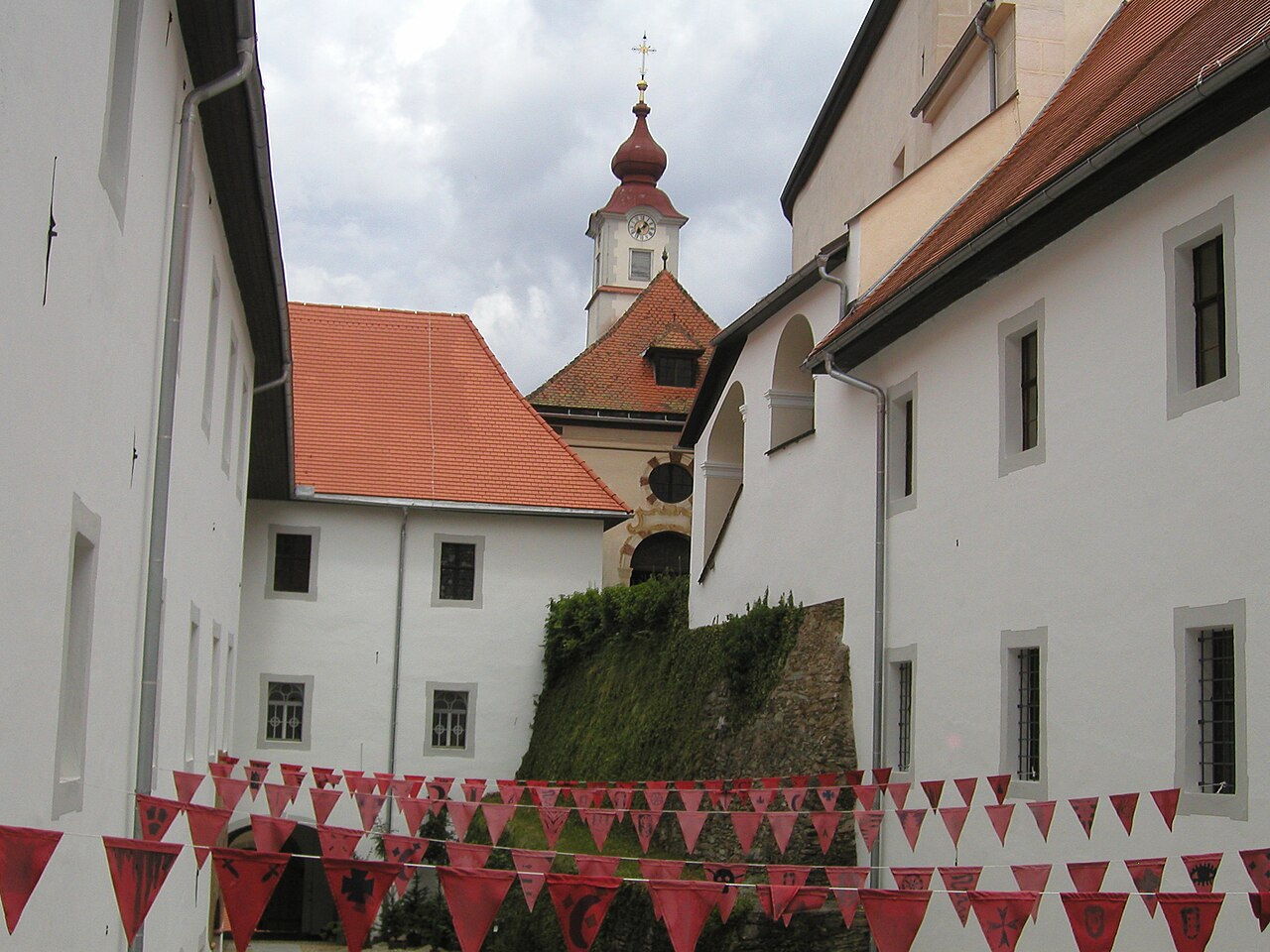
Hohenwang Castle
Hohenwang castle, located in Langenwang, Austria, is a remarkable example of a high medieval hill castle with origins dating back to the 12th century. It stands as one of the largest and longest castle complexes in the region of Styria, notable for its elongated layout stretching approximately 90 meters from southwest to northeast. This castle played a crucial role as a local administrative center, a protective fortress for the population during times of crisis, and as a hub for the spread of Christianity in the upper Mürztal valley.
Historical foundation and ownership
The construction of Hohenwang began between 1122 and 1160 under the auspices of Erchinger I. von Landesere, a member of the noble Stubenberger family. Initially, the castle was held by the Landesere lineage until their extinction in 1286. Subsequently, ownership passed through several prominent noble families, including the Stadecker, Fladnitzer, and Montfort houses. From 1512 onwards, the Scherffenberg family became the principal lords, maintaining control into the 17th century. Historical records suggest that the Scherffenbergs were relatively benevolent landlords to the local peasantry during their tenure.
Architectural layout and fortifications
Hohenwang castle is distinctive for its lack of a traditional central keep or donjon, which was uncommon for castles of its era. Instead, the castle's defense relied heavily on its natural topography and robust fortifications. The site occupies a narrow hilltop with steep cliffs on the south, west, and north sides, making direct assaults difficult. The eastern approach is guarded by a wide neck ditch up to 25 meters across, originally spanned by two drawbridges and a stone arch bridge, now replaced by a masonry causeway.
Stronghold and front castle
The castle complex consists primarily of a main stronghold (Hochburg) and a front castle (Vorburg), separated by trenches. The main stronghold features a massive Romanesque core built in the 12th century, including a shield wall over 20 meters high and about 2 meters thick, topped with rectangular battlements. This shield wall was designed to withstand siege weaponry and includes three large window openings for light and defense. The Palas, or main residential building, extends approximately 34 meters along the northern side, enclosing a large courtyard roughly 65 meters in length.
The front castle, constructed later and expanded through the 17th century, extends about 60 meters and includes the Hochgarten bastion with a rounded corner facing southeast. This bastion is partly built on artificial ground and served as an important defensive position. Adjacent to the bastion was a stable building, now mostly lost.
Defensive features
The castle's defenses include three fortified gates, two equipped with sally ports allowing defenders to launch counterattacks. The main gatehouse, dating to the 16th or 17th century, is well preserved and features a gate chamber with a manhole and two keyhole-shaped gunports for muskets or small artillery, one of which remains intact. The gate tower originally had an onion-shaped roof, as depicted in historical engravings.
A notable defensive structure is the wehrgalerie, a double-angled gallery protecting the shield wall on the southeast side of the stronghold. Though only the southeast wall survives, it contains three firing slits and a sally port. Access was via a flat-arched gate formerly spanned by a drawbridge over a deep fissure in the rock, later replaced by a fixed wooden bridge.
Interior arrangements and facilities
A 15th-century inventory provides detailed insight into the castle's interior, listing a chapel, servants' quarters, a large hall, four cellars, four granaries, a bathhouse, kitchen, and vaulted stables for twelve horses. The castle's chapel, dedicated to the Visitation of Mary, was built in the 12th century in typical Romanesque style, featuring a polygonal choir with a semicircular closure and decorated capitals. Two Romanesque round-arched windows illuminated the interior.
The chapel's bell tower was destroyed by lightning in 1700, and due to structural concerns, the chapel was demolished in 1776. Its important late Gothic altarpiece from 1509 and a venerated image were relocated to the nearby parish church and a newly built Marian chapel. From the 13th century, the castle also housed a resident priest, and the chapel became a local pilgrimage site. During the religious conflicts of the late 16th century, the chapel was used alternately by Protestants and Catholics, reflecting the region's religious tensions.
Water supply and utilities
Hohenwang castle was equipped with a sophisticated water supply system. A deep draw well approximately 45 meters in depth featured a large wooden tread wheel about four meters in diameter, capable of lifting around 100 liters of water every ten minutes. Supplementing the well, a wooden pipeline extending 4 to 5 kilometers brought spring water from near Brunnsteig/Wetterkreuz, with iron fittings discovered during 20th-century excavations, demonstrating advanced medieval engineering.
Historical events and decline
Throughout its history, Hohenwang witnessed several significant events. It was occupied by Hungarian mercenaries during King Matthias Corvinus's 1477 campaign. The castle also served as a defensive stronghold against Turkish raids in the 16th and 17th centuries, with a nearby fire beacon post equipped with artillery for early warning.
The castle suffered damage from a major fire in 1525 and lightning in 1700. An earthquake in 1770 caused further structural damage, and World War II bombing in 1945 destroyed parts of the southern curtain wall and remnants of the chapel.
By the early 18th century, the castle's upkeep declined. To avoid taxes, the roof was removed, and administrative functions moved to Schloss Neu-Hohenwang, a more comfortable residence completed by 1780 in the valley below. The last known inhabitant was a hermit who reportedly died from a lightning strike in 1774.
Modern preservation efforts and visitor experience
Since 1961, the Burgverein Hohenwang association has been dedicated to preserving the castle ruins. Their work includes stabilizing walls, restoring gatehouses, and making the site accessible to visitors. Exhibits such as a detailed scale model illustrate the castle's 16th-century appearance, enhancing the educational experience.
The castle grounds today feature a park-like environment with reinforced and partially reconstructed walls and gates. Nearby, a historic meadow known as "Der Platz am Sprengzaun" was historically used for tournaments and festivals, adding cultural context to the site. Visitors can explore the extensive ruins and appreciate the castle's strategic design and historical significance in the region.
Frequently asked questions (FAQ)
- What is the best time to visit Hohenwang castle?
- The best time to visit Hohenwang castle is during the warmer months from late spring to early autumn when the weather is pleasant and the ruins are fully accessible. This period offers ideal conditions for exploring the outdoor site and enjoying the surrounding landscape.
- How do I get to Hohenwang castle in Langenwang?
- Hohenwang castle is located in Langenwang, Styria, Austria. It is accessible by car via local roads, and there are parking facilities nearby. Visitors can also reach Langenwang by regional train or bus services, followed by a short walk to the castle hill.
- Is Hohenwang castle suitable for families with children?
- Yes, Hohenwang castle is suitable for families, offering an educational and engaging experience exploring medieval architecture and history. However, due to the uneven terrain and ruins, parental supervision is advised to ensure safety, especially for younger children.
- Can I explore the interior of Hohenwang castle?
- As a ruin, Hohenwang castle does not have fully intact interiors to explore, but visitors can walk through the extensive courtyard, gatehouses, and defensive structures. Informational signage and exhibits provide insight into the castle's historical layout and functions.
- Are guided tours available at Hohenwang castle?
- Guided tours may be available through the Burgverein Hohenwang or local tourist offices, offering detailed historical and architectural information. It is recommended to check in advance for tour availability and schedules.
Information
Current owner
Burgverein Hohenwang
Loading map...
Visitor reviews
No reviews yet. Been here? Write the first review and help other travelers!
Write the first reviewVisited this castle? Share your experience
Your review helps other travelers and adds first-hand knowledge to our encyclopedia.