Burgruine Hohenwart
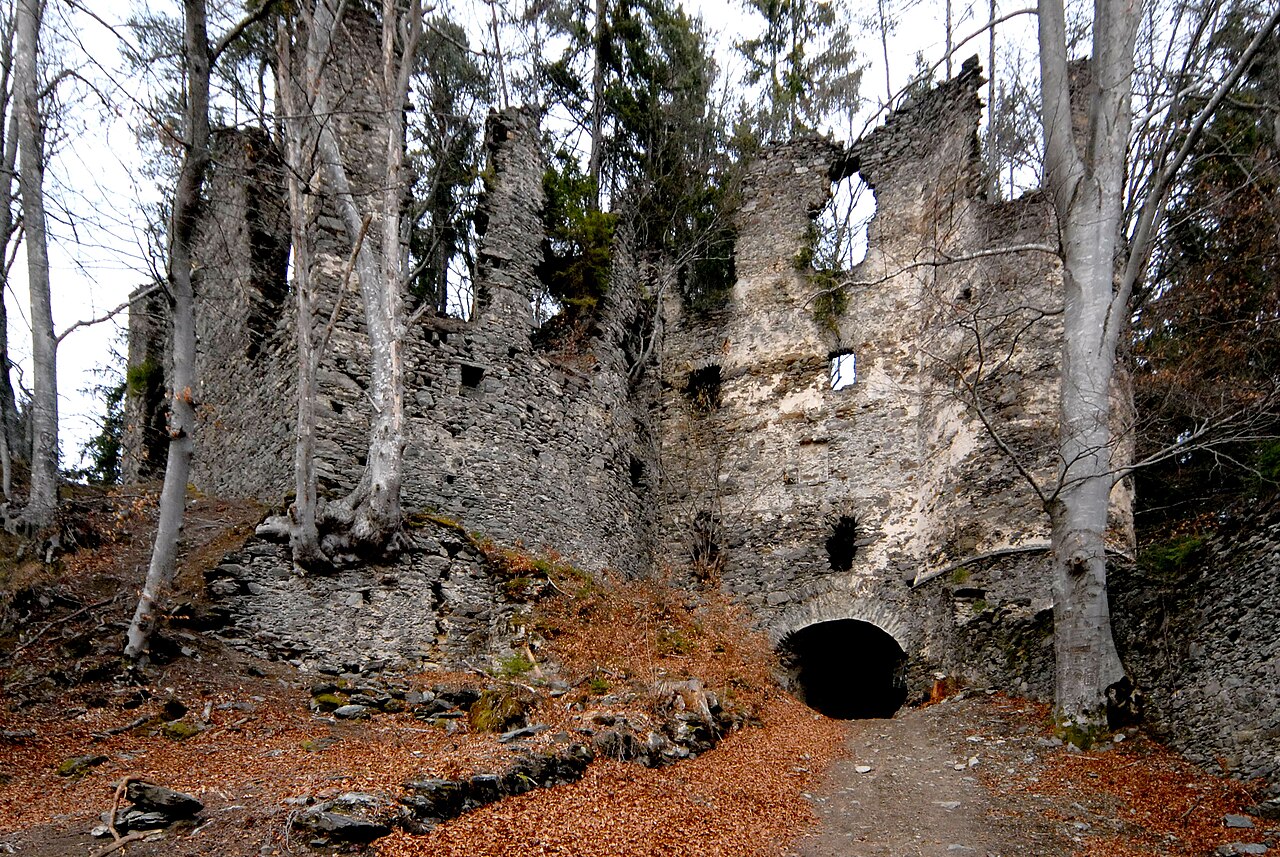
Burgruine Hohenwart, also known as Črni grad and Hochwart, stands as a significant medieval hill castle ruin in the municipality of Köstenberg, Austria. Nestled atop the rocky summit of the Kleiner Sternberg at 802 meters above sea level, this fortress offers a commanding view of the surrounding Carinthian landscape. Its origins trace back to the mid-12th century, marking it as a notable stronghold during the High Medieval period in Central Europe.
The castle's strategic location and complex architectural layout reflect its dual roles in military defense and religious administration. The fortress is arranged around three consecutive courtyards, a design that underscores its layered defensive capabilities and functional zoning for residential, military, and ecclesiastical purposes. This tiered setup was typical for hill castles of the era, facilitating control over the surrounding territory and protection against invaders.
Historical development and ownership
Historical records first mention Burgruine Hohenwart around the 1130s, with the earliest documented owner being Pilgrim of Pozzuolo, also known as Pilgrim Hohenwart. In approximately 1135, he transferred ownership to Duke Heinrich V of Carinthia, illustrating the castle's importance within the feudal hierarchy of the region. This initial transfer highlights the castle's role as a feudal asset and military stronghold.
By 1162, ownership passed to Bishop Roman I of Gurk after Duke Hermann, Heinrich's brother, sold the property. The bishopric then granted the castle as a fief to various local knights, integrating religious authority with military oversight. Throughout the 14th century, the castle was managed by ministeriales, unfree knights serving the bishop, including the notable Teufenbacher family. In 1312, the castle came under the control of nobles Ditmar and Hartnid of Vivšnik.
Later, in 1365, the powerful Counts of Ortenburg took stewardship, followed by the Counts of Celje after 1418. The Celje dynasty maintained control until their extinction in 1456, after which the castle fell under the influence of Emperor Frederick III. The fortress likely suffered destruction during the mid-15th or 16th century, a turbulent period marked by regional conflicts and shifting power dynamics.
By 1515, Burgruine Hohenwart was recorded as a ruin. The lordship was sold to Johann Geumann, leader of the Knights of St. George, a chivalric order. Following the dissolution of this order, the castle's remains became part of the Habsburg dynasty holdings. Emperor Ferdinand I subsequently sold the estate to Bernard Khevenhüller. However, after Hans Khevenhüller adopted Protestantism, their properties were confiscated, reflecting the religious upheavals of the Reformation era.
In 1639, Emperor Ferdinand III transferred ownership to the Dietrichstein family, who retained the property for nearly three centuries. The castle later passed through private hands, including the Maresch-Wittgenstein family and an individual named Josef Neff. Over these centuries, Burgruine Hohenwart remained a symbol of the region's complex political and religious transformations.
Architectural features and castle layout
Castle complex and courtyards
The castle complex is strategically arranged around three successive courtyards, reflecting its multifaceted defensive and administrative functions. The innermost courtyard contains the oldest surviving structures, dating primarily to the 12th century, including parts of the southern enclosing walls. These remnants provide valuable insight into the castle's original medieval form and construction techniques.
The outer courtyards, particularly to the northeast, feature architectural elements from the late 13th century, indicating a significant expansion and fortification phase. This period saw the strengthening of the outer defenses to adapt to evolving military technologies and threats.
The bergfried and defensive structures
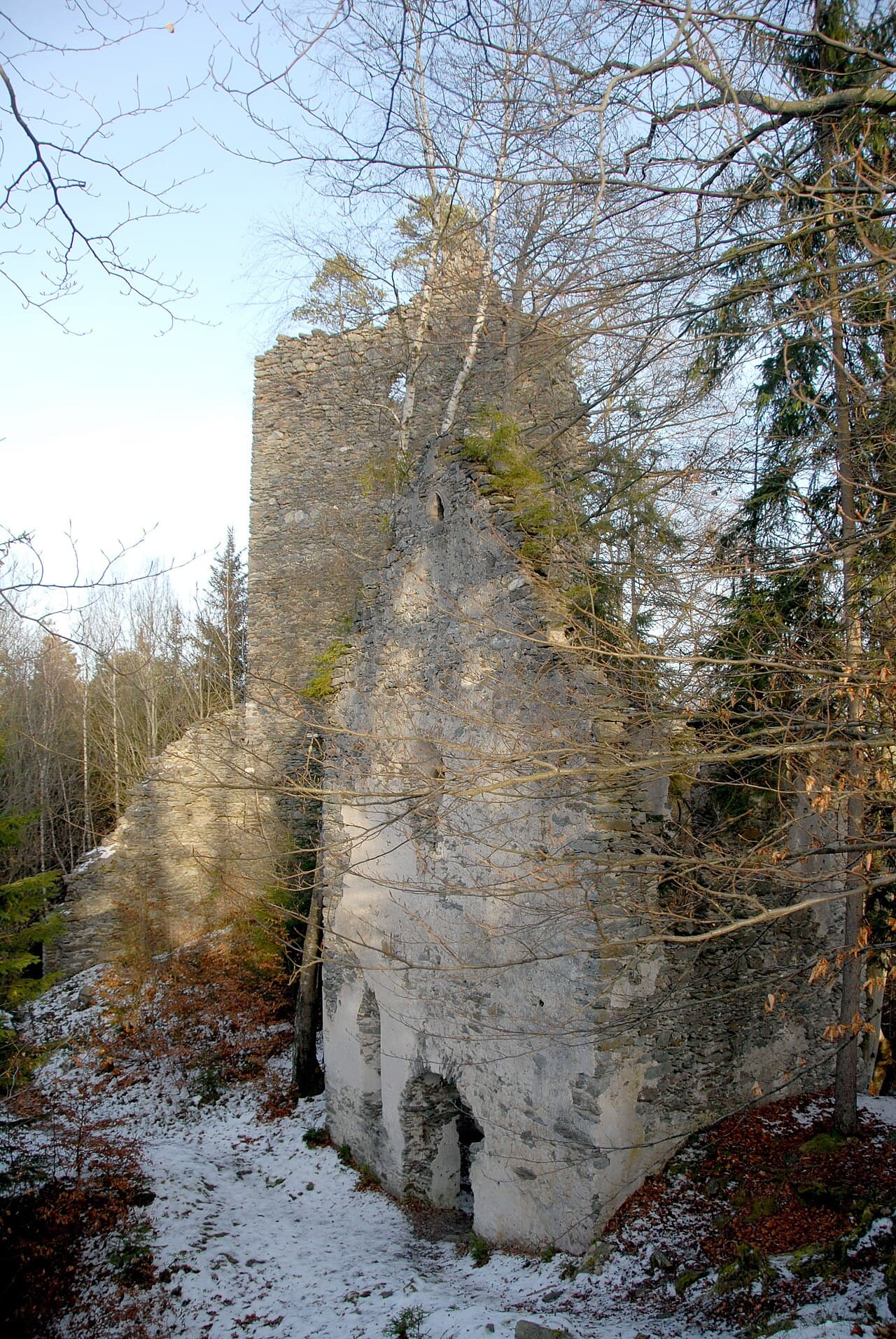
A key architectural highlight is the former bergfried, or main tower, built in the late 13th century. This square-shaped tower was integrated into the outer defensive wall, serving as a last refuge and lookout point. Although the eastern portion of the tower is now broken, the western side retains a pointed-arch entrance on the first floor, exemplifying typical medieval military architecture. The fourth floor features a south-facing oriel window, a projecting bay window that would have provided both light and a vantage point.
The tower also includes several pointed-arch windows, characteristic of the Gothic architectural style prevalent during its construction. These windows not only enhanced the tower's defensive capabilities by allowing archers to shoot while remaining protected but also contributed to the aesthetic of the fortress.
Castle chapel and religious architecture
The castle chapel is another significant feature, accessible from the outer courtyard. It is a double chapel with two distinct worship levels and a semicircular apse, indicative of Romanesque architectural influence. Likely constructed in the early 12th century, the chapel originally had a flat roof but was later modified with a steep gabled roof to improve weather resistance.
Inside the lower chapel, remnants of a pointed triumphal arch remain visible. This arch traditionally separates the nave from the choir in ecclesiastical architecture. The upper chapel has not survived, but the vaulted choir area covered with stone arches still exists, though it is currently unstable and at risk of collapse.
Two rose-shaped windows remain on the chapel's west wall, an ornamental feature that would have illuminated the interior with patterned light, enhancing the spiritual atmosphere. These windows are notable examples of medieval decorative stonework.
The castle's role in regional history and legacy
Throughout its history, Burgruine Hohenwart served as a focal point of military, religious, and political power in Carinthia. Its successive ownership by dukes, bishops, noble families, and imperial authorities reflects the shifting allegiances and complex feudal relationships that characterized the region from the High Middle Ages through the early modern period.
The castle's decline and eventual ruination by the early 16th century correspond with broader trends of changing military technology and the centralization of power, which rendered many hill castles obsolete. Nevertheless, the ruins remain a tangible link to Carinthia's medieval past and the region's cultural heritage.
Today, Burgruine Hohenwart is valued not only for its historical significance but also for its architectural remnants, which offer insights into medieval fortification techniques, religious architecture, and feudal society. Its location atop the Kleiner Sternberg continues to attract visitors interested in history, architecture, and panoramic views of the Austrian landscape.
Visiting information and preservation status
As a hill castle ruin, Burgruine Hohenwart is accessible to visitors who appreciate historical sites and hiking. The castle's remains are partially preserved, with ongoing concerns about the stability of some structures, particularly the chapel's vaulted choir. Preservation efforts focus on maintaining the integrity of the ruins while allowing safe public access.
Visitors can explore the three courtyards, the bergfried remains, and the chapel ruins, gaining a comprehensive understanding of medieval castle life and architecture. The site offers educational opportunities for those interested in medieval history, architecture, and the evolution of feudal power in Austria.
Frequently asked questions (FAQ)
- How do I get to Burgruine Hohenwart?
- Burgruine Hohenwart is located near the municipality of Köstenberg in Carinthia, Austria. Visitors typically reach the site by car or hiking, as it is situated on a rocky hilltop accessible via local trails.
- What is the historical significance of Burgruine Hohenwart?
- Burgruine Hohenwart played a vital role in the feudal system of Carinthia during the High Middle Ages. It was owned by prominent figures such as Duke Heinrich V and Bishop Roman I of Gurk, reflecting its military and religious importance.
- Is the castle suitable for visitors with limited mobility?
- Due to its hilltop location and uneven terrain, Burgruine Hohenwart may be challenging for visitors with limited mobility. The site involves walking on rocky and partly wooded paths, so appropriate footwear and physical fitness are recommended.
- What architectural styles are evident at Burgruine Hohenwart?
- The castle exhibits primarily Romanesque architectural features, especially in the chapel with its semicircular apse and pointed arches. Gothic elements are also present in the bergfried’s pointed-arch windows, reflecting the evolution of medieval styles.
- When is the best time to visit Burgruine Hohenwart?
- The best time to visit Burgruine Hohenwart is during late spring through early autumn when weather conditions are favorable for hiking and exploring the outdoor ruins.
Photo gallery

Information
Loading map...
Visitor reviews
No reviews yet. Been here? Write the first review and help other travelers!
Write the first reviewVisited this castle? Share your experience
Your review helps other travelers and adds first-hand knowledge to our encyclopedia.