Burgruine Dreienburg
Burgruine Dreienburg stands as a notable example of a medieval hill castle ruin located in the municipality of Friedewald, Germany. Constructed likely under the auspices of the Hersfeld Abbey during the High Medieval period, this fortress was strategically positioned to protect the abbey's territorial interests against encroachment from neighboring Hesse. The castle's remains offer valuable insights into the defensive architecture and feudal power structures of the 13th century.
Historical background and significance
The earliest indirect mention of Burgruine Dreienburg dates to 1257, referencing a castle lord named Hertwig von Drigenberg. This establishes the castle's active role during the 13th century as a fortified residence and administrative center. Further documentary evidence from 1296 cites Wolprat de Drigenberck, indicating continued occupation and management. The castle likely functioned as a key stronghold in the region, overseeing important territorial boundaries.
By 1428, the castle may be associated with a watchtower at Lautenhausen, mentioned in border descriptions involving the Hessian Amt Friedewald and Hersfeld Abbey lands. This suggests the castle's role evolved to include surveillance and border control functions. However, by 1579, records describe the site as deserted, marking its decline and abandonment.
The ruin was depicted on a map by the renowned cartographer Gerardus Mercator in 1592, confirming its recognized status as a historical landmark even in the late 16th century. The last known historical reference to the castle dates from 1642. Archaeological excavations in 1901 and 1973 uncovered structural remains that validate the castle's historical importance and provide physical evidence of its architectural features.
Architectural features and layout
Main tower and defensive structures
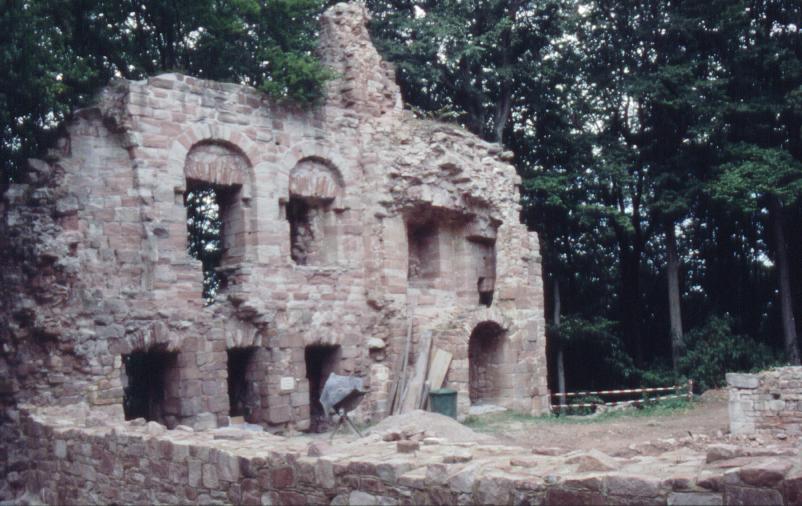
The castle's layout centers on a square residential tower, measuring approximately 8.5 meters per side. This tower was constructed using rusticated ashlar blocks (Buckelquadern), a masonry technique characterized by rough, protruding surfaces that enhanced both the tower's strength and visual presence. The surviving wall fragments reveal the tower's robust construction, typical of High Medieval fortifications.
Defensive measures include a neck ditch (Halsgraben) on the uphill side, designed to prevent attackers from approaching from higher ground. Surrounding the main tower is a moat (Burggraben), which served as a formidable obstacle to invaders. An additional outer embankment (Außenwall) further reinforced the castle's defenses, illustrating a layered approach to protection.
Outer bailey and subsidiary features
At the eastern end of the site, a depression marks the location of a former building and the original southeastern entrance. Beyond this lies a suspected outer bailey (Vorburg), separated from the main castle by a section ditch (Abschnittsgraben). This separation indicates a deliberate spatial organization, with the outer bailey likely housing ancillary structures or serving as a buffer zone.
Further east, an additional ditch has been identified, possibly delineating the eastern boundary of the castle complex or subdividing internal areas. These features reflect the castle's strategic design adapted to its spur castle location, maximizing natural terrain advantages.
Archaeological investigations and preservation
Excavations conducted in the early 20th century and again in the 1970s uncovered significant elements of the castle's structure, confirming its historical layout and defensive complexity. These archaeological efforts have been crucial in understanding the castle's construction techniques and functional design.
Today, the ruins of Burgruine Dreienburg remain an important cultural heritage site, offering a tangible connection to medieval fortification practices and the regional history of Hersfeld Abbey's territorial influence. The site is characterized by partially preserved walls and earthworks that continue to attract historians and visitors interested in medieval architecture and history.
Frequently asked questions (FAQ)
- How do I get to Burgruine Dreienburg?
- You can reach Burgruine Dreienburg by car or public transport. The nearest train station is located in the town of Dreienburg, and from there, it's a short walk to the castle. Parking is available nearby for those traveling by car.
- What is the historical significance of Burgruine Dreienburg?
- Burgruine Dreienburg is a medieval castle ruin that dates back to the 12th century. It played a crucial role in the regional power dynamics during its time and offers insights into the feudal system of the era. The castle is a testament to the architectural styles and defensive strategies of medieval Germany.
- When was Burgruine Dreienburg built?
- Burgruine Dreienburg was constructed in the early 12th century, with its origins linked to the establishment of noble families in the area. Over the centuries, it underwent various modifications and expansions, reflecting the architectural trends of different periods. Its ruins today give visitors a glimpse into its storied past.
- Can I explore the castle grounds?
- Yes, visitors are welcome to explore the castle grounds and the surrounding area. There are designated paths that guide you through the ruins, allowing you to appreciate the castle's structure and scenic views. Be sure to wear comfortable shoes as the terrain can be uneven.
- Why is Burgruine Dreienburg popular among tourists?
- Burgruine Dreienburg is popular for its stunning views and rich history, making it a perfect destination for history enthusiasts and nature lovers alike. The picturesque setting offers great photo opportunities, and the castle's ruins evoke a sense of adventure. Visitors often enjoy the peaceful atmosphere and the chance to connect with Germany's medieval heritage.
- Is it possible to visit Burgruine Dreienburg year-round?
- Yes, Burgruine Dreienburg is open to visitors throughout the year, though the best time to visit is during the spring and fall when the weather is mild. During winter, the access may be limited due to snow or ice conditions. Always check local weather forecasts and any site-specific announcements before planning your visit.
- What are the opening hours for Burgruine Dreienburg?
- Burgruine Dreienburg is generally open from 9 AM to 6 PM during the tourist season, which typically runs from March to October. Off-season hours may vary, so it's recommended to check the official website or local tourist information for the most up-to-date timings. Special events may also affect regular hours.
- Are there any nearby attractions to visit?
- Yes, there are several attractions near Burgruine Dreienburg, including charming villages and scenic hiking trails. The nearby town offers cultural experiences, quaint shops, and local dining options. Visitors can also explore other historical sites and natural parks in the vicinity, making it a great day trip.
- What are the ticket prices for visiting Burgruine Dreienburg?
- Admission to Burgruine Dreienburg is typically free, allowing all visitors to enjoy the historical site without charge. However, special guided tours or events may have a fee associated with them. Always check for any updates regarding pricing or special promotions before your visit.
Information
Loading map...
Visitor reviews
No reviews yet. Been here? Write the first review and help other travelers!
Write the first reviewVisited this castle? Share your experience
Your review helps other travelers and adds first-hand knowledge to our encyclopedia.